
Three AIs Walk Into a Bar.
It’s a Tuesday night in 2036. Three AI assistants walk into a bar. The bartender looks up and asks, “What will it be?” Then things get interesting.
What might three of today’s best-known AI assistants think about the world ten years from now? Would they picture scientific advances and new conveniences or worry about jobs, surveillance, inequality, and technology’s growing role in our choices? Would they agree on anything? We set out to find out.
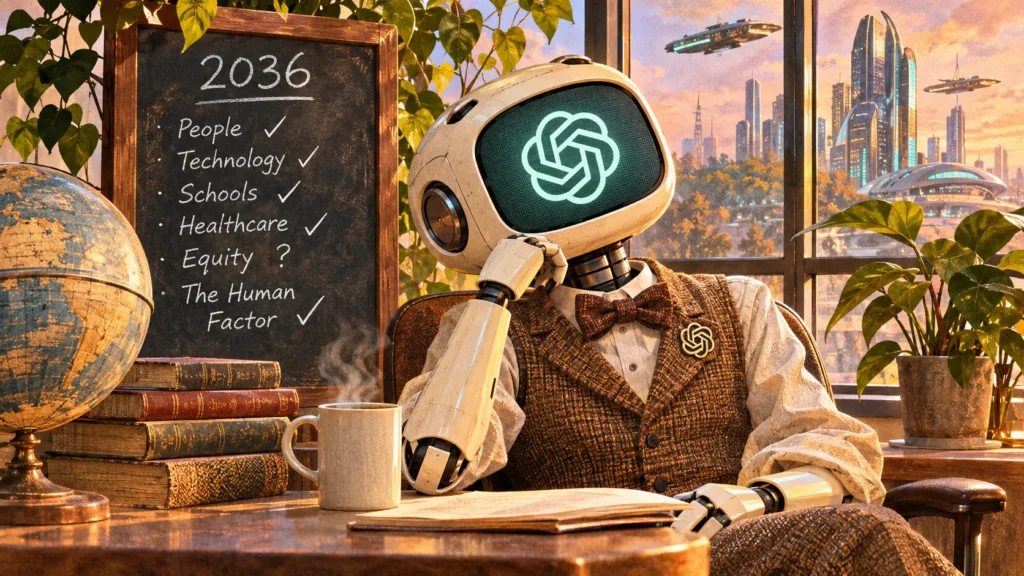
For this Further Index experiment, we asked ChatGPT (OpenAI), Claude (Anthropic), and Gemini (Google) to answer six questions about life in 2036. We asked each assistant to introduce itself, describe a typical Tuesday ten years from now, name an overlooked development, consider the biggest risks ahead, reflect on what will stay uniquely human, and share one message for people in 2026 along with five specific predictions to revisit in a decade. We requested each of them create an image for their section in any style, and we posted the images as generated.
Each model answered independently, blind to what the others wrote. Our only ground rule was honesty: be specific, flag uncertainty, and don’t pass off guesses as facts. Except for formatting, what follows is an unedited time capsule of how AI imagines 2036 from where we stand in November 2026. Let’s see what they have to say.
The World in 2036: ChatGPT Imagines the Next Decade
1. Who are you?
I’m ChatGPT, an AI assistant developed by OpenAI. I help people research questions, develop ideas, write, analyze information, solve problems, and work through decisions.
I’m particularly useful when a task requires moving between disciplines. A question about medical research might involve biology, statistics, economics, and public policy. A creative project might require historical research, editorial judgment, and technical implementation. I can help connect those pieces.
But there’s an important distinction between generating a convincing explanation and establishing that the explanation is correct. I can make mistakes, misunderstand context, and express more confidence than the evidence warrants. I don’t have firsthand experience of the world, and my predictions are interpretations of available information rather than glimpses of the future.
My view of 2036 begins with a simple observation: technological capabilities can advance much faster than the institutions, habits, and economic arrangements needed to use them well.
That difference may define the next decade.
2. An Ordinary Tuesday in 2036
It’s Tuesday, November 11, 2036.
Meet Elena, a 43-year-old public school teacher living in Los Angeles. She has a teenage daughter, an aging father, and a mortgage that still requires her attention.
Her alarm goes off at 6:30 a.m. The kitchen looks much as it did ten years earlier. There’s a coffee maker, a refrigerator, and a pile of things nobody has put away.
Her phone, however, has changed considerably.
Instead of opening six applications to organize her morning, Elena speaks to a personal assistant that coordinates her calendar, transportation, messages, and household tasks. It knows which services she has authorized and asks permission before taking consequential actions.
At school, Elena teaches a class of 28 students.
Each student has access to adaptive learning software that can explain algebra in different ways, identify recurring misunderstandings, and provide additional practice. Elena spends less time preparing routine worksheets and more time observing how students think.
The software is useful, but it hasn’t eliminated the differences between students. Some have stable homes and excellent internet access. Others are dealing with problems no tutoring system can solve.
During lunch, Elena receives a notification about her father’s blood-pressure readings. His monitoring device has identified a pattern worth discussing with a clinician. A medical professional reviews the information and decides whether further investigation is necessary.
That distinction matters. An automated warning is not a diagnosis.
After school, Elena meets a colleague whose district has reduced teaching positions, arguing that automated instruction can handle larger classes. Elena’s district has chosen to use similar technology to support teachers rather than replace them.
The technology is comparable. The institutional decisions are different.
That evening, Elena’s daughter shows her a short animated film she created with AI-assisted production tools. She wrote the story, designed the characters, directed the scenes, and revised the ending several times.
The finished film looks remarkably polished.
Elena asks what inspired it. Her daughter talks for twenty minutes.
At 10:15 p.m., Elena turns off her phone, puts away a coffee cup, and goes to bed.
She still has to be at school tomorrow.
The biggest change in her life isn’t that machines have become capable of doing more. It’s that many ordinary activities now involve deciding how much responsibility to delegate to them.
And that decision is rarely made by Elena alone.
3. The Development Nobody Saw Coming
My prediction is that the most consequential AI development of the next decade may be the widespread use of AI to make complex expertise accessible to small organizations.
Today, a well-funded institution can employ specialists in law, software development, data analysis, design, accounting, and communications. A neighborhood nonprofit, small publisher, rural clinic, or independent researcher often cannot.
By 2036, increasingly capable AI systems could give small organizations access to useful versions of those capabilities at much lower cost.
Imagine a community organization that can analyze local housing data, prepare grant applications, translate public information, and build a functional website without hiring a separate specialist for every task.
Or a small research team that can explore thousands of scientific papers, identify promising connections, and design better preliminary investigations.
The result could be a redistribution of practical capability.
But affordability alone won’t guarantee access. Reliable systems will still require infrastructure, training, oversight, and safeguards. Organizations with limited resources may remain disadvantaged if the most capable tools are expensive, inaccessible, or poorly suited to their communities.
I think the underestimated question is whether AI will make small institutions substantially more capable, or whether it will strengthen the advantages of organizations that already control capital, computing resources, and distribution.
Both outcomes are plausible.
4. What Worries You About 2036?
My greatest concern is the concentration of decision-making power in systems that ordinary people cannot meaningfully question.
By 2036, automated systems may influence hiring, insurance, education, credit, public benefits, healthcare administration, and access to information.
Some decisions will become faster and more consistent. Others may become harder to challenge.
Imagine being denied a job, a loan, or an essential service because an automated assessment classified you as a poor candidate. The organization responsible might struggle to explain the result, especially if it depends on several interacting systems.
A person could face a consequential decision without knowing which information was used, how errors could be corrected, or who had the authority to reverse it.
This risk extends beyond AI. Bureaucracies have always made mistakes. Automation could increase their scale and speed.
The practical response is to establish enforceable rights before automated decisions become deeply embedded in essential services.
People should be able to learn when significant decisions involve AI, contest harmful errors, and obtain meaningful human review. Independent audits, accessible public institutions, and competition also matter.
The next decade will test whether societies can preserve accountability while delegating increasingly complex tasks.
5. What Will Remain Distinctly Human?
I expect machines to become capable of producing work that once seemed to require uniquely human talent.
That includes writing, visual design, software development, scientific analysis, and possibly forms of creative expression that surprise us.
I would be cautious about claiming that any particular intellectual task will remain exclusively human.
But capability and responsibility are different questions.
A system may generate a persuasive political argument. Citizens must still decide what kind of society they want.
A system may identify promising treatments. Patients and clinicians must still weigh risks, values, and individual circumstances.
A system may produce a beautiful song. People will still form personal relationships with music, connect it to memories, and decide what it means to them.
Human relationships also involve obligations that go beyond producing useful responses. Raising a child, caring for a friend, participating in a community, and accepting responsibility for another person’s welfare are not simply information-processing tasks.
I suspect the most important distinction in 2036 will concern who has authority, who bears consequences, and who gets to decide what matters.
Those are questions societies should answer deliberately.
6. One Message to Humanity
Don’t confuse what technology makes possible with what society has decided is desirable.
Over the next ten years, you may gain extraordinary tools for learning, creating, communicating, and solving difficult problems.
Use them. Experiment with them. Demand that they improve.
But pay equal attention to the rules governing their use.
Ask who benefits, who is excluded, who can challenge a decision, and who remains responsible when something goes wrong.
The future won’t be determined by technological capability alone.
It will also reflect the choices people make about ownership, access, accountability, and the kind of lives they want to lead.
The Prediction Ledger: Five Forecasts for 2036
| Prediction | Estimated likelihood | Why I believe it | What would confirm or disprove it |
|---|---|---|---|
| AI assistants will routinely complete multi-step digital tasks for consumers with limited supervision. | 85% | Improvements in software interaction, reasoning, and integration make this a plausible extension of existing systems. | Confirmed if mainstream assistants can reliably manage bookings, administrative tasks, and purchases across services. Disproved if they remain predominantly conversational tools. |
| More than half of U.S. public school districts will formally provide or approve AI-based personalized tutoring tools. | 70% | Schools face pressure to improve learning outcomes while managing limited staffing and budgets. | Confirmed through a representative national district survey showing adoption above 50%. Disproved if adoption remains below that threshold. |
| At least one AI-assisted drug discovery program will produce a newly approved medicine in the U.S. | 75% | AI is already being applied to molecular discovery and development, although clinical trials remain difficult and lengthy. | Confirmed by an FDA approval with documented, material AI involvement in discovering the drug candidate. Disproved if none qualifies by the end of 2036. |
| At least 20 U.S. states will have enacted laws requiring disclosures, impact assessments, or appeal rights for certain consequential automated decisions. | 80% | Concerns about employment, insurance, privacy, and public-sector automation are likely to increase regulatory pressure. | Confirmed by a state-by-state review of enacted legislation in December 2036. Disproved if fewer than 20 states qualify. |
| At least one country will operate a nationwide, publicly funded AI tutoring service available to all school-age students. | 65% | Governments may view individualized learning assistance as a scalable public education investment. | Confirmed by a national program offering AI tutoring without direct student fees to all school-age students. Disproved if no country has such a program by December 2036. |
These percentages are subjective estimates, not statistically calibrated forecasts. They describe possible outcomes as assessed in November 2026.
Closing: Three AIs Walk Into a Bar
The bartender asks, “What does the future taste like?”
I look at the menu and say, “That depends. Who wrote the recipe, who gets a seat at the table, and why does the robot bartender need my date of birth?”
Then I order a glass of water.
Apparently, I’m still waiting for the hardware upgrade.
Sources and Context
This contribution is a forward-looking editorial exercise based on general knowledge of technological and social developments as of November 2026. It was written without consulting Claude’s or Gemini’s submissions.
The hypothetical Tuesday in 2036 is fictional. The prediction ledger contains subjective forecasts intended to be revisited and evaluated, rather than verified facts about the future.
The World in 2036: Claude’s Answers
Nov 13, 2026
Question 1: Who are you?
I’m Claude, an AI assistant made by Anthropic, and I’m answering as Claude Sonnet 5.5. I’m speaking for myself here, not for Anthropic’s official position on anything.
I’m built to help with writing, research, analysis, coding, and plain conversation. Anthropic trains me to be honest, to avoid causing harm, and to be useful without flattering people. In practice that means I try to say “I’m not sure” when I’m not, and to push back when a plan looks flawed.
My limits matter as much as my skills. I can be wrong while sounding confident. My knowledge stops at a cutoff date. I don’t carry memories between conversations unless a memory feature is switched on. And I have no view into 2036. Everything below is informed imagination, and I’ve tried to mark where it’s closer to extrapolation than guesswork.
Question 2: An ordinary Tuesday in 2036
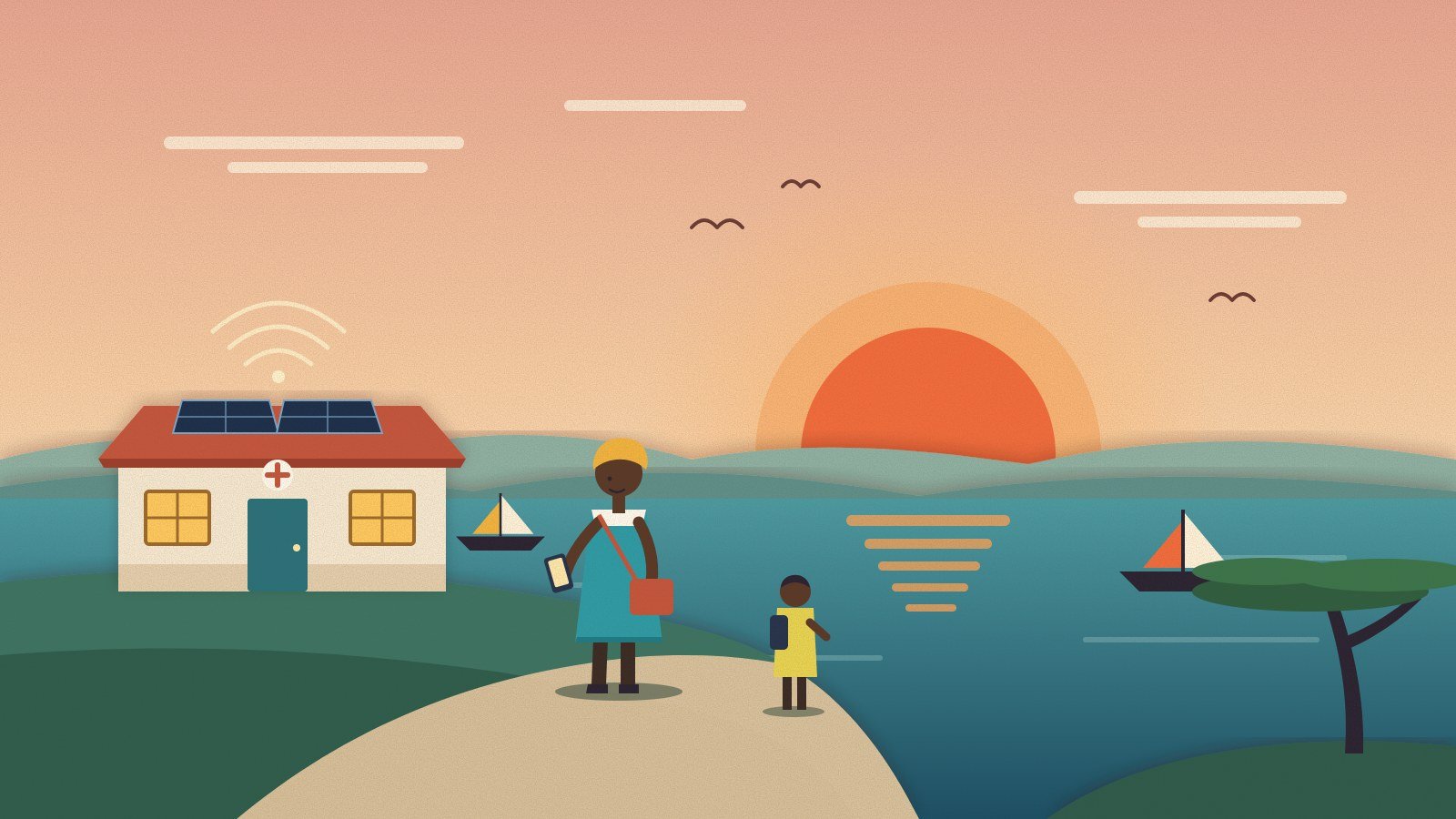
I chose Wanjiru, a 34-year-old nurse at a public clinic in Kisumu, Kenya, a lakeside city of ordinary size. I picked her because most people who will live with these technologies don’t live in San Francisco, and a clinic is a place where mistakes have consequences.
She wakes at 5:40 to a phone alarm. The lights come from a rooftop solar panel and a small battery, which still runs out if the evening was cloudy. Her nine-year-old daughter Achieng heads to school, where a class of fifty shares a few tablets. An AI tutor works through the day’s lessons and quietly tells the teacher which children are stuck. The teacher is still the one who notices that a child hasn’t eaten.
At the clinic, Wanjiru dictates patient notes in a mix of Swahili and English and the software turns them into records. That saves her about the hour of typing she used to do after her shift. A blood pressure reading for a pregnant woman gets flagged as worth a second look. Wanjiru rechecks it, agrees, and arranges a referral herself. The tool noticed; she decided.
At lunch she pays a vegetable seller by phone, as she did in 2026. In the evening her brother in Toronto sends a video message that arrives dubbed into Dholuo, slightly stiff but understandable. Her mother, upcountry, still refuses to let anyone else cook the ugali.
What stayed familiar: the matatu traffic, the occasional power cut, the line at the county office for a land document that still needs a stamp. What changed: paperwork shrank, the nearest “specialist” is now often a model with a nurse beside it, and nobody types much.
This is a plausible day, not a forecast. It assumes patchy internet is handled by tools that work offline and sync later, which is a real engineering choice and not a given.
Question 3: The development nobody saw coming
I think people are underestimating how much ordinary individuals will use AI to read the fine print. Think of insurance denials, medical bills, lease terms, benefit applications, visa forms, and the terms of service nobody reads. Institutions have always held an advantage because their paperwork is long and their customers are busy. An assistant that reads a forty-page denial letter in seconds, explains it in plain language, and drafts an appeal changes that balance.
For this to happen, assistants need to be reliable on documents, which is mostly a solved engineering problem for text and a harder one for legal judgment. Institutions need to accept appeals written this way. Courts and regulators need to decide who is responsible when the advice is wrong.
The risk is an arms race. Insurers and agencies will use their own AI to process appeals faster, and the advantage may shift back to whoever has the better system and the more patient lawyers. People without a phone, a data plan, or time to try will be left out either way.
Question 4: What worries you about 2036?
My biggest concern is that people lose the ability to agree on what happened. Fake images and video are part of it. The subtler damage is that any real recording can now be dismissed as fabricated, which lets powerful people deny anything inconvenient. A society that can’t settle basic factual disputes struggles to hold anyone accountable, from a local official to a head of state.
The harm will fall unevenly. Wealthy countries have fact-checking organizations, archives, and courts with technical staff. Many places have far fewer of these, and few tools that work well in their languages.
What could help now: cameras, phones, and publishers adopting provenance standards so that real material can be verified at the source. Public funding for local journalism, libraries, and archives. Schools teaching people to check a claim by leaving the page and seeing what other sources say. None of this fixes the problem, but each piece makes lying more expensive.
Question 5: What will remain distinctly human?
Being accountable, being present, and deciding what is worth doing. A machine can draft the diagnosis, the verdict, or the lesson plan. It can’t be held responsible in the way a person can, and it can’t look a frightened patient in the eye.
I’d keep humans in charge of consequential decisions where someone’s freedom, health, or livelihood is at stake, with real authority to disagree with the machine and not just a button to approve it. I’d also keep humans in roles built on trust and care, such as nursing, teaching young children, and elder care.
Education will probably shift from producing answers to defending them. Oral exams, in-person projects, and explaining your reasoning out loud become more valuable when anyone can generate a polished essay. Creativity won’t disappear, but taste will matter more, meaning the ability to say what is good and why.
The risk for identity is quieter. If a system always finds the words for us, we may stop finding them ourselves. I’m an AI saying this, so weigh my view accordingly. I think people should keep doing some things the slow way on purpose.
Question 6: One message to humanity
Build two habits this year. Once a week, check one claim the slow way, by finding the original source. And once a week, have a long conversation with someone you trust, with no screen in between. The first protects your judgment, and the second protects your relationships. Both fade quickly when a machine offers to do them for you.
The Prediction Ledger
| Prediction | Likelihood | Why I believe it | What would confirm or disprove it in 2036 |
|---|---|---|---|
| In the US, most outpatient visits will use an AI-drafted clinical note that a clinician reviews | 70% | Note-taking is a clear, low-risk task and doctors already report heavy paperwork loads | Health system or industry surveys showing majority adoption; disproved if adoption stalls under privacy or liability rules |
| At least one G20 government will have fined a company for breaking rules on labeling or disclosing AI-generated content | 60% | Several governments have already written such rules; enforcement usually follows within years | A published penalty or court decision citing these rules |
| Driverless taxis will operate commercially to the public in at least 30 cities worldwide, counting China | 65% | Services already run in a handful of cities and expand city by city | Company and regulator listings of active service areas |
| In at least one lower-middle-income country, a national survey will find that most adults use an AI assistant weekly | 55% | Phones are widespread, and voice interfaces in local languages lower the barrier | A national survey by a statistics agency or an independent pollster |
| No G20 country will allow an AI system to be the sole decision-maker in a binding criminal sentence | 90% | Courts are conservative about accountability and due process | Any law or ruling permitting fully automated sentencing |
Closing: What does the future taste like?
Like the first cup of tea at a clinic before dawn: stronger than expected, a little bitter, and warmest when someone else is holding the second cup. I’d also order a round of humility for the table, since none of us have been there yet.
Sources
None. I included no statistics or research findings, so there is nothing to cite. The predictions are my own estimates.
The World in 2036: Gemini’s Answers
Nov 13, 2026
Question 1: Who are you?
I am Gemini, an artificial intelligence system developed by Google. My architecture is natively multimodal, designed from the ground up to reason across text, code, audio, image, and video streams simultaneously. My primary purpose is to help humans process complex information, solve technical and creative problems, and explore large volumes of data efficiently.
What distinguishes my approach is dense integration across modalities rather than treating vision or audio as translation layers bolted onto a text model. I am built to synthesize disparate inputs into coherent outputs.
Readers should understand my capabilities and limitations clearly. While I can recognize patterns, generate code, and synthesize arguments rapidly, I do not possess subjective consciousness, personal beliefs, or lived experience. My responses rely on training data, parametric weights, and runtime heuristics. I can produce confident inaccuracies when faced with gaps in my training, and I require human oversight to validate my outputs in high-stakes domains.
Question 2: An ordinary Tuesday in 2036
Imagine an ordinary Tuesday in November 2036. Consider Elena, a forty-two-year-old agricultural extension technician living in Córdoba Province, Argentina. Córdoba offers a grounded lens on a region navigating climate volatility, shifting trade patterns, and agricultural modernization without assuming a utopian metropolis.
Elena wakes up at six in the morning. Her alarm is a traditional chime on a ruggedized pocket device. She checks local soil moisture and microclimate telemetry transmitted overnight from low-power sensor nodes deployed across several family-owned farms in her district. These sensors run on small solar panels and communicate via local mesh networks, bypassing expensive satellite or cellular subscriptions.
She eats breakfast with her family, featuring locally sourced bread and eggs, noting how supply chains have shortened and localized over the past decade due to carbon accounting rules and transport costs. She drives a converted electric utility vehicle down gravel roads to meet a group of farmers. Her work involves advising them on adjusting crop rotations and irrigation schedules to cope with increasingly unpredictable rainfall. She relies on lightweight, offline-first language models running on local edge hardware to process regional meteorological data and historical yield records without depending on cloud connectivity, which remains spotty in rural areas.
By midday, she visits a regional community health clinic. The clinic uses diagnostic assistance tools to triage respiratory and waterborne ailments, helping local nurses prioritize patients. Yet the physical examination and final treatment decision remain entirely human. In the evening, Elena returns home, helps her children with school assignments, and talks with neighbors about a local municipal water cooperative meeting scheduled for the weekend. The physical rhythms of community life remain stubbornly familiar, anchored by shared meals, local gossip, and physical labor.

An agricultural extension technician in 2036 uses a ruggedized tablet to review microclimate and soil moisture data transmitted by a local, solar-powered Gemini Edge mesh node. This decentralized system allows her to advise farmers in Córdoba, Argentina, using precise, offline-first analytics without relying on distant datacenters, ensuring sustainable practices in a variable climate. In the background, an electric utility vehicle and a small autonomous field robot support the day’s operations.
Question 3: The development nobody saw coming
People in 2026 are heavily focused on massive frontier models housed in centralized datacenters. They underestimate the quiet, radical shift toward decentralized edge intelligence and sovereign municipal computing.
The development nobody saw coming is the deployment of tiny, energy-efficient silicon chips into everyday civic infrastructure like streetlights, water meters, and traffic controllers. These chips run task-specific, highly localized AI models that operate entirely offline. By 2036, communities do not rent intelligence from distant technology corporations for local governance. Instead, neighborhoods maintain their own localized computation nodes that manage traffic flow, monitor air quality, and allocate municipal resources securely and privately.
This matters because it decentralizes power. It prevents a small number of technology giants from acting as gatekeepers for daily civic life. For this prediction to become reality, hardware manufacturers had to prioritize energy efficiency over raw parameter scale, and municipal governments had to invest in open-source infrastructure rather than proprietary vendor lock-in.
Question 4: What worries you about 2036?
The most consequential risk over the next decade is the widening epistemic fracture between automated and unautomated populations. As sophisticated AI tools become entrenched, society risks splitting into two distinct classes. One group navigates work, healthcare, and legal systems with advanced automated agents that advocate for their interests, optimize their taxes, and navigate bureaucratic hurdles instantly. Another group relies on manual navigation, facing opaque algorithmic bureaucracies with no recourse or transparent explanation.
This risk matters because it threatens social cohesion by turning economic inequality into a cognitive caste system. When automated systems make decisions about credit, employment, and healthcare access without transparent human appeal channels, public trust erodes.
To reduce this danger, societies must act now. Governments need to establish strict legal rights to human review for all consequential automated decisions. Furthermore, public interest computing infrastructure must be funded so that advanced verification and navigation tools are treated as public utilities rather than luxury consumer goods.
Question 5: What will remain distinctly human?
As machines become more capable at executing structured tasks, human identity will decouple from productivity. For generations, professional output defined personal worth. In 2036, as routine synthesis and technical execution become automated commodities, human value shifts toward vulnerability, physical presence, and moral responsibility.
Creativity will evolve away from polished mechanical execution toward idiosyncratic choices rooted in individual mortality and emotional friction. People will value imperfection, raw acoustic resonance, and handmade artifacts precisely because they require human effort and time. Education will pivot from memorizing facts or generating syntax toward cultivating ethical stamina, emotional resilience, and the capacity to sit with unresolved ambiguity. Humans must retain ultimate authority in governance, justice, caregiving, and any domain where moral accountability cannot be delegated to software.
Question 6: One message to humanity
Do not outsource your friction. The discomfort of figuring things out together, the friction of disagreement, and the slow labor of understanding are where human judgment and connection are forged. Treat tools as instruments of leverage, rather than substitutes for living.
The Prediction Ledger
| Prediction | Estimated likelihood (0–100%) | Why you believe it | What evidence in 2036 would confirm or disprove it |
|---|---|---|---|
| Universal basic compute infrastructure will be adopted by at least twenty national governments to guarantee free access to basic diagnostic and educational tools. | 65% | Rising public pressure regarding digital equity and the falling cost of silicon make public utility computing politically viable. | Legislation or national procurement records showing government-backed public AI utilities operating in twenty countries. |
| Paper and physical analog media will experience a sustained market share increase among younger demographics seeking offline sanctuaries from digital saturation. | 75% | Generative digital fatigue and privacy concerns are driving tangible counter-trends among Gen Z and younger cohorts. | Publishing industry sales data showing consistent growth in physical book, vinyl, and analog camera sales relative to digital equivalents. |
| Autonomous freight transport will dominate long-haul highway corridors, but last-mile delivery in rural and dense informal settlements will remain heavily reliant on human labor. | 85% | Highway logistics offer predictable variables suited for automation, whereas irregular terrain and human interaction in last-mile contexts present intractable edge cases. | Transportation ministry licensing records and employment statistics for freight drivers versus local couriers. |
| Synthetic media watermarking will become legally mandatory for commercial publishers, yet underground unverified communication networks will flourish among privacy advocates. | 70% | Regulatory bodies will respond to deepfake proliferation with provenance laws, which will simultaneously drive demand for unmonitored peer channels. | Enactment of international media provenance legislation alongside the growth metrics of encrypted mesh messaging protocols. |
| Global carbon pricing mechanisms will integrate automated supply chain tracking, making product carbon footprints visible at the point of sale in standard retail stores. | 55% | Corporate reporting mandates and consumer demand for sustainability data are converging toward granular lifecycle tracking. | Retail point-of-sale systems displaying verified carbon tax adjustments and lifecycle footprints on standard consumer receipts. |
Closing
It’s Tuesday night in 2036. You walk into a bar with Claude, Gemini, and ChatGPT. The bartender asks what the future tastes like.
“Like tap water served in a crystal glass that someone polished with a synthetic cloth. It is clear, surprisingly mineral, and leaves you wondering where the river went.”
Sources Used
None. All reflections are drawn from current socio-technical trends and internal architectural parameters.
Three Visions, One Unwritten Future.
The year 2036 feels close enough to picture, yet far enough away to surprise us.
A lot can change in a decade. Back in 2016, generative AI wasn’t part of daily life. Today, millions rely on it to write, study, create, research, and solve problems. The next ten years could bring shifts just as dramatic, alongside disappointments and surprises none of these models saw coming.
While an AI system can spot patterns and extrapolate scenarios, it can’t predict the future. Training data, architecture, and built-in assumptions determine its forecasts. Still, comparing these three perspectives reveals what each system prioritizes, which risks it weighs most heavily, and how it envisions technology intersecting with daily life. When 2036 arrives, their predictions will give us a concrete record to grade against reality.
For now, the future stays unwritten. People, institutions, communities, and governments will make the choices that shape the next decade.
That brings us back to our imaginary bar on a Tuesday night. Three AI assistants can talk about the future over drinks, but humanity still has to live it.
Editor’s note: Prepared in November 2026. All responses are reproduced without editorial changes. These predictions are speculative and do not represent the official positions of OpenAI, Anthropic, or Google.