

From the How I Search column at Further Index.
Table of Contents
I. A New Layer of Reality: The Uncaged Digital Experience
We may be on the cusp of a real change in how we perceive and interact with the world. For too long, the digital realm has been confined to glass screens: our phones, monitors, and tablets. In the immersive future, computation steps out of the box and into our real lives.
This shift is about effortless interaction, more than tapping an app. When you look, gesture, or speak in a particular space, digital information responds and blends into the physical world. The result is a reality that is annotated, searchable, deeply contextual, and quick to adapt to your needs.
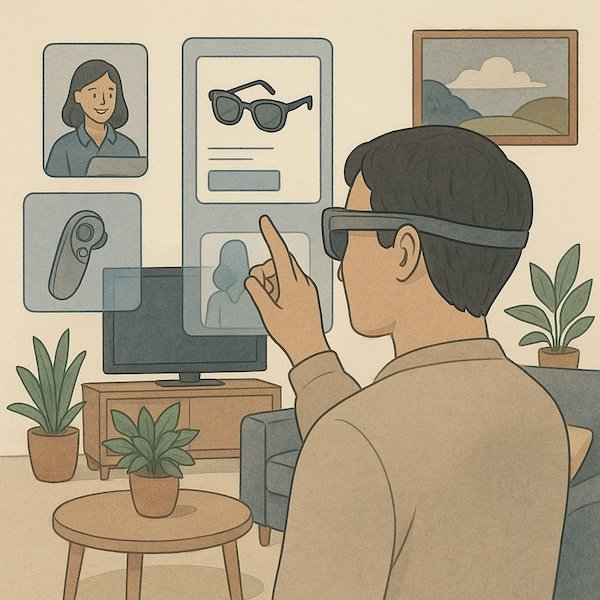
This technology isn’t designed as an escape from real life. Imagine standing in a foreign city and seeing translations of signs at the edge of your vision. Directions don’t require looking down; they follow your gaze, and a complex appliance can walk you through its repair steps. The idea is a new layer of guidance that feels woven into the fabric of life, not bolted on.
AI glasses and Extended Reality (XR) systems are the early architects of this transformation. The goal is an interface so natural it never interrupts the flow of life. This future feels less like stepping into a simulation and more like walking through reality with a welcomed, extra sense.
More Technology Guides You Might Need Next
II. The Spectrum of Immersion: From Escape to Enhancement
The term “immersive technology” describes a family of tools, each offering a different relationship between the user and the digital world. Understanding this spectrum helps us see where the human experience is being prioritized.
- Virtual Reality (VR): The World Remade. Sitting at the digital extreme, VR headsets masterfully rewrite the rules of reality. They replace your surroundings entirely, creating a powerful mental arena for training, complex design work, therapy, and intensely focused play. VR’s strength lies in its complete removal of distractions, allowing for a concentrated, self-contained experience. Its limit is the complete severance from the physical surroundings.
- Augmented Reality (AR) & Mixed Reality (MR): The Blended Canvas. AR and MR bring the digital back home. Instead of replacing the environment, they layer digital content onto it. A wall becomes a live display for notes; a table holds a holographic prototype. MR goes further, making digital objects behave as if they belong: they are anchored, respond to light, and follow physical rules. This powerful blend allows us to gain digital insight without sacrificing our connection to the real world and the people in it.
- Extended Reality (XR): The Unified Field. XR is the umbrella term for the entire, dissolving spectrum. It acknowledges that modern devices will fluidly shift between modes, allowing you to transition from a VR-focused work session to an AR-enhanced collaboration in the same space.
- AI Eyewear: Ambient Intelligence. This new category is built for constant spatial and contextual companionship. Small, lightweight, and socially natural, AI glasses prioritize a deep understanding of the world you inhabit. They are designed to enrich your existing reality and make it more manageable.
III. A Quiet Revolution & The Human Desire to See More
The yearning to amplify our senses is not new. Early scientists in the 1800s were captivated by stereoscopic vision, learning how to trick the brain into perceiving depth. From the 1930s on, speculative fiction dreamt of goggles that could transport the wearer.
The prototypes followed. Morton Heilig’s Sensorama in the mid-20th century attempted a fully sensory cinematic experience, engaging vibration and scent. Ivan Sutherland’s massive “Sword of Damocles” proved the concept of merging computer graphics with the physical world. However, these systems were too heavy and too expensive to be truly human-scaled.
The persistent truth of immersive technology is this: its power grows as its physical presence shrinks. Today’s breakthrough comes from a cascade of miniaturization, enabling powerful spatial computers to fit into the familiar form of eyewear. The dream of overlaying intelligence onto our daily activities is no longer theoretical. It is being worn, tested, and transforming the subtle texture of our lives.
IV. AI Glasses: The Age of Contextual Assistance
AI glasses are moving from niche gadget toward mainstream curiosity. What sets them apart is onboard intelligence that acts as a co-pilot. They don’t only display notifications; they interpret the scene, including what you see and hear, to offer support that blends a personal assistant with a real-time researcher.
The features are expanding quickly, with a focus on removing friction:
- Instant Context: Scene awareness can recognize objects and tasks and offer relevant information without a query. Recognizing people raises the privacy questions covered below.
- Real-time Human Connection: Instant translation of speech and text, dissolving language barriers in a natural conversation.
- Seamless Memory: Subtle prompts help recall names, key points from a previous conversation, or the location of a misplaced item.
- Hands-Free Interaction: Looking becomes a query. Subtle audio guidance via bone conduction lets you navigate or follow instructions without checking a screen.
The user no longer has to reach for knowledge; it can appear in the moment of need. That shift could change how people learn, shop, travel, and make decisions, and the convenience may become the new norm.
V. The Ethical Mirror: Reflecting Our Responsibilities
With every great leap in technology, society must pause to consider its responsibilities. Immersive computing is powerful because it touches our senses and our most private moments.
- The Right to Be Unrecorded (Bystander Privacy): If my glasses can record and analyze every face and conversation, what does that mean for your right to anonymity? The ethics of bystander consent will become a central cultural debate, requiring new norms for how these devices behave in public spaces.
- Data Sovereignty and Trust: Because AI glasses rely heavily on processing our environment, they collect massive amounts of behavioral and spatial data. We must establish clear boundaries and regulations on how this “map” of our lives is stored, used, and monetized to ensure it serves the user, not just the corporation.
- Social & Psychological Balance: Will constant digital augmentation diminish our presence in the physical world? We need to ensure these tools enhance, rather than supplant, genuine human connection. New social etiquette must evolve to maintain shared attention and respect.
These tensions highlight a vital need for thoughtful design. As with the introduction of the smartphone, norms will emerge gradually, guided by culture, policy, and our collective agreement on how we want to live together.
VI. Where Immersive Technology is Amplifying Human Potential
Despite the ethical challenges, XR and AI are already delivering real benefits in several fields. Results vary by use, and many of these applications are still being studied.
- Healing and Health (Empathetic Care): Surgeons can overlay vital patient data directly onto the body during procedures. Therapists use controlled VR environments as part of treatment for phobias and PTSD, offering safe spaces for gradual exposure. Rehabilitation programs use spatial guidance to ensure correct movement and track progress with precision.
- Education and Learning (Tangible Knowledge): Immersive learning makes the abstract feel tangible. Molecular structures orbit the learner. Historical events unfold at scale in the classroom. Tradespeople, from welders to engineers, benefit from realistic, guided simulations that accelerate expertise and reduce risk.
- Work and Collaboration (Shared Vision): Architects gather around a table to collaborate on a full-scale, holographic model of a building. Factory workers follow step-by-step repair instructions superimposed directly onto complex machinery. Remote experts can digitally “mark up” a technician’s real-world view, offering assistance across continents.
- Creative Expression and Play (Unbound Imagination): Gaming worlds become fully sensory. Artists can sculpt in 3D space with their hands. Movies and shows can be watched on massive virtual screens that travel with you, turning any quiet moment into a personal cinema experience.
Immersion is no longer only a future novelty. In some fields it is already a useful tool for seeing, learning, and collaborating.
VII. The Next Decade: Toward Ambient Spatial Computing
Clunky headsets are unlikely to define the final phase of this shift. The more likely path is technology that fades into the background:
- Disappearance: Glasses may become as thin as ordinary eyewear, with microLED displays offering better color and contrast.
- Intimacy: Research into smart contact lenses suggests a future of nearly invisible, subtle augmentation.
- Anticipation: AI systems may get better at anticipating needs, filtering noise, and offering only high-value information.
- Frictionless Control: Early brain-computer interfaces may offer new levels of accessibility and control for people who need it most.
The goal is an Ambient Spatial Computing environment where the digital world doesn’t make demands on you; it lightly drapes itself around you, serving your needs without you having to ask.
VIII. Shaping Reality 2.0: A Human-Centered Future
This Reality 2.0 immersive future is neither a utopia nor a nightmare. It is a new, powerful language for human interaction.
AI glasses and XR tools invite us to imagine a world where knowledge is a readily available companion, where interfaces vanish, and assistance is as natural as breathing.
But a technology this close to our perception requires intention. The decisions we make today as designers, regulators, and users will determine whether immersive computing becomes a source of empowerment or a tool for alienation.
We are gaining a profound second layer of reality. It is a fresh canvas and a responsibility, and it is entirely up to us to ensure we shape it well, grounded in the values of connection, context, and a richer human life.
Featured Company: World Labs
World Labs is developing the next frontier of spatial intelligence and AI systems that can perceive, understand, and generate fully realized 3D environments. Their work moves beyond flat screens and into the structure of the physical world itself, turning perception into reasoning and imagination into interactive environments. The company was founded by Fei-Fei Li, Justin Johnson, Christoph Lassner, and Ben Mildenhall, a team known for work in machine learning, computer vision, generative AI, and graphics.
Their first product, Marble, uses 3D world models to generate virtual environments from an image, video, or text prompt. It’s an early look at how spatial AI may expand future storytelling, design, simulation, and immersive experiences across both digital and physical spaces.
Visit WorldLabs