
From the How I Search column at Further Index.
Table of Contents
The Supply Chain Architecture of Silence
There is a specific, disorienting vertigo that hits you in the aisle of a well-lit store. You are holding a bottle of facial serum or a bag of “fair trade” coffee. The packaging is a masterpiece of soft gradients and sans-serif sincerity. It promises sustainability, mindfulness, and ethics. It uses words that feel heavy with virtue but are legally weightless: clean, artisanal, responsible.
You want to believe it. The desire to believe is the engine of the modern economy.
But beneath that desire, there is a quiet doubt in your ribs. Is this real? Or is this just a story purchased to soothe the conscience of the affluent?

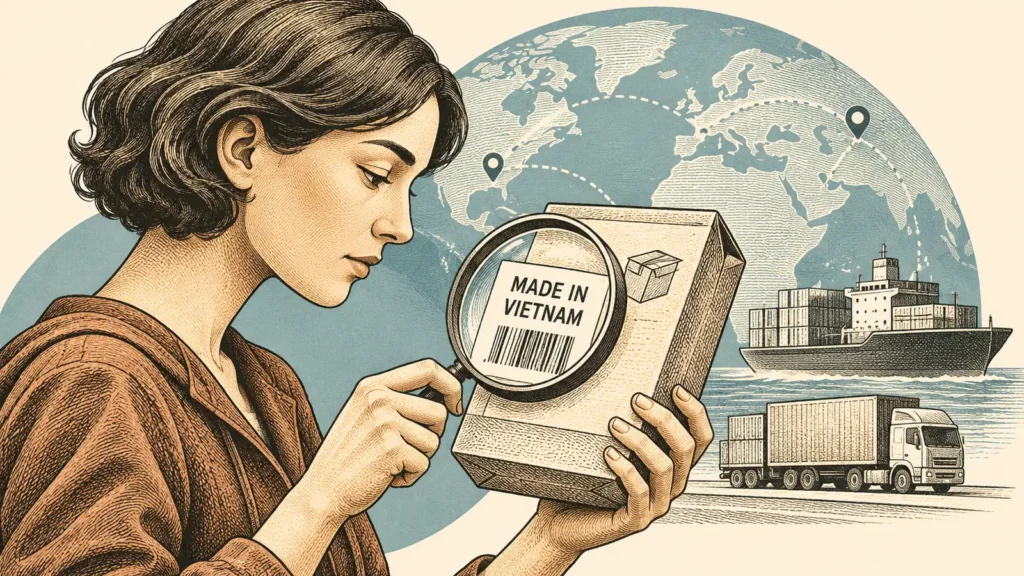
For decades, the global supply chain has been hard to see, and many brands benefit from that. It works like an architecture of silence. Distance is part of what is being sold: the distance between your hand and the factory floor where the object was forged, stitched, or bottled.
This guide isn’t a guilt trip. Guilt is paralyzing and ultimately useless. It’s about collapsing that distance through Investigative Living, our term for shifting from passive consumer to active researcher of your own purchases. With four search techniques, you can often cut through the marketing fog and trace a product to a particular factory.
Here is how I search for the truth behind the label. Records and codes can be incomplete or wrong, so treat each finding as a lead to confirm, not as proof.
Phase I: The Forensic Signature (Decoding the Lot Number)
The supply chain investigation begins not with a database, but with the physical object in your hand.
While the brand name on the front of the package is a fiction created by a marketing department in New York or London, the Lot Number on the bottom is a hard fact created by a factory floor manager in Guangdong or Ohio.
It is usually a cryptic string of dot-matrix text printed on the crimp of a tube or the neck of a bottle: L2316508A.
Where most people see gibberish, I see a coordinate system.
The Julian Date Deception
Many manufacturers print a compact code instead of a standard date like May 12, 2024. One common format is a Julian date, a count of the days of the year from 001 to 365. Formats vary by company and product, so treat this as a common pattern, not a rule.
Suppose a code reads L23165.
- 23 often represents the year (2023).
- 165 represents the 165th day of that year (June 14th).
If you are buying a “fresh” organic cream in December, and the code appears to say day 032 (February 1), the product may have been sitting in a warehouse or on a shelf for ten months. Confirm the format with the brand first, since some codes mark the fill date, the packing date, or the expiration date.
The Tactical Inquiry
The lot number can get you past the gatekeepers. When you email a brand with a vague question like “Where are your products made?”, you often get a vague PR script about “global partners.”
A lot number shows that you are holding the actual product, which can get you a more specific answer.
My Script:
“I’m holding a bottle of your Daily Cleanser, Lot #L2316508A. To ensure this aligns with my sourcing values, can you confirm the specific facility location where this batch was produced?”
If they reply with the factory name: Green Light.
If they reply that this information is “proprietary”: Red Flag. A formula can be a trade secret, but many brands will confirm where something is made.
More Search Guides You Might Need Next
Phase II: Piercing the Corporate Veil
The name on the box is rarely the same as the name on the shipping contract.
If you search shipping records for a consumer brand’s name, you may find nothing. That’s because many brands use a separate legal entity to manage logistics. That is the “Doing Business As” (DBA) distinction.
I start by scrolling to the footer of the brand’s website. I’m looking for the copyright notice: © 2025 Global Wellness Holdings Ltd.
If that fails, I check the Terms of Service or Privacy Policy. These legal documents must disclose the entity collecting your data. A privacy policy for a trendy boutique might say, “This policy applies to information collected by Example Brands, Inc.”
That boring, unglamorous name, such as Example Brands, Inc. or Global Wellness Holdings, is the key. It is often the name that appears on the customs forms.
Phase III: The Ocean (Bills of Lading)
The ocean is a public highway. To prevent smuggling and tax evasion, most governments maintain detailed records of what crosses their borders. In the United States, ocean import manifests, which include the Bill of Lading (BOL), are largely public record. Importers can ask U.S. Customs and Border Protection to keep some details confidential, so some shipments won’t show up.
That is the OSINT heartbeat of ethical consumption. OSINT, or open-source intelligence, means collecting and analyzing publicly available information, such as government records, company filings, news, and websites.
I use tools like ImportYeti (free) or Panjiva (paid) to access this data. I enter the legal entity found in Phase II and review the supplier map that comes back.
What I Look For
When I pull up the shipping records for a brand, I look at three specific columns:
- The Shipper: This is the key column. If the record says “ABC Textiles Co. Ltd, Dhaka, Bangladesh,” shipped the goods, I have a likely supplier, which is much better than a marketing story. The shipper isn’t always the maker, so confirm it in Phase IV.
- The Weight & Volume: Does a brand claim to be “small batch” and “artisanal”? If their shipping records show they import 50,000 kilograms of product every month from a mega-factory in Shenzhen, the “small batch” story deserves a hard look.
- The HS Code: This code classifies a product for tariff purposes. If a brand claims to sell “Italian Leather” but the HS Code on their import corresponds to “Synthetic Rubber” or “Plastics,” that mismatch is worth questioning. Filing errors happen, so ask the brand before you draw a conclusion.
The “Freight Forwarder” Trap:
Sometimes, the “Shipper” is listed as DHL Global Forwarding or Kuehne + Nagel. These are logistics intermediaries that hide the factory name. If I see this, I look for “House Bills of Lading” or check the “Description of Goods” field, where filing agents sometimes include the factory’s name.
Phase IV: The Reality Check (Vetting the Factory)
Once I have the factory name, such as ABC Textiles Co. Ltd., I stop searching only in English.
Labor problems at a factory in China or Bangladesh may never reach the New York Times, but local news often reports them in the local language.
I use Google Translate to find the local terms for “strike,” “pollution,” or “unpaid wages,” and combine them with the factory name. Machine translation can miss nuance, so confirm any serious finding with a native speaker or a second source.
My Search Queries:
- China: “[Factory Name]” + 罢工 (Strike) or 拖欠工资 (Wage Arrears).
- Bangladesh: “[Factory Name]” + শ্রমিক অসন্তোষ (Labor Unrest).
- Vietnam: “[Factory Name]” + đình công (Strike).
The Traffic Light System:
- Green: The factory appears in business directories and recruitment ads, but there is no news of accidents or strikes. Green means I found nothing, not that the factory is clean.
- Yellow: I find reports of a minor wage dispute from five years ago that appears resolved.
- Red: I find recent reports of fire safety violations, mass faintings among workers, or “wage arrears” (months of unpaid wages).
If I find a Red signal, I usually do not buy the product. No amount of “sustainable” branding can wash away a credible local report of unsafe or unpaid work.
What this method can’t tell you. A shipping record shows a shipment, not every product a factory makes. News coverage can be missing even when problems exist. And a single record is not enough to publicly accuse a company of wrongdoing, so use these steps to decide what you buy and which questions to ask.
Conclusion: Voting With the Search Bar
The transition from a passive shopper to an active investigator changes the texture of your daily life. It is a shift from “trust” to “verification.”
That is not paranoia. It is about respecting the world’s complexity and the labor of the people who build it.
When you trace a product, you stop seeing a “Brand.” You start seeing a Supply Chain. You see the container ship crossing the Pacific, the production shift encoded in the lot number, and the factory floor in the satellite view.
Brands have learned that “ethical” is a powerful keyword. They have packaged it, aestheticized it, and sold it back to us. But transparency is not a vibe. It is a set of coordinates. It is a shipping record. It is a factory address.
To live investigatively is to refuse to be seduced by the soft gradient. It is the quiet, decisive act of following a product home, and in doing so, acknowledging the reality of the world we have built.
Tools and Databases Referenced in This Article
Organized by their function, these resources form the “Investigator’s Toolkit” for tracing supply chains.
1. The Logistics Engines (Bill of Lading Data)
These platforms allow you to search for a “legal entity” and see exactly what they are importing, from where, and in what volume.
- ImportYeti: A free, accessible source of US Customs data. It visualizes the supply chain graph, making it easy to spot suppliers. Best for: Initial searches for a parent company’s shipments. Link: importyeti.com
- Panjiva (S&P Global): A professional-grade trade data platform. While often paid/enterprise, they publish significant research and trends. Best for: Deep-dive analytics if you have institutional access. Link: panjiva.com
2. Factory Vetting & Environmental Checks
Once you find a factory name in the shipping records, use these tools to check its safety and environmental track record.
- Open Supply Hub: An open-data map of global production facilities. You can search by factory name or ID to see which other brands source from that factory and whether any NGOs have flagged issues. Best for: Connecting a specific factory to multiple brands. Link: opensupplyhub.org
- IPE (Institute of Public & Environmental Affairs) / Blue Map: A database specifically for tracking environmental violations in China. Best for: Checking if a Chinese supplier has been fined for water or air pollution. Link: ipe.org.cn
- Violation Tracker (Good Jobs First): A search engine for corporate misconduct, covering environmental, health, and safety violations in the US and UK. Best for: Checking the “Parent Company” for domestic fines and legal settlements. Link: violationtracker.goodjobsfirst.org
3. Corporate Structure & Connections
Use these to find the “boring” legal entity name hidden behind the flashy consumer brand.
- LittleSis: A free database detailing the connections between influential people and organizations. It helps track ownership structures and private equity ties. Best for: Seeing who really owns a brand (e.g., Private Equity firms). Link: LittleSis
- OpenCorporates: The largest open database of companies in the world. It helps verify if a “shell company” name exists and where it is registered. Best for: Verifying legal entity names found in Privacy Policies. Link: Open Corporates
4. Decoding the Artifacts
Tools to help you read the physical codes on the product.
- Natural Grocers Julian Calendar: This is a clean, consumer-friendly chart that converts the “Day of the Year” (001–365) into a standard calendar date. It specifically addresses how to read codes on bulk packaging.
Link: Natural Grocers Julian Calendar - Neil Jones Food Company – Can Code Guide: This resource is excellent because it provides visual examples of where to find the codes on metal cans and how to interpret the alphanumeric sequences often used in food packaging.
Link: Neil Jones Food Company – Can Code Guide - UNL Institute of Agriculture: While this guide focuses on egg cartons, the 3-digit “Day of the Year” system it explains is the universal standard for most US consumer goods. Link: UNL Institute of Agriculture
- The Wayback Machine (Internet Archive): Use this to compare a brand’s sustainability page today vs. 3 years ago to spot “silent edits” or removed promises. Best for: Holding brands accountable to past claims. Link: The Wayback Machine (Internet Archive)