
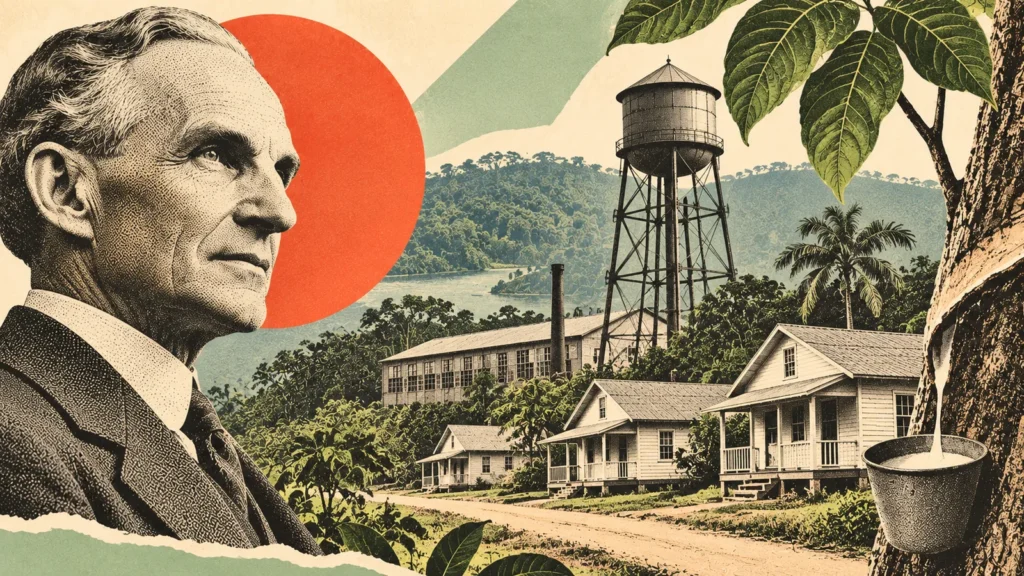
In 1928, Henry Ford began building an American-style industrial town in the Brazilian rainforest. He wanted rubber for his cars. What followed was an expensive experiment in agriculture, urban planning, and cultural control.
In 1928, two vessels carrying machinery, construction supplies, and equipment traveled toward a remote stretch of the Tapajós River in northern Brazil. Their destination was a settlement that would soon bear the name of one of America’s richest industrialists.
Henry Ford had decided to grow his own rubber.
His company needed enormous quantities of it for automobile tires and other components. Rather than keep depending on overseas suppliers, Ford planned to establish plantations in the Amazon, where rubber trees thrived naturally.
The project would eventually include factories, houses, hospitals, schools, and recreational facilities. Ford’s managers also tried to introduce American working hours, food, and social customs.
The settlement became known as Fordlândia.
Its buildings rose from the rainforest, but the rubber trees proved far harder to manage. Workers challenged the company’s rules, agricultural disease spread through the plantations, and Ford’s expensive experiment never fulfilled its central purpose.
Why Henry Ford Went Looking for Rubber
By the 1920s, Ford Motor Company was producing automobiles on an enormous scale. Rubber was essential to that operation, and much of the world’s commercial supply came from plantations in Southeast Asia.
The rubber tree, Hevea brasiliensis, was native to the Amazon. In the 19th century, Brazil was a major center of the rubber trade. But seeds taken from South America helped establish successful plantations in Asia, where growers could cultivate the trees more efficiently and supply international markets.
In 1922, Britain’s Stevenson Plan restricted rubber exports to raise prices, pushing American manufacturers to seek supplies they could control. Ford wanted that control. He had already pursued direct access to timber, coal, iron, and other industrial resources.
A 1923 U.S. government survey identified the Amazon as a promising region for rubber production. In 1926, Ford commissioned a separate investigation of the Tapajós River valley.
On July 21, 1927, his company secured a concession covering about 2.5 million acres in the Brazilian state of Pará.
The agreement gave Ford a vast territory at no cost. After 12 years of operation, the company would pay 7 percent of its annual profits to the Brazilian government and 2 percent to local authorities.
Ford’s ambitions extended beyond agriculture. He believed the project could demonstrate the benefits of American industrial organization and community planning.
Building an American Town in the Rainforest
The first shipments of equipment arrived in 1928.
The company brought tractors, prefabricated buildings, machinery, hospital supplies, and power-generation equipment. Workers cleared forest, prepared construction sites, and began building the settlement.
Fordlândia stood along the Tapajós River, a tributary of the Amazon. The river provided an essential transportation route through a region with limited roads and industrial infrastructure.
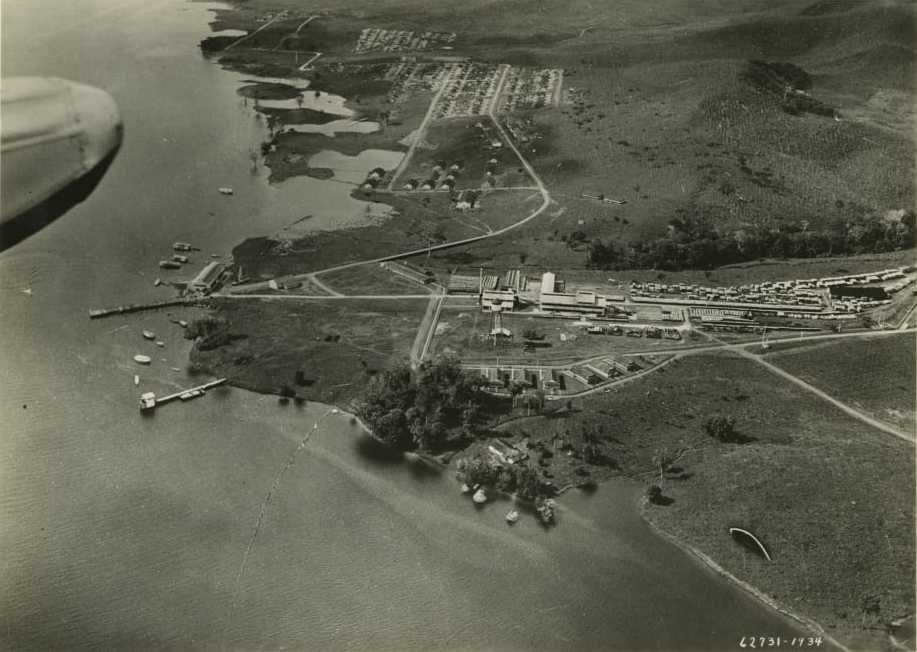
The settlement gradually acquired the features of an American company town.
Workers and managers had access to housing, medical facilities, shops, and recreational amenities. The company offered services unusual in many rural communities in the region.
These investments attracted workers. Ford paid comparatively high wages and offered benefits, including medical care.
But the town’s design reflected assumptions developed thousands of miles away.
Some houses followed Midwestern American models that suited the tropical climate poorly. Managers encouraged unfamiliar social activities and introduced dietary arrangements that did not necessarily match local preferences.
The company also tried to regulate workers’ conduct beyond the workplace.
Ford’s managers expected the settlement to operate by the standards of the company’s American factories. Brazilian workers had their own expectations about work, food, family life, and self-determination.
When Factory Rules Met Amazonian Life
The Amazon’s climate shaped the working day.
Local laborers were accustomed to adjusting their schedules around heat and other environmental conditions. Ford’s managers preferred more standardized hours.
Company policies also reached into recreation and personal habits. Alcohol restrictions and organized social activities reflected Henry Ford’s ideas about orderly community life.
Food became a particularly sensitive issue.
Workers ate meals at company facilities, where unfamiliar dishes and dining arrangements caused dissatisfaction.
The conflict reached a breaking point in December 1930.
During a dispute over cafeteria service and broader working conditions, workers rebelled against the company’s management. They damaged buildings and equipment, and American employees fled the disturbance.
People often call the uprising the Fordlândia revolt.
Some stories reduce it to workers objecting to cafeteria trays. The deeper conflict involved management authority, cultural expectations, and workers’ limited control over their lives within the company settlement.
Ford’s administrators eventually restored operations, but the confrontation exposed the difficulty of imposing a rigid industrial system on a community with different working traditions.
The Rubber Trees That Wouldn’t Cooperate
Rubber trees thrived naturally in the Amazon, but their presence in the forest did not guarantee that growers could cultivate them successfully in dense plantations.
In the wild, rubber trees stand scattered among many other species. Commercial plantations place large numbers of the same species close together, which makes cultivation and harvesting more efficient.
That arrangement also gives disease room to spread.
Ford’s managers planted rubber trees in organized rows, following methods familiar from industrial agriculture.
The trees grew, but South American leaf blight became a devastating problem.
The fungal disease attacks rubber-tree foliage. Under favorable conditions, infection can spread quickly through closely planted trees, damaging growth and lowering latex production.
The disease had long impeded efforts to establish large commercial rubber plantations in tropical America.
Ford’s operation suffered badly. Leaf fungus, together with pests such as leaf-cutting ants, lace bugs, and red spiders, attacked the closely planted trees as their foliage developed, and the losses were extensive.
The company experimented with agricultural techniques and sought specialist help, but the original site never became the reliable rubber supplier Ford had envisioned.

The problem was especially frustrating because rubber trees were native to the region.
Successful commercial cultivation required more than land, labor, and machinery. It depended on understanding plant diseases, local ecological conditions, and the differences between a natural forest and a plantation.
A Second Attempt at Belterra
Ford Motor Company did not immediately abandon its Brazilian ambitions.
In 1934, it established another plantation at Belterra, downstream from Fordlândia and closer to Santarém.
The new location offered different terrain and a chance to apply lessons from Fordlândia.
By 1940, Belterra had approximately 7,000 inhabitants, more than 2,000 workers, and hundreds of houses. Schools, medical facilities, shops, and other services supported the community.
The company also pursued more systematic agricultural research, including efforts to identify and propagate rubber trees with greater disease resistance. By 1941, the company had planted about 3.65 million rubber trees across Fordlândia and Belterra.
Belterra initially looked more promising, but it eventually met many of the same biological difficulties.
South American leaf blight continued to threaten the plantations.
The company had invested years building settlements, clearing land, planting trees, and maintaining infrastructure. Yet rubber supply remained far below the scale needed to justify the investment.
The End of Ford’s Amazon Experiment
By the 1940s, the original vision had become increasingly difficult to sustain.
Ford Motor Company had invested heavily in both settlements without obtaining the dependable rubber supply it wanted.
Agricultural disease remained a major obstacle. Labor and administrative problems added to the expense, while changing technology and international economic conditions, including the rise of synthetic rubber, shaped the company’s long-term calculations.
Henry Ford’s grandson, Henry Ford II, became president of the company on September 21, 1945.
That same year, Ford Motor Company transferred its Brazilian plantation operations to the Brazilian government.
The sale price was roughly $250,000, a fraction of the company’s investment. Ford’s own institutional history puts the total investment at about $20 million.
The plantations had never become a major source of the world’s rubber.
For Ford Motor Company, the project was over.
For the people who had made their lives in the settlements, the story continued.
What Happened to Fordlândia?
Fordlândia did not simply disappear when the company left.
Its buildings, streets, and infrastructure remained. Residents kept living there, and the settlement developed a life beyond its original corporate purpose.
Some structures deteriorated. Others stayed in use or adapted to new needs.
The old water tower became one of Fordlândia’s most recognizable landmarks. Surviving buildings and industrial remnants still show the scale of the company’s construction program.
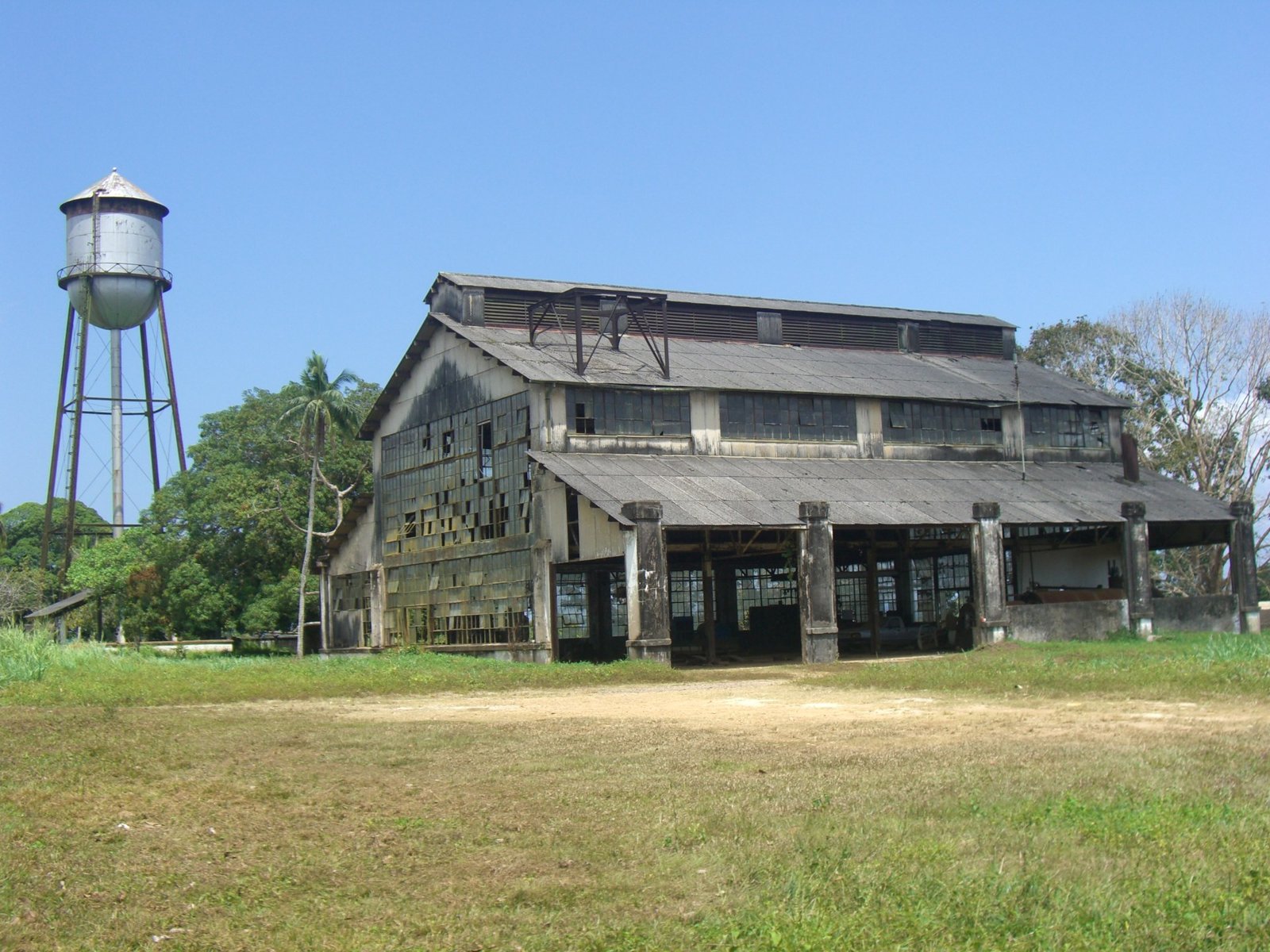
Photographs of the settlement often emphasize abandoned machinery and decaying architecture. Those images can make Fordlândia look completely deserted.
The former company town is also a living community, and its history includes the people who stayed after the American industrial experiment ended.
Its surviving buildings are part of a much larger story about work, migration, economic change, and the long consequences of corporate development in the Amazon.
What Fordlândia Reveals About Industrial Ambition
Henry Ford had transformed automobile manufacturing through standardization, mechanization, and the moving assembly line.
In Brazil, he tried to apply elements of that industrial philosophy to a rainforest landscape and the people who worked there.
The company’s financial resources let it build large-scale infrastructure in a remote region. It could ship machinery across continents, construct housing, open hospitals, and employ thousands of workers.
Those resources could not eliminate the biological obstacles of growing rubber in the Amazon.
Nor could they make Brazilian workers accept American management practices.
Fordlândia’s failure had several overlapping causes. Agricultural disease undermined the plantations, and management decisions produced unnecessary conflict. The expense of running an isolated industrial settlement made every setback more costly.
The project also left a complicated legacy. Company investment brought employment, housing, and medical services, but workers lived under rules that frequently ignored their preferences and local conditions.
Today, the surviving town offers an unusual view of 20th-century industrial history.
American-style buildings still stand beside the Tapajós River, far from Michigan’s factories. Some have aged badly in the tropical climate. Others remain part of the community.
Ford came to the Amazon to grow rubber for his cars.
Instead, he built a town whose history outlasted the business that created it.
Further Reading & Sources
- Greg Grandin, Fordlandia: The Rise and Fall of Henry Ford’s Forgotten Jungle City (2009). A major historical study of the project, including its labor relations, environmental consequences, and social ambitions.
- The Henry Ford, “Ford Rubber Plantations in Brazil”. Institutional research based on Ford Motor Company collections; source for the concession terms, Belterra’s 1940 population, the 1941 tree count, and the $20 million investment.
- The Henry Ford, “Fordlandia Time Clock, Destroyed in the Riot of December 1930.” Archival documentation of the workers’ uprising.
- “Industrialist in the Wilderness: Henry Ford’s Amazon Venture”, Journal of Interamerican Studies and World Affairs (1979). Academic research on Ford’s concession and the development of the Amazon venture.
- The Henry Ford, “Fordlandia”, Google Arts & Culture. Historical photographs and information about rubber cultivation, pests, and the Belterra plantation.
- The Henry Ford, Ford Motor Company historical chronology. Source for Henry Ford II’s appointment as company president on September 21, 1945.
- Simanaitis Says, “Henry Ford’s Amazon Adventure”. Secondary account discussing Greg Grandin’s reported sale price of $244,200.