
Art-directed conceptual editorial illustration created with AI. Figures, buildings, and scenes are illustrative, not documentary reconstructions.
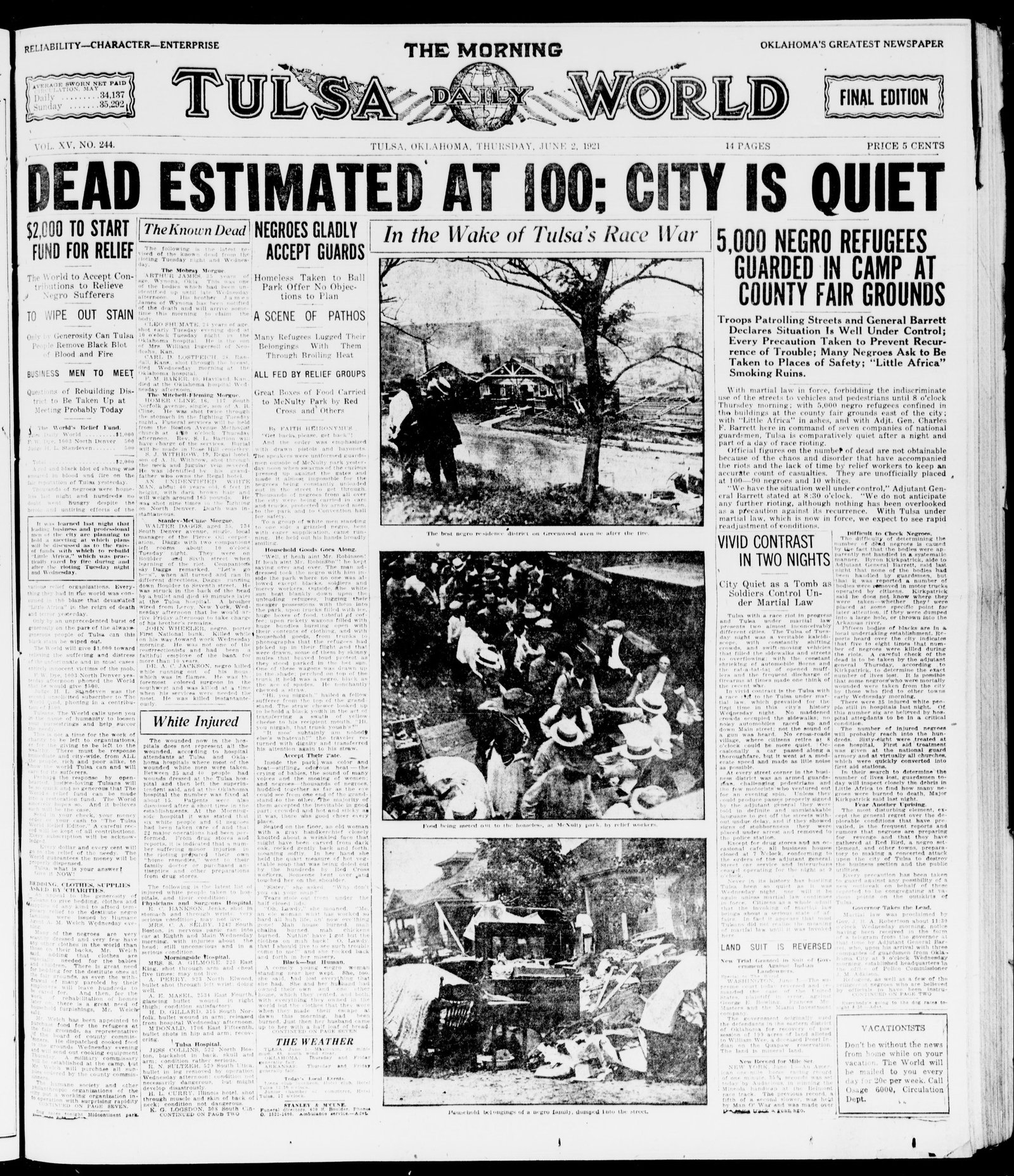
The Tulsa Race Massacre is often described as a forgotten event. That description leaves out the people who remembered it.
Survivors told their children. Black newspapers printed what white papers left out. A teacher compiled testimony within a year of the attack, a Red Cross director wrote a report, and a lawyer who lived through the violence wrote his own account. Later, journalists, historians, and a state commission built on that work. Dominant institutions did fail to give the massacre the attention it deserved, and some records went missing. But the history survived because particular people chose to keep it.
This part separates four things that are easy to conflate: records that were deliberately removed, institutions that stayed silent, records that were never complete, and the ongoing work of recovery. They differ in cause, and the evidence for each is different.
What survivors and the Black press kept
Mary E. Jones Parrish published Events of the Tulsa Disaster privately in 1922, as Part III describes. Her book is among the earliest published accounts, and it carries survivors’ testimony in their own words.
Black newspapers also carried the story. The Black Dispatch of Oklahoma City reprinted the Tulsa Tribune’s May 31 story on July 1, 1921, under a headline calling it the false story that set Tulsa on fire, according to the footnotes of Alfred Brophy’s law review article on the massacre. The Justice Department’s 2025 review drew on an account that attorney B. C. Franklin wrote ten years after the massacre, as well as his autobiography. Maurice Willows of the Red Cross compiled a relief report that is now held by the National Archives.
Research also continued. In 1946, Loren Gill wrote a master’s thesis on the massacre at the University of Tulsa, and according to the Oklahoma Historical Society, he found the Tribune’s front-page article and used it there. Survivors kept telling their stories for decades. A Smithsonian magazine writer who learned of the massacre in 2000 described the event as one that few people knew about apart from elderly survivors and those they had entrusted with their memories.
Records that were removed
One loss is well documented. The Tulsa Tribune’s May 31, 1921 front-page story about Dick Rowland, along with part of the editorial page, was torn from the paper’s archived copy before it was microfilmed; the University of Tulsa’s exhibit calls the removal deliberate, and the Library of Congress notes that the surviving May 31 copy is missing other portions as well. The story’s words did not disappear with the pages. Loren Gill quoted it in his 1946 thesis, and the University of Tulsa reports that several copies of the article have surfaced since.
Many survivors and witnesses also remember an editorial titled “To Lynch Negro Tonight.” The Oklahoma Historical Society says it has never been found, and its contents and fate remain a mystery. The Library of Congress adds that historians agree the front-page story alone was enough to provoke a lynching, whether or not that second item existed.
Those sources establish that pages were removed. None establishes who removed them, when, or why. That limit is also part of the record: a deliberate act can leave a gap that no one can later explain.
Records that were never complete or cannot be found
Other gaps have different explanations. The Red Cross, as Part III noted, recorded no death total because it had no reliable way to count the dead. In Brophy’s footnotes, the city fire marshal’s report on the massacre cannot be located, and he notes that a separate investigation, perhaps by a special city court of inquiry, also left no clear trace. A missing report does not prove concealment. It shows that decisions about what to write down, keep, and index shaped what historians could later find.
Part II showed another kind of choice: what investigators recorded and whom they chose to ask. The Justice Department’s account of the federal agent who claimed to have interviewed more than 100 witnesses but summarized five, all white men, shows how an investigation can narrow the record as it is made.
Silence in schools and public life
A third pattern is silence. The Oklahoma Historical Society says that for decades after the massacre, scholars and officials ignored it. AP reporting adds that Oklahoma’s public schools called it a “race riot” when they discussed it at all. According to the Society, journalist Ed Wheeler began studying the massacre in the early 1970s; the publication he wrote for rejected his article, and it ran instead in a small periodical called Impact.
This kind of silence is not the same as destruction. It is institutions declining to teach, publish, or investigate. It happened in public, through ordinary decisions, and left the people who held the memories with little official support.
The work of recovery
Recovery came in steps. In 1982, Scott Ellsworth published Death in a Promised Land, a comprehensive history from Louisiana State University Press. In 1997, the Oklahoma Legislature created the Oklahoma Commission to Study the Tulsa Race Riot of 1921. After four years of work, with historians including Ellsworth and John Hope Franklin, the Commission issued its report in 2001. The Commission recommended reparations. Lawsuits seeking compensation have since failed on different legal grounds, a history Part V traces.
In January 2025, the Justice Department’s Civil Rights Division issued its own review. As Part II described, it concluded that the destruction was a coordinated attack involving white civilians and law enforcement participation. It also found that criminal prosecution was no longer possible. The review and the Commission report used different sources and, on some points, reached different conclusions about the death toll and the role of aircraft; Part II sets out those differences.
The search for the graves
Witness accounts of many dead led to a search for mass graves. The investigation has a long, uneven history. According to National Geographic, a mayor closed an earlier effort without a physical search, and in 2018 Mayor G. T. Bynum announced the city would reopen it. The city began ground-penetrating radar surveys in October 2019. Test excavations in July 2020 at Oaklawn Cemetery found no mass grave or other human remains in the first area searched, and in October 2020 scientists found unmarked coffins in a second area. By June 2021, according to the University of Oklahoma, 19 sets of remains had been exhumed from an unmarked part of Oaklawn.
Since then, the findings have been specific and limited. The city’s investigators report that the 36 burials of interest in the New Potter’s Field section of Oaklawn are all male, all in simple wooden containers, and all in old stream channels. Through the 2025 field season, the city’s executive summary counts eight confirmed gunshot victims recovered in Section 20 of Oaklawn, and it describes the two found in 2025 as potential victims of the massacre; a gunshot wound alone does not tie a burial to the massacre. Neither location tied to the eyewitness account of a trench contained a trench-style mass grave, although investigators say they have not ruled out the trench location. They also report that the number of expected adult male trauma victims has not been recovered and that most identities remain unconfirmed.
Identification has begun. In July 2024, the city announced the first identification, a World War I veteran named C. L. Daniel. In June 2025, the city described a second identification, George Melvin Gillispie, through genetic genealogy, while stating that his cause of death is unknown and that he is not confirmed as a massacre victim. Historical research has also named other victims, including James Goings, a veteran whose records indicate he died June 1, 1921, and John White, whose 1925 death certificate states that he died of gunshot wounds that day. The city’s November 5, 2026 update on the sixth field season at Oaklawn reports 47 previously unrecorded burials. Two show gunshot wounds, and they were found outside the fenceline; News9 reports the city’s count across all seasons is now 10 gunshot victims, compared with the eight in Section 20 through 2025. News9 reported that 13 of the 47 lay just outside the cemetery fence, a dozen of them beneath a walking trail, and that a preliminary summary report is expected in the coming months. These are counts of burials documented, which differ from counts of remains exhumed. News9 also reports that more than 300 previously unknown burials have been documented since the investigation began, and that C. L. Daniel remains the only confirmed massacre victim.
These results do not settle the death toll. They have found unmarked burials of people with gunshot wounds, but the city has confirmed only one person, C. L. Daniel, as a massacre victim, and it has not tied the other remains to the massacre. The work has begun returning names. Investigators have not located a mass grave, and their findings have neither confirmed nor ruled out the highest death toll estimates. Part II lays out the range.
Survivors in public
For decades, survivors were the main witnesses. On May 19, 2021, Viola Fletcher, her brother Hughes Van Ellis, and Lessie Benningfield Randle testified before a House Judiciary subcommittee at a hearing titled “Continuing Injustice: The Centennial of the Tulsa-Greenwood Race Massacre.” Fletcher told the members, “I have lived through the massacre every day.” Van Ellis, a World War II veteran, died on October 9, 2023, at 102. Fletcher, who published a memoir, Don’t Let Them Bury My Story, died on November 24, 2025, at 111. Lessie Benningfield Randle turned 112 on November 10, 2026, and news reports that month describe her as the last known living survivor.
The final part covers what the state, the city, the courts, and the federal government have done in response.
What survived, and who kept it
The record we have reflects both loss and persistence. Someone unknown tore pages from a newspaper. Official reports were never written, or cannot be found. Schools and publishers stayed silent. And still, a teacher wrote a book within a year, newspapers reprinted what they could, survivors told their families, and a small number of researchers kept at it until a legislature and then the federal government looked again.
That is a more accurate story than a story of forgetting, and it is also a more demanding one. It asks readers to look at who made the records, who kept them, and who decided what counted as evidence.
Explore the records yourself
- City of Tulsa, 1921 Graves Investigation. Field reports, timelines, and updates: https://www.cityoftulsa.org/1921graves
- 2025 field season executive summary (May 2026). What the investigation has and has not established: https://www.cityoftulsa.org/media/30752/trmi_oaklawn-2025-executive-summary.pdf
- City update, June 18, 2025. Identifications and historical research: https://cityoftulsa.org/press-room/city-provides-significant-archeological-dna-updates-in-1921-graves-investigation/
- Final Report of the Oklahoma Commission to Study the Tulsa Race Riot of 1921 (2001). https://www.okhistory.org/research/forms/freport.pdf
- U.S. Department of Justice, 2025 review. https://www.justice.gov/crt/media/1383756/dl
- Oklahoma Historical Society, “Remembering the Massacre.” https://okhistory.org/learn/trm6
- Alfred L. Brophy, “The Tulsa Race Riot of 1921 in the Oklahoma Supreme Court.” https://core.ac.uk/download/323046433.pdf
- Mary E. Jones Parrish, Events of the Tulsa Disaster. Excerpts: https://lithub.com/king-mob-rule-on-a-first-person-account-of-the-horrific-tulsa-race-massacre-of-1921/
Sources
- Oklahoma Historical Society, The Tulsa Race Massacre, “Remembering the Massacre”: https://okhistory.org/learn/trm6
- CNBC, “How the Tulsa race massacre was covered up and unearthed”: https://www.cnbc.com/amp/2021/05/31/black-wall-street-was-shattered-100-years-ago-how-tulsa-race-massacre-was-covered-up.html
- AP via WTTW, “How Tulsa Massacre Spent Most of Last Century Unremembered”: https://news.wttw.com/2021/05/30/how-tulsa-massacre-spent-most-last-century-unremembered
- Smithsonian Magazine, “Tulsa Race Massacre, a Century Later”: https://www.smithsonianmag.com/history/tulsa-race-massacre-century-later-180977145/
- National Geographic, “Search for victims of the Tulsa Race Massacre continues” (October 2020): https://www.nationalgeographic.com/history/2020/10/search-for-victims-tulsa-race-massacre-continues-mass-grave-unearthed/
- University of Oklahoma, “Reflecting on Progress: The Tulsa Race Massacre Graves Investigation”: https://www.ou.edu/insideou/articles/2021/september/reflecting-on-progress-the-tulsa-race-massacre-graves-investigation
- PBS NewsHour, first identified victim (July 2024): https://www.pbs.org/newshour/nation/a-world-war-i-veteran-is-the-1st-tulsa-race-massacre-victim-to-be-identified-in-citys-yearslong-investigation
- City of Tulsa, 1921 Graves Investigation pages and reports: https://www.cityoftulsa.org/1921graves
- Alfred L. Brophy, 54 Okla. L. Rev. 67 (2001): https://core.ac.uk/download/323046433.pdf
- U.S. Department of Justice, Civil Rights Division, review (January 2025): https://www.justice.gov/crt/media/1383756/dl
- CBS News, Viola Ford Fletcher obituary: https://www.cbsnews.com/amp/texas/news/viola-ford-fletcher-oldest-survivor-of-tulsa-race-massacre-dies
- ABC News, Randle’s 110th birthday: https://www.goodmorningamerica.com/living/story/survivor-of-tulsa-race-massacre-mother-randle-marks-110th-birthday-115728666
Next in the series: Part V. Greenwood and the Unfinished Question of Justice