
Art-directed conceptual editorial illustration created with AI. Figures, buildings, and scenes are illustrative, not documentary reconstructions.
A five-part Further Index history of Greenwood, Black Wall Street, and the 1921 Tulsa Race Massacre
This series draws on the 2001 report of the Oklahoma Commission to Study the Tulsa Race Riot of 1921, the U.S. Department of Justice’s January 2025 review, and archival and institutional sources.
How this series handles evidence
Where sources disagree, the text says so. Claims are marked by kind: what the record establishes, what witnesses recalled, what was alleged, and what remains unresolved. Numbers that vary by source, such as the death toll, the count of the homeless, and property losses, are given as ranges with their sources.
The event’s name is still disputed. Some people consider “riot” inaccurate and say it helped insurers deny claims, while others point out that the word was common for large clashes at the time. This series uses “massacre,” the term the Oklahoma Historical Society and most current institutions now use.
The five parts
- Greenwood Before the Flames: the community and its economy before 1921.
- The Night Greenwood Came Under Attack: the attack, the role of public authorities, and what the record establishes.
- Greenwood After the Fire: relief, the fire ordinance, rebuilding, and what rebuilding could not restore.
- Who Kept the Record: who preserved the evidence, what was removed, and how recovery began.
- Greenwood and the Unfinished Question of Justice: the Commission’s recommendations, the courts, and the open question of restitution.
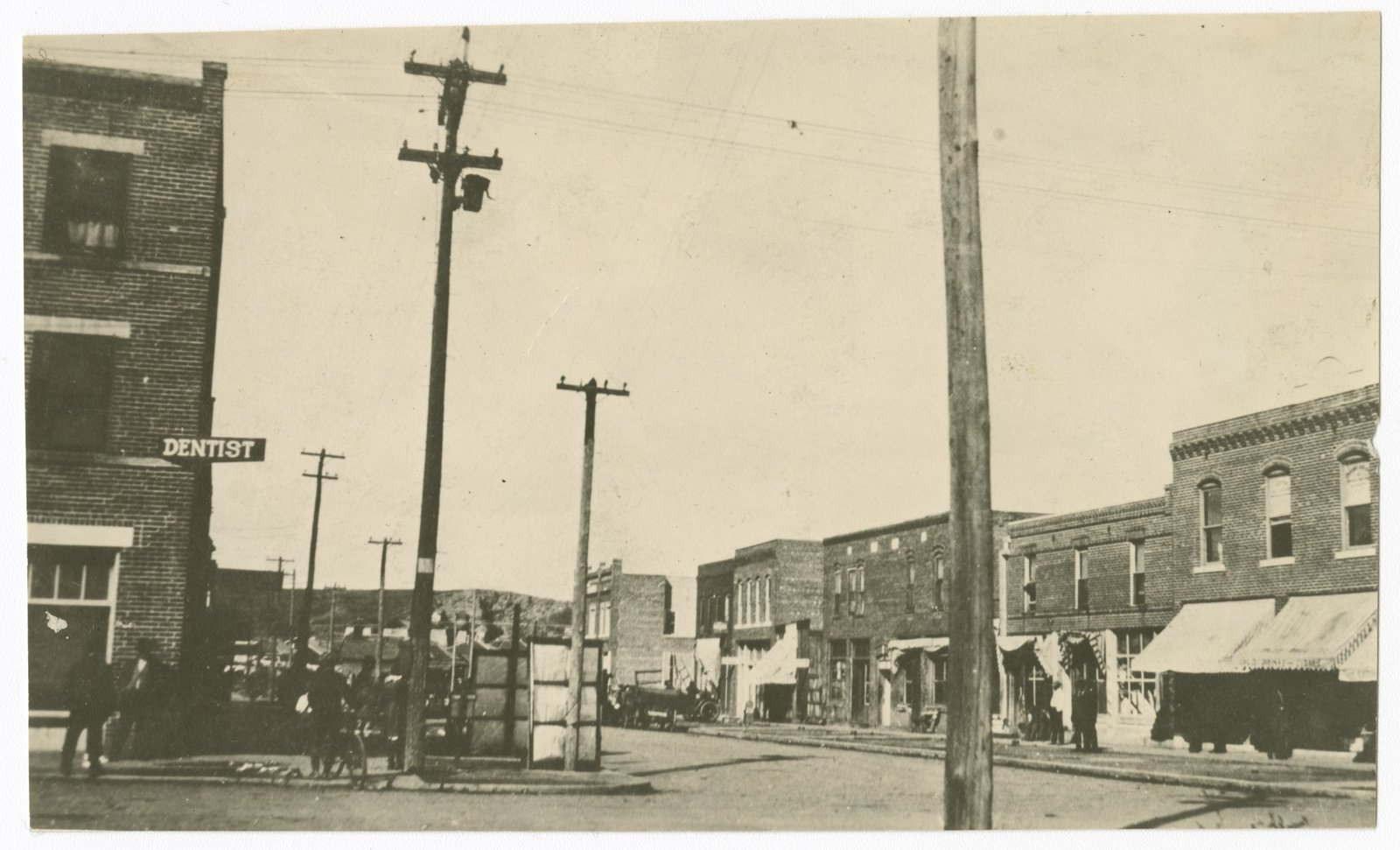
Before Greenwood became known to millions of Americans as the site of the 1921 Tulsa Race Massacre, it was a neighborhood where people went to school, attended church, opened businesses, visited doctors, bought groceries, and raised families. Along Greenwood Avenue, shops and professional offices served a growing Black population. Nearby streets held everything from makeshift shanties to the multi-story homes of Professor’s Row. The district had theaters, hotels, newspapers, and community organizations, and its commercial success earned it a name that would become inseparable from its history: Black Wall Street.
That name captures something real about Greenwood, but it tells only part of the story. The district was prosperous by the standards of many Black communities in the early twentieth century, yet its residents did not share that prosperity equally. According to the Oklahoma Historical Society, manual laborers and hospitality workers made up the majority of the population. Physicians, attorneys, property owners, and merchants lived alongside maids, cooks, porters, and day laborers. Some residents owned their homes; others rented. All of them lived in a segregated city that limited where they could shop, travel, and take part in public life.
To understand what was destroyed in 1921, we need to understand how this community developed, what sustained it, and what its residents built within the limits imposed on them.
A place to build a life
Greenwood’s history starts well before Tulsa’s oil boom. In the 1830s, the first African Americans arrived in what is now Oklahoma with the Native nations removed along the Trail of Tears; some were enslaved, and some were free. After emancipation, Black settlers founded towns across Indian Territory and Oklahoma Territory. The Oklahoma Historical Society counts more than fifty all-Black towns founded in the state, including Boley, Langston, and Red Bird; thirteen still exist. For many families, these places offered land, schools, and a measure of self-government that was hard to find elsewhere.
The promise had limits. Oklahoma became a state on November 16, 1907, and in December its first legislature passed Senate Bill One, requiring separate railway coaches and separate waiting rooms for white and Black passengers. It was the state’s first Jim Crow law, and more segregation measures followed.
Tulsa was changing fast. The 1905 Glenn Pool oil strike turned a small town into a boom city. Its population grew from 1,390 in 1900 to 18,182 in 1910 and 72,075 in 1920. Black newcomers found work in domestic service, hospitality, and transportation, and some saw an opening to build businesses for a growing Black clientele.
One of them was Ottawa W. Gurley, known as O. W. Gurley. Born in Huntsville, Alabama, on Christmas Day, 1868, he was raised in Arkansas and took part in the 1893 Cherokee Outlet land run, where he and his wife helped found the town of Perry and opened a general store. He moved to Tulsa in about 1906 (sources give 1905 or 1906) and bought roughly 40 acres north of the Frisco railroad tracks. He sold the land only to Black buyers, built a rooming house, and opened a second general store. Many accounts say the district took its name from Greenwood, Mississippi, the hometown of some early residents.
Gurley was one builder among many. J. B. Stradford, a lawyer who had come to Tulsa in 1899, bought and rented out property. A. J. Smitherman, who arrived in 1913, published the weekly Tulsa Star from 118 North Greenwood Avenue. Families moved in, churches organized, and each new household created demand for services that each new business could meet.
The economy behind Black Wall Street
Segregation shaped Greenwood’s commercial life. Many white-owned businesses refused Black customers or treated them badly, so Greenwood’s enterprises served people with few other options. Residents also chose to spend at home, which kept part of their earnings circulating in the neighborhood.
The district that resulted was remarkable. It had grocery stores, restaurants, barbershops, funeral homes, boardinghouses, pool rooms, dance halls, insurance agencies, and medical, dental, and law offices. Counts of Black-owned businesses vary by directory and definition, but the figure was well over a hundred.
John and Loula Williams ran several of them. They started with a garage and a confectionery, and in 1914 they opened the Williams Dreamland Theatre, which showed silent films and live revues to a Black audience and reportedly seated about 750. On June 1, 1918, Stradford opened the Stradford Hotel at 301 North Greenwood Avenue. Most sources describe it as a 54-room brick building and, at the time, the largest Black-owned hotel in the country.
These businesses mattered beyond their owners’ profits. A theater hosted entertainment and social gatherings, a hotel housed visitors, and a doctor’s office treated people who might otherwise struggle to find care. Dr. A. C. Jackson and Dr. R. T. Bridgewater were among the physicians who practiced there.
The economy also rested on people whose names appear less often in the story. Black Tulsans worked as maids, shoe shiners, waiters, chauffeurs, cooks, barbers, and gardeners, and many earned wages outside Greenwood and spent them inside it. LaVerne Cooksey Davis, born in 1904, worked as a maid in South Tulsa; she later said she watched the fires from across the city. The Reverend C. Netherland was both a Baptist minister and a barber. Bertha Black ran a café near Archer Street. Their work held the neighborhood up as surely as the hotel and the theater did.
The nickname Black Wall Street should not lead us to picture a community of wealthy business owners. Income, housing, and social standing varied widely. The Oklahoma Historical Society says Booker T. Washington may have coined the nickname; the claim is widely repeated, though not firmly documented.
More than a business district
Greenwood’s institutions mattered as much as its businesses. Churches offered worship, meeting space, mutual aid, and a base for organizing. The Reverend J. E. Roy organized Vernon African Methodist Episcopal Church in 1905 in a one-room house on North Detroit Street; it had 71 members at statehood. Mount Zion Baptist Church began in 1909 in a one-room school building. Its new sanctuary, which cost $92,000, had been in use only since April 4, 1921.
Education drew families to the district. Dunbar Grade School and Booker T. Washington High School both opened in 1913, and Ellis Walker Woods, the high school’s first principal, led it for thirty-five years. Newspapers kept residents informed: the Tulsa Star was the prominent voice, and the Oklahoma Sun was newer.
These details matter because accounts of Greenwood sometimes shrink the neighborhood to a list of successful businesses. Its destruction took far more than storefronts. Residents lost homes, family belongings, places of worship, schools, and the familiar surroundings of daily life.
Surviving records give us glimpses of that earlier world: photographs of crowded streets, a 1921 city directory, a school yearbook, and survivors’ recollections. They also show how incomplete the record is. Many ordinary lives appear only indirectly, through addresses, job listings, property documents, and memory.
Prosperity under threat
By 1921, Greenwood was among the best-known Black communities in the United States. Estimates of its population range from just over 9,000 to about 11,000, depending on the source and on where its boundaries are drawn. For comparison, Black residents made up about 12 percent of Tulsa’s 72,075 people in 1920.
Prosperity did not protect them. Tulsa sat inside a national climate of segregation, lynching, and white supremacist violence, and the years after World War I were especially dangerous. In the Red Summer of 1919, white mobs attacked Black communities in cities across the country. Black veterans came home expecting the rights of citizens, and many white Americans reacted by defending the racial order with force. Economic success could not shield a community when the law applied unequally, and public officials failed to protect it.
This was the setting as Greenwood entered the last days of May 1921. Its residents had built homes, businesses, and institutions despite every restriction placed in their way, and their achievements were known far beyond Tulsa.
Within days, much of it would be gone.
Explore the records yourself
- Tulsa City-County Library, Digital Collection for the 1921 Tulsa Race Massacre: photographs, reports, and documents. https://digitalcollections.tulsalibrary.org/digital/collection/p15020coll6
- 1921 Polk-Hoffhine Tulsa City Directory: find Greenwood’s households and businesses by name. https://digitalcollections.tulsalibrary.org/digital/collection/p15020coll12/id/2857/rec/2
- 1921 Booker T. Washington High School Yearbook: https://digitalcollections.tulsalibrary.org/digital/collection/p16063coll5/id/391/rec/1
- 2001 Report of the Oklahoma Commission to Study the Tulsa Race Riot of 1921: https://www.okhistory.org/research/forms/freport.pdf
- Survivor accounts gathered by the Tulsa library, including LaVerne Cooksey Davis, Otis Clark, Veneice Dunn Sims, and Dr. R. T. Bridgewater: https://www.tulsalibrary.org/1921-tulsa-race-massacre
- Mary E. Jones Parrish, Events of the Tulsa Disaster (1922; some catalogs give 1923), an account written by a survivor soon after the massacre.
Sources
- Oklahoma Historical Society, Tulsa and Black Wall Street
- Oklahoma Historical Society, Senate Bill One
- Oklahoma Historical Society, Civil Rights and All-Black Towns
- National Endowment for the Humanities, The 1921 Tulsa Massacre
- Smithsonian NMAAHC, Remembering Tulsa Before the Massacre
- Tulsa City-County Library, 1921 Tulsa Race Massacre
- BlackPast, John “the Baptist” Stradford
- BlackPast, Vernon A.M.E. Church
- National Geographic, Before the Tulsa Race Massacre
- Library of Congress, Tulsa Race Massacre: Newspaper Complicity and Coverage
Next in the series: Part II. The Night Greenwood Came Under Attack