
Art-directed conceptual editorial illustration created with AI. Figures, buildings, and scenes are illustrative, not documentary reconstructions.
On the evening of May 31, 1921, a crowd gathered outside the Tulsa County Courthouse. Inside, in the county jail on the courthouse’s top floor, a nineteen-year-old Black shoe shiner named Dick Rowland sat in a cell, accused of assaulting a white elevator operator. Rumors had spread through the city, and a newspaper report had inflamed them. By nightfall, hundreds of white residents stood outside the courthouse, and some demanded that the sheriff hand Rowland over.
In Greenwood, news of the crowd raised fears of a lynching. Black residents had every reason to take the threat seriously. A mob had lynched a white teenager named Roy Belton from the same courthouse nine months earlier, and the police had not intervened. Armed Black men, many of them World War I veterans, went to the courthouse to help protect Rowland. They left, and later that night more men came back.
Before the next day ended, much of Greenwood had been looted, burned, and destroyed. Residents had been killed, and thousands had been detained or left homeless. The violence was not an inevitable result of a disputed moment in an elevator. People chose to threaten a lynching, to arm themselves, and to invade a neighborhood, and public officials gave them the means to do it.
What happened in the elevator?
The incident took place on Monday, May 30, 1921, in the Drexel Building in downtown Tulsa. Rowland stepped into an elevator operated by Sarah Page, a white woman. What happened next is unclear. The most common explanation is that Rowland stepped on her foot and she cried out. A white clerk reported the incident to the police.
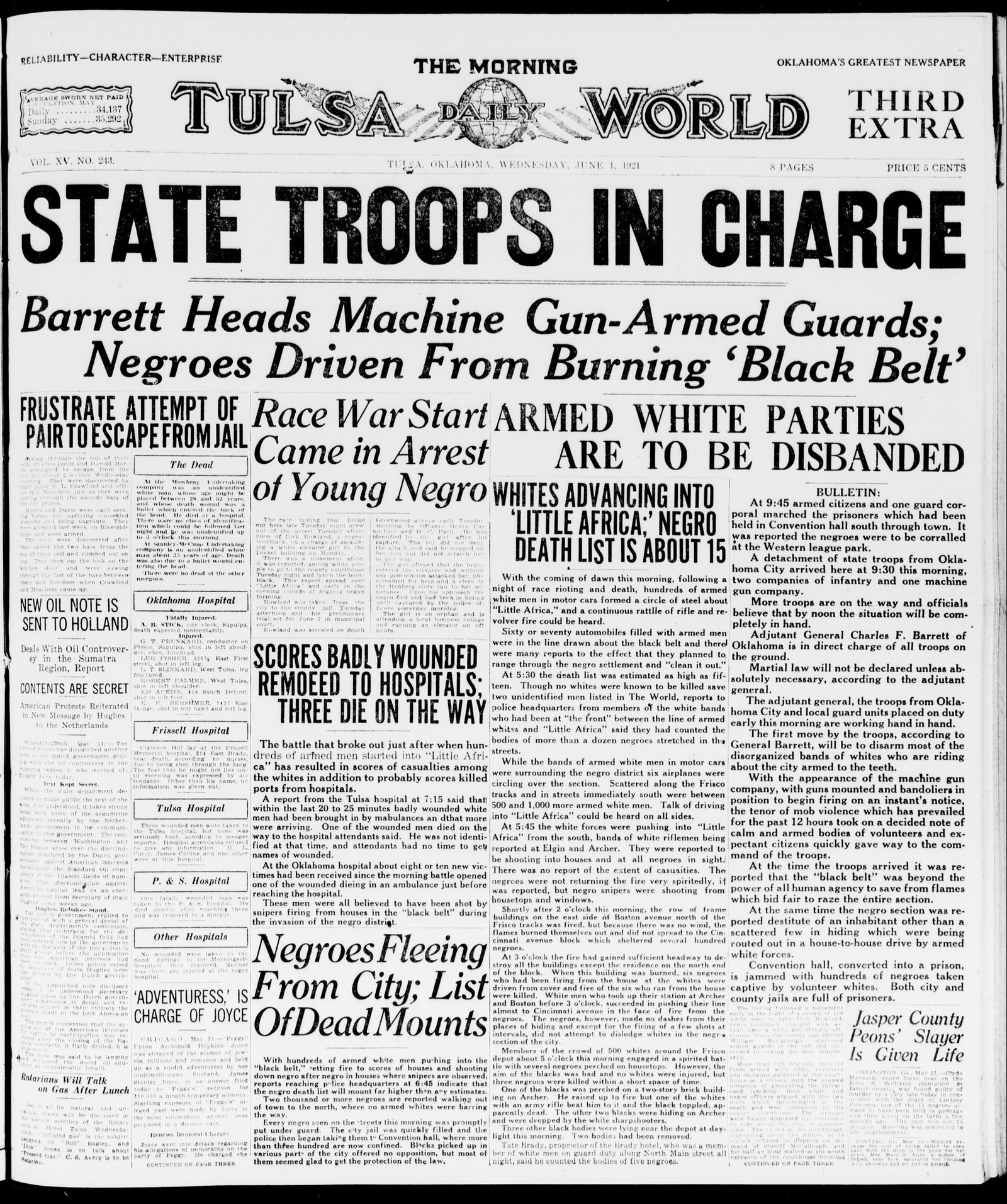
Police arrested Rowland the next morning, May 31. The Justice Department’s 2025 review quotes Police Chief Gustafson saying Page had no scratches, bruises, or disarranged clothing, and it records that she declined to press charges. The accusation outlived those facts. On the afternoon of May 31, the Tulsa Tribune ran a story announcing the arrest of a Black man for attacking a girl in an elevator. According to the Justice Department, the story falsely claimed that Page had been scratched and that she was an orphan.
Many survivors also remembered an editorial in that day’s paper, which the Oklahoma Historical Society says was titled “To Lynch Negro Tonight.” No one has found a copy of the editorial, and Part IV describes what happened to the paper’s archived copy. The Justice Department’s review concludes that whether the editorial existed matters less than the article, which was false and appeared in a city where an accusation like this could get a man killed.
A courthouse with a history
Black Tulsans knew what a mob could do at that building. In August 1920, armed men took Roy Belton, a white teenager accused of killing a taxi driver, from the jail on the courthouse’s top floor and lynched him outside town. The Justice Department reports that police apparently acquiesced and that Chief Gustafson ordered officers not to intervene. The Oklahoma Historical Society says the lynching left Greenwood residents uneasy, even though the victim was white.
Rowland’s own path to that building is better documented than most of what followed. Police arrested him on the morning of May 31 and handed him to the sheriff by 6 p.m., perhaps, the Justice Department says, because the courthouse jail looked easier to defend against a mob than police facilities. The Commission’s narrative places him in the top-floor jail, and the Justice Department adds that his cell was the one that had held Belton. The Commission’s account elsewhere refers to him as in police custody, so the sources describe the same transfer from different angles.
The courthouse confrontation
Sheriff Willard McCullough took the threat seriously. According to the Justice Department, he refused to give up Rowland, disabled the elevator, and posted deputies around the cell.
By about 9 p.m., roughly 25 armed Black men, many of them veterans and some still in uniform, had gone to the courthouse to offer their help. Officers there persuaded them that no lynching would take place, and they went back to Greenwood. Sources differ on who spoke to them. The Oklahoma Historical Society says the sheriff turned down their offer. J. B. Stradford, whose memoir the Oklahoma Commission quotes, said the sheriff first asked Black leaders for help and then told them he could handle it. The Justice Department notes that federal files make the sheriff’s request possible but do not confirm it. A third version, from O. W. Gurley’s account in the Commission’s legal essay, says the sheriff told him there would be no lynching if Black onlookers stayed away from the courthouse.
Some accounts have presented the veterans’ armed arrival as the spark of the massacre. The sequence shows otherwise. A white crowd had already gathered to demand a prisoner, and the Black men went to prevent a lynching.
Around 10 p.m., a false rumor spread that white men were storming the courthouse. About 75 more Black men marched downtown, and by then the white crowd had grown to roughly 2,000, according to the Justice Department. As this second group was leaving, a white man tried to take a pistol from a Black veteran, and a shot rang out. The Justice Department says the common account names a Black veteran and a white man, E. S. McQueen. A second account, from the attorney L. W. Crutcher, says a white man fired into the crowd, and the report blames that man. The accounts agree that a white man tried to disarm a Black man, but they disagree on who fired first, and the Justice Department does not settle the question. A caption on one of the Commission’s maps calls the first shot perhaps unintentional.
What happened next is not disputed. More than twenty people, Black and white, lay dead or wounded after the first exchange. The Black men ran for Greenwood, and white mobs more than twenty times their number chased them.
From confrontation to organized destruction
Through the night, armed white groups attacked Black residents downtown and along the railroad tracks that separated the white business district from Greenwood. Veterans took positions in buildings along the tracks to protect the neighborhood. The Justice Department describes a stand at Mount Zion Baptist Church, the new sanctuary described in Part I, and Stradford’s defense of his hotel.
Fires started along the edge of the Black business district, and white Tulsans organized a dawn invasion of Greenwood. The Justice Department rejects the idea of a disorderly riot. In its words, the attackers were “an organized force that invaded Greenwood.” Its review cites the Oklahoma Commission’s estimate of about 10,000 white participants. It also notes that the National Guard commander’s figure of 25,000 appears to be a misprint for 2,500, so estimates run from a few thousand to about 10,000.
Greenwood’s residents responded in different ways. Some took up arms to defend their homes and neighbors. Others fled with their families or went into hiding. Most had little warning, and few had a safe place to go.
The people under attack were not an invading army. They were Tulsa residents whose homes, shops, churches, and schools stood in the way of an armed mob.
The role of public authorities
The Justice Department’s findings about officials go further than earlier histories did, and they are worth stating carefully.
Deputization. Soon after the courthouse gunfire, police deputized white men, including members of the mob that had come for Rowland. The Justice Department says police deputized about 500 men in under half an hour, many of them drinking, and found no sign that anyone vetted or supervised them. The Oklahoma Commission’s account matches: nearly 500 white men and boys were sworn in at police headquarters, only the police commissioned them, and officials supplied firearms and ammunition to individuals, all of them white. Later, the Oklahoma Supreme Court questioned whether men wearing police badges had acted officially, a ruling the Commission’s legal essay calls biased in favor of the police.
Police. The department was short-staffed because of a shift change, and it did little to disperse the mob. The Justice Department says the evidence suggests police helped plan the invasion, and a hardware store owner said a police captain broke into his store and handed out the weapons.
The National Guard. The Commission lists the Guard’s part in the mass arrests among the facts that are not in doubt. Local units, all white, set up at police headquarters and worked under police command, according to both reports. The Justice Department says they helped form white men into companies, rounded up Black residents, and did not disarm white and Black men equally. The Commission’s narrative says they arrested and disarmed Black men while leaving Greenwood undefended, and that they armed volunteers, many of them American Legion members. Guard officers’ own reports describe their men firing on Black defenders at Sunset Hill and Standpipe Hill. One officer, Lt. Col. Rooney, acknowledged that his men fired but said they did so only when fired upon; that claim is his own testimony. The Commission’s narrative also describes a Guard machine gun firing on Greenwood from Sunset Hill. Conduct varied: Major James Bell refused a white mob’s demand for rifles at the armory. The Oklahoma Historical Society adds that local units spent much of the night guarding a white neighborhood against a Black counterattack that never came. Troops from elsewhere in the state arrived between about 9:00 and 9:15 a.m. on June 1, after most of Greenwood had burned.
Allegations against individual officers. The Justice Department describes witness testimony that some officers took part in arson and murder, including testimony at Chief Gustafson’s later trial that an officer and a civilian were among the men setting fires. The report presents these accounts as allegations. It calls the Gustafson-trial testimony the most persuasive evidence of a police plan to destroy Greenwood, and it adds that this evidence does not conclusively prove police complicity. In testimony the Commission cites, attorney John A. Oliphant said four Tulsa police officers arrived between 10:15 and 10:30 a.m. and set homes on fire; the Commission’s own narrative describes three or four white men, probably special deputies wearing badges, doing so. Legal pleadings alleged that a deputy told men to kill Black residents and that the mayor ordered houses burned. These remain testimony and allegations. The Justice Department found no evidence beyond what it called bare allegations against the mayor. The evidence supports a firm finding about deputization, weapons, and the Guard, and a less certain one about individual officers.
Sheriff McCullough’s refusal to hand over Rowland showed that officials could resist a mob when they chose to. Elsewhere, the people charged with keeping order helped it along. The Justice Department concluded that if today’s civil rights laws had applied in 1921, police officers, public officials, and anyone acting with them could have faced prosecution.
Greenwood burns
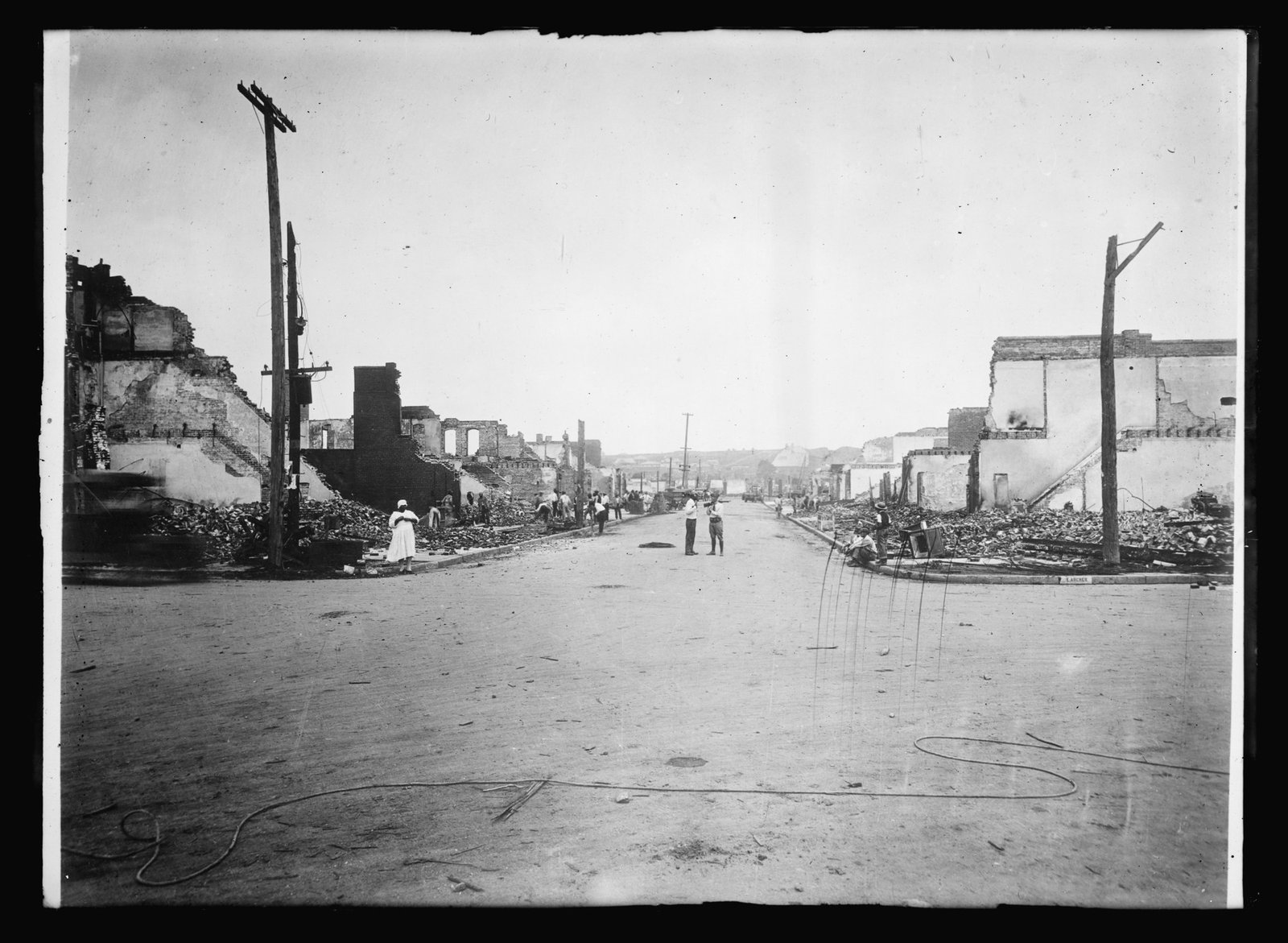
By the morning of June 1, fires covered Greenwood. Armed whites poured into the neighborhood, looting and burning homes and businesses. The Red Cross estimated that white Tulsans burned more than 1,250 houses and looted 215 more. Churches, hotels, restaurants, the public library, and professional offices were lost. The Justice Department puts the destruction at 35 city blocks; the Oklahoma Commission’s overview describes about 40.
Aircraft played a part, though the evidence is weaker than the legend. The Justice Department says it is undisputed that planes tracked Black residents and reported their movements to police. It calls the dropping of incendiary material hotly disputed. The Commission established that civilian aircraft flew over the area and ruled out military planes carrying military weapons. Its aviation analyst, Richard Warner, concluded the planes were probably private or commercial aircraft based in Tulsa, and that accounts of bombing and shooting from the air are numerous but poorly documented. He found shooting and incendiary drops plausible and their effect minor. A Commission chapter agrees that some occupants probably fired rifles and pistols and that dynamite may have been dropped on fleeing refugees, while calling claims of liquid fire technically improbable and noting that ground fires destroyed Greenwood. Dr. R. T. Bridgewater’s testimony describes low flights and a warning that the planes were shooting. Some of the most vivid claims did not survive scrutiny: the Commission found no record of a former officer cited in a nitroglycerin account.
Some of the deaths are documented by name. Dr. A. C. Jackson, introduced in Part I as one of Greenwood’s leading physicians and by then about seventy years old, walked out of his home with his hands raised to surrender. A landowner asked the armed men not to hurt him, and a young white man shot him anyway. Jackson later died of his wounds, according to the Commission at the National Guard Armory, and looters burned his house. A witness described the shooter as a citizen, not a law enforcement officer.
The full toll is unknown, and the numbers fall into three groups. The documented count is small. The official count was 36 dead (ten white and 26 Black, according to the health department figures the Commission cites; another Commission text says nine and 26, which makes 35). The Commission’s forensic anthropologist, Clyde Snow, confirmed 39 deaths from death certificates, 13 white and 26 Black, including a stillborn infant, and found four burned Black bodies that could not be identified. Estimates run much higher. The Commission’s list of established facts describes the dead as “likely numbering between one and three hundred.” Red Cross relief director Maurice Willows suggested a figure near 300, other contributors argue for 150 to 300, and the Oklahoma Historical Society gives 50 to 300. The Justice Department concludes that white Tulsans murdered hundreds of Black residents and that the dead number as many as 300, possibly more.
Why the gap? Death certificates were sometimes signed with blanks, funeral home ledgers list “unidentified Negroes,” and burials were unmarked. Snow confirmed 21 Black victims buried at Oaklawn Cemetery and noted a hypothesis that as many as 150 bodies lie there, which remains a hypothesis. The Red Cross counted about 700 people injured and reported 163 operations in the week afterward, and 18 deaths at its hospital through January 1922 remain unconfirmed.
The losses were financial as well, and the figures vary by source. The Tulsa Real Estate Exchange estimated $1.5 million in property damage and $750,000 in personal property at the time; the Commission’s essay on property loss puts the total near $2 million in 1921 dollars. The Red Cross also counted 314 other buildings looted. Claims against the city exceeded $1.8 million by one Commission count and reached about $4 million by another, and the city disallowed most of them.
Detention and displacement
The violence did not end when the fires died down.
Governor J. B. A. Robertson declared martial law at 11:30 a.m. on June 1. Armed guards held between 4,000 and 6,000 Black Tulsans at the height of the detentions, in camps at Convention Hall, McNulty Park, and the fairgrounds; the Commission also named Golden Gate Park. The Justice Department found that the detentions lacked probable cause or reasonable suspicion; virtually every Greenwood resident was held. Conditions in at least some camps were filthy, with little food.
To leave, a detainee needed a white sponsor to vouch for them and a card. Those who worked in white homes and businesses received a permanent green pass. Unemployed Black workers received a red card good for one day. Anyone caught without a valid card was arrested again, and the system lasted at least a month. A National Guard field order on June 2 required able-bodied Black men in the camp to work for the military and the Red Cross, and some scholars say a number of them never received pay. Guards took firearms from Black men and many Black women, and Black residents could not buy or keep guns for several weeks.
Martial law ended at 5 p.m. on June 3, and the Guard left the next day. The Red Cross took charge of relief, but it could not give money or goods to able-bodied men. Booker T. Washington High School became an emergency hospital. The Oklahoma Historical Society says most displaced residents lived in tents for a year or more, and Part III sets that account beside the Red Cross’s own year-end count. The Commission’s pages put the number left homeless between nearly nine thousand and nearly ten thousand.
Some people left Tulsa. Others stayed and began to rebuild, which Part III covers.
The massacre and the historical record
The evidence includes photographs, newspaper articles, court records, official investigations, property claims, and survivor testimony. These sources often disagree, and several were produced by people with reasons to protect themselves.
The record of what the authorities did afterward shows how this happened. A state grand jury subpoenaed almost 200 witnesses and indicted about 70 people, most of them Black and many of them Greenwood leaders. Most cases were dismissed in September 1921, including the assault charge against Rowland after Page did not appear. The grand jury’s report blamed the Black men who went to the courthouse, and the Commission notes that it found no mob spirit among white Tulsans. A federal agent named Weiss reported within days that no federal violation appeared. The Justice Department notes that although he claimed to have interviewed more than 100 witnesses, he summarized five interviews, all with white men, and included no individual Black witness.
The 2001 Oklahoma Commission report gathered substantial research and established a fuller public account of what happened. The Justice Department’s 2025 review, signed January 9 and posted January 10, was the department’s first full accounting. Taken together, these reviews provide a more precise account than earlier histories. They also show what remains unknown, including how many people died, where they were buried, and how far official participation went.
Accountability: criminal and civil
The central findings stand. White assailants attacked and destroyed Greenwood, public officials and law enforcement helped them, and Black residents were killed, detained, and robbed of their property. What followed in the courts falls into two separate tracks, and they should not be confused.
Criminal proceedings. The Commission found that no white Tulsan went to prison for murder, arson, or larceny; the few criminal cases that went forward were mostly against Black residents. The grand jury did charge Police Chief Gustafson with five counts, including failing to do his duty during the riot and an unrelated conspiracy to free auto thieves and collect rewards. A jury found him guilty on two counts in July 1921, and he lost his job. The surviving records describe that outcome as removal from office; they do not show a prison term. Federal prosecution never happened. The Justice Department says the statutes of limitations for federal civil rights offenses expired long ago, no living perpetrators have been found, and the government could not now produce living witnesses for cross-examination. It adds that no federal hate crime law existed in 1921, and that under today’s laws police, officials, and anyone acting with them could have faced prosecution. It concludes that no avenue of prosecution remains.
Civil proceedings. Here the record is different, because survivors and property owners did sue. The city disallowed most claims presented to it. The Commission counts more than a hundred suits against insurers, the city, and Sinclair Oil, and reports that none succeeded. The Oklahoma Supreme Court decided one insurance case in 1926 on the policy’s riot exclusion, and the remaining cases were dismissed in 1937. Survivors’ modern suits fared no better. In Alexander v. Oklahoma, the federal courts held the claims time-barred, and in Randle v. City of Tulsa, the Oklahoma Supreme Court affirmed dismissal of public nuisance and unjust enrichment claims in June 2024, while calling the plaintiffs’ grievances legitimate. Part V covers both cases. The Justice Department’s review does not reach conclusions about civil liability. The Commission recommended direct payments to survivors and their descendants, and its majority judged reparations appropriate.
In short, the federal criminal path closed through the passage of time and the deaths of witnesses and perpetrators. The civil path closed in different ways at different times. The 1920s suits failed on the terms of insurance policies and on dismissals whose reasons the surviving records do not show. Alexander failed on limitations. In Randle, the Oklahoma Supreme Court ruled on the substance, holding that the public nuisance and unjust enrichment claims as pleaded gave no legal remedy. Those rulings addressed what the law allows, and the Commission and the Justice Department addressed what the evidence shows. Part V covers the modern cases.
Greenwood’s story did not end with its destruction. Survivors had to decide whether they could rebuild what had been taken from them, and that is where Part III begins.
Explore the records yourself
- Justice Department, Review and Evaluation: Tulsa Race Massacre (January 2025): the first federal accounting, with page-referenced sections on the courthouse, deputization, the Guard, detention, and the grand jury. https://www.justice.gov/crt/media/1383756/dl
- Justice Department press release and remarks: https://www.justice.gov/archives/opa/pr/justice-department-announces-results-review-and-evaluation-tulsa-race-massacre
- 2001 Report of the Oklahoma Commission to Study the Tulsa Race Riot of 1921: includes essays, survivor accounts, and the account of the aircraft. https://www.okhistory.org/research/forms/freport.pdf
- Oklahoma Historical Society, timeline of the massacre: https://www.okhistory.org/publications/enc/entry.php?entry=TU013
- Library of Congress, “Tulsa Race Massacre: Newspaper Complicity and Coverage”: how newspapers reported the events. https://blogs.loc.gov/headlinesandheroes/2021/05/tulsa-race-massacre-newspaper-complicity-and-coverage/
- Tulsa City-County Library, Digital Collection for the 1921 Tulsa Race Massacre: photographs, reports, and documents. https://digitalcollections.tulsalibrary.org/digital/collection/p15020coll6
- Mary E. Jones Parrish, Events of the Tulsa Disaster (1922; some catalogs give 1923): a survivor’s account, available through the Tulsa library catalog.
Sources
- U.S. Department of Justice, Review and Evaluation: Tulsa Race Massacre
- U.S. Department of Justice, press release, January 2025
- Oklahoma Commission to Study the Tulsa Race Riot of 1921, Final Report (2001)
- Oklahoma Historical Society, Encyclopedia entry on the Tulsa Race Massacre
- Oklahoma Historical Society, Causes and Catalysts
- Library of Congress, Headlines and Heroes
Next in the series: Part III. Greenwood After the Fire