
Art-directed conceptual editorial illustration created with AI. Figures, buildings, and scenes are illustrative, not documentary reconstructions.
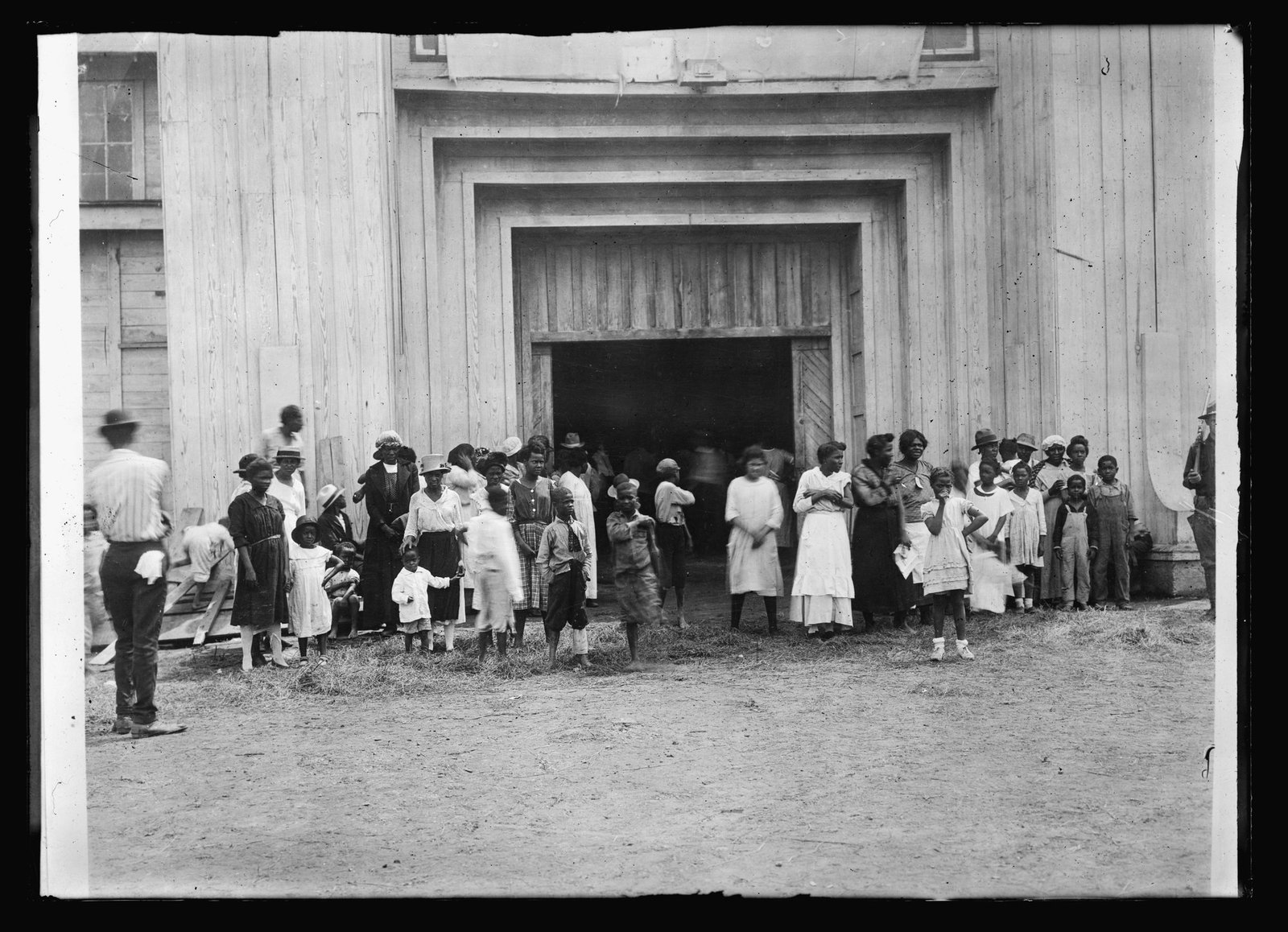
When the fires burned out, Greenwood’s survivors faced a question with no simple answer: where could they go?
The National Archives, summarizing the Red Cross count, reports more than 1,200 buildings burned and more than 10,000 people homeless. The 2001 Oklahoma Commission’s pages give a range of nearly 9,000 to nearly 10,000 homeless, and sources do not agree on a single number. Thousands of residents had spent days in detention camps under armed guard. Families needed food, clothing, medical care, and a place to sleep. Business owners had lost their stock and equipment, and homeowners had lost property that represented years of work and savings. Renters lost their housing too, even though their names never appeared on a deed.
The destruction did not settle Greenwood’s future. Residents who stayed in Tulsa wanted to recover their land, rebuild their homes, reopen their businesses, and restore their churches and schools. They soon learned that city leaders had other plans for the land.
Life among the ruins
On June 2, 1921, Mayor T. D. Evans wrote to the Red Cross, “The responsibility is placed in your hands entirely.” Maurice Willows, a Red Cross relief director from St. Louis, had arrived to assess the city’s needs. According to the Oklahoma Historical Society, the Red Cross had never before run relief after a man-made disaster other than war; Willows persuaded its leaders to treat Tulsa as a disaster area.
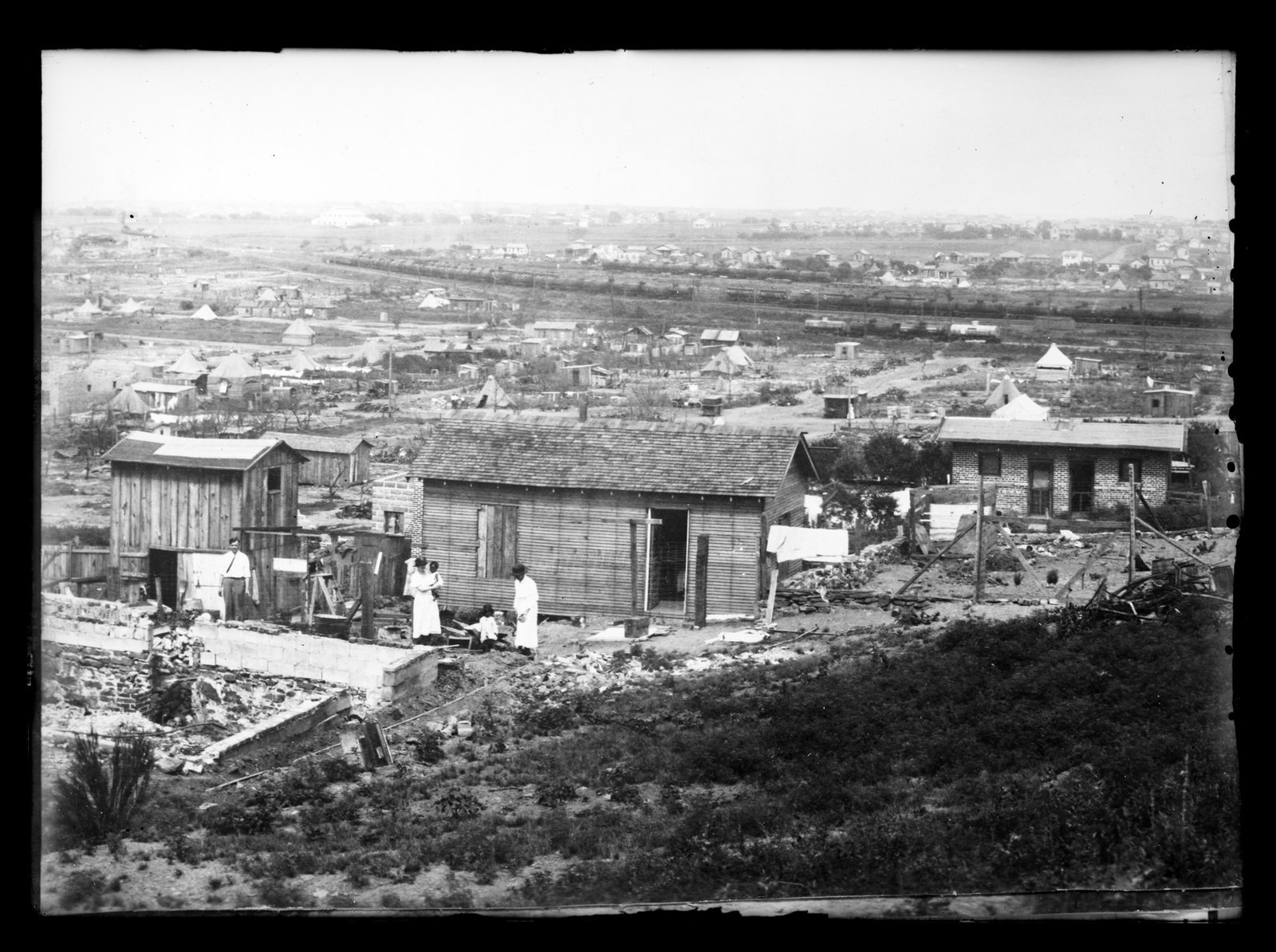
Booker T. Washington High School, one of the few Greenwood buildings the fires spared, became the relief base. Photographs in the Tulsa Historical Society’s collection show a Red Cross hospital on its campus. The Red Cross distributed 384 tents in the first week, and planned to give each a wood floor and later replace the tents with one- or two-room frame structures.
The relief had firm limits. By the Red Cross’s own account, its program rested on the principle of helping Black Tulsans help themselves. Survivors received lumber, but they supplied their own labor. The Justice Department’s 2025 review reports that the Red Cross could not give money to able-bodied men, so it paid them up to 25 cents an hour for work, while meals cost most of them 20 cents. The NAACP also raised money through a Tulsa Relief and Defense Fund, and a Tulsa library exhibit reports that the Red Cross spent nearly $100,000 on relief in Greenwood.
A tent could shelter a family; it could not replace a house. Sources disagree on how long the tents stayed. The National Archives, which holds the Red Cross records, reports that 49 families were still living in tent homes when the Red Cross ended its Greenwood relief on December 31, 1921. The Oklahoma Historical Society says most displaced residents lived in tents for “a year or more,” and the Justice Department reports that many lived in tents or makeshift shelters through the winter of 1921 and 1922, often without floors and in unsanitary conditions. The sources present these accounts without explaining the difference.
Mary E. Jones Parrish preserves the testimony
Mary E. Jones Parrish had moved to Tulsa from the East around 1919, where she taught typing and shorthand at a branch of the YMCA. During the massacre, she escaped with her daughter, Florence.
Afterward, a local interracial committee hired her to collect accounts of what had happened. She gathered testimony from survivors, along with photographs, and combined them with her own story in Events of the Tulsa Disaster. She published it privately in 1922; some library catalogs and recent reporting give 1923, and the sources do not settle the difference. Very few copies were printed, estimated at two dozen or fewer in some accounts and under one hundred in others.
Parrish wrote from inside the community that had suffered the attack. Official statements and newspaper stories of the period often blamed Black residents for the violence. Her book recorded, in their own words, what survivors said they had seen and lost. Trinity University Press reissued it in 2021 as The Nation Must Awake.
A city attempts to reshape Greenwood
Within days of the massacre, some of Tulsa’s leading white residents started planning for the land. According to the Oklahoma Historical Society, the Real Estate Exchange proposed by June 3 that the burned district be rezoned for industrial use instead of rebuilt, and some realtors tried to buy land from Black owners at discounted prices. Willows helped owners keep their property.
On June 7, the city’s Board of Commissioners adopted Fire Ordinance No. 2156. The Justice Department’s review says the ordinance placed most of Greenwood inside the city’s fire limits, where new buildings had to be concrete, brick, or steel and at least two stories high. The review finds that the rules made rebuilding prohibitively expensive for most owners, and it states that the drafters “planned to drive Black people out of Greenwood.” A news article quoted in the report said the land would never again be a Black quarter and would become a wholesale and industrial center.
The ordinance shows how the fight over Greenwood continued after the fires. Residents who had survived the destruction of their property now faced a city policy that threatened their right to return.
A law office in a tent
Attorney Buck Colbert Franklin lost his office in the fires and resumed work from a tent on Archer Street. According to the Justice Department’s review, he worked there with fellow attorneys I. H. Spears and Chappelle to attack the ordinance. The Oklahoma Historical Society reports that the three lawyers urged residents to rebuild despite the threat of arrest, and promised to win the release of anyone jailed for doing so.
The case moved quickly. The Justice Department reports that the lawyers first halted enforcement temporarily on grounds of insufficient notice. In late August, three district judges heard the challenge together, according to a Tulsa Tribune clipping in the Tulsa Historical Society’s collection. On September 2, the Tulsa Daily World reported that the court had held the ordinance unconstitutional and unenforceable. The Justice Department describes the outcome as a permanent injunction, granted in September 1921 on the argument that the ordinance deprived owners of their property rights.
It was a major victory, and Greenwood residents could rebuild on their own land without meeting the ordinance’s costly requirements. It did not return what had been lost or pay anyone for it. It protected one thing: the right to remain on land they already owned.
Franklin and his colleagues did this work for clients who were often poor or displaced, in a legal system that had offered almost no accountability for the violence. A photograph of the tent office survives; the Oklahoma Historical Society’s caption names Franklin, Spears, and their secretary, Effie Thompson, at work there days after the massacre.
Rebuilding without restitution
The financial obstacles did not end with the ordinance.
Many homes and businesses had been insured, but insurers denied claims under the standard riot clause in their policies. Franklin’s firm filed claims worth about $4 million against the city and insurers, according to the Justice Department; the 2001 Oklahoma Commission reports a smaller figure for claims against the city, so the exact total is unsettled. In 1926, the Oklahoma Supreme Court ruled in Redfearn v. American Central Insurance Co. that the riot clause barred suits against insurers over the massacre. Tort suits against the city, the mayor, police, and other defendants were dismissed, and the Justice Department could not find the reasons.
City institutions offered little help. Mayor Evans’s Public Welfare Board gave way to a Reconstruction Committee that, according to the Justice Department, raised no significant funds and paid no reparations. The Justice Department also reports that the board returned a $1,000 contribution from the Chicago Tribune, and the Oklahoma Historical Society says officials refused help from other cities, calling the disaster a “Tulsa affair.”
Here the surviving records shape the story. The Red Cross’s reports are the main source for how many families received help, yet the organization recorded no total of the dead because it had no reliable way to count them. Some documents that would answer basic questions are missing from the available sources: the judges’ written reasoning in the ordinance case and the reasons for dismissing the tort suits. Their absence does not show that anyone removed them; they may be lost, unindexed, or simply not yet found. What we know about reconstruction comes largely from papers kept by the agencies that relieved, insured, and judged Greenwood, and those papers recorded what each agency needed to record.
Residents carried most of the burden themselves. They salvaged usable materials, repaired damaged buildings, and put up new ones. Some owners had savings or credit that others lacked, and renters faced different problems than owners of commercial buildings. Not everyone could afford to stay.
A second life for Black Wall Street
By its own count, the Red Cross had helped 2,480 families in some way by the end of 1921, and more than 700 semipermanent buildings and homes had been rebuilt in the six months after the massacre. The National Archives, which holds the records, notes that the figures do not say how many were new construction and how many were repairs.
Over the following years, the commercial district came back. A new weekly, the Oklahoma Eagle, appeared in the fall of 1922. Theodore Baughman, who had worked at the Tulsa Star, salvaged the burned newspaper’s press and opened an office at 117 North Greenwood Avenue. The Star’s publisher, A. J. Smitherman, fled Tulsa after the massacre and later started a new paper in Buffalo, New York. Edward L. Goodwin bought the Eagle in the 1930s; the Oklahoma Historical Society dates his purchase to 1936, and the paper’s own history gives 1933.
In August 1925, the National Negro Business League held its annual convention in Tulsa. One recent history reports that Greenwood women’s clubs had petitioned the league to meet there, and period press coverage welcomed the delegates. According to a historical marker erected by the Oklahoma Historical Society, Greenwood’s business district reached a new peak in the 1940s.
The revival should not hide the difference between rebuilding and being made whole. Reopened shops did not make up for years of lost income. New houses did not return every family’s possessions. Some residents left Tulsa for good, and others lived with injuries, grief, and memories that no construction could repair.
The achievement belonged to the people who rebuilt. So did the losses.
Another transformation approaches
Greenwood’s recovery did not guarantee that it would last.
According to the Oklahoma Historical Society’s encyclopedia, integration, urban renewal, a changed business climate, and the aging of the district’s early pioneers combined to bring decline from the 1960s through the early 1980s. When Black residents gained access to white-owned stores, they spent money outside Greenwood. The city also used eminent domain to clear parts of the district for an interstate highway; PBS reports that Tulsa demolished the rebuilt Dreamland Theatre in 1960. Sources differ on when the highway work began.
These changes differ from the violence of 1921 and need their own explanation. They fell on a community whose property and savings had already been badly damaged. Understanding them explains why Greenwood cannot be told as a thriving community destroyed once and restored.
What rebuilding could not restore
Greenwood’s rebuilding is often told as a story of resilience. Its residents’ determination deserves that recognition. But resilience is a limited explanation.
Residents rebuilt because they needed homes, jobs, and places to worship and raise their children. They did it while facing an ordinance built to keep them out, insurance denials, failed lawsuits, and a city that gave no meaningful financial help. Their success did not answer who was responsible for the destruction, and it did not repay anyone for lost property, lost family, or lost years.
Their rebuilding showed what the community could do. It also showed how much they had to do without the support or restitution they sought.
That unresolved history carried into later generations, even as many accounts of Tulsa’s past gave the massacre little attention. The next part of the story follows the records that survived, the memories that were kept, and the long effort to bring the massacre back into public view.
Explore the records yourself
- Red Cross relief, National Archives. The blog post “The Responsibility is Placed in Your Hands Entirely” explains the Red Cross reports and lists the relief figures: https://rediscovering-black-history.blogs.archives.gov/2021/05/26/red-cross-relief-after-the-tulsa-massacre/
- Maurice Willows’s Red Cross report, December 31, 1921. Scanned pages with teaching notes: https://www.docsteach.org/documents/document/report-tulsa-massacre-willows
- Library of Congress, Red Cross photographs and relief records. https://blogs.loc.gov/inside_adams/2021/05/tulsa-red-cross/
- “Cannot Enforce Fire Ordinance,” Tulsa Daily World, September 2, 1921. https://www.docsteach.org/documents/document/cannot-enforce-fire-ordinance
- “Blacks Attack New Ordinance Passed by City,” Tulsa Tribune. The lawsuit’s argument, in the newspaper’s words: https://www.docsteach.org/documents/document/blacks-attack-new-ordinance-passed-by-city
- Tulsa Historical Society, August 25, 1921 hearing clipping. https://tulsahistory.pastperfectonline.com/archive/7AB7CD91-F722-4DF7-8076-507100613953
- Mary E. Jones Parrish, Events of the Tulsa Disaster. Excerpts and the 2021 edition: https://lithub.com/king-mob-rule-on-a-first-person-account-of-the-horrific-tulsa-race-massacre-of-1921/
- Alfred L. Brophy, “The Tulsa Race Riot of 1921 in the Oklahoma Supreme Court,” on the fire ordinance, insurance suits, and Redfearn: https://core.ac.uk/download/323046433.pdf
- U.S. Department of Justice, 2025 review. Sections F.6 and F.7 cover the ordinance and the early lawsuits: https://www.justice.gov/crt/media/1383756/dl
Sources
- U.S. Department of Justice, Civil Rights Division, review of the 1921 Tulsa Race Massacre (January 2025): https://www.justice.gov/crt/media/1383756/dl
- Oklahoma Historical Society, The Tulsa Race Massacre, “The Aftermath”: https://www.okhistory.org/learn/trm5
- National Archives, “Red Cross Relief after the Tulsa Race Massacre”: https://rediscovering-black-history.blogs.archives.gov/2021/05/26/red-cross-relief-after-the-tulsa-massacre/
- Library of Congress, Inside Adams, “The Tulsa Race Massacre: Relief and the Role of the American Red Cross”: https://blogs.loc.gov/inside_adams/2021/05/tulsa-red-cross/
- Tulsa City-County Library, 1921 Tulsa Race Massacre exhibit: https://www.tulsalibrary.org/node/233242
- Tulsa Historical Society & Museum, archive records (Red Cross hospital photograph; August 25, 1921 clipping): https://tulsahistory.pastperfectonline.com/photo/17A61190-4272-4FA6-8FD0-177640521233
- Oklahoma Historical Society historical marker, Booker T. Washington High School: https://www.hmdb.org/marker.asp?marker=111510
- Alfred L. Brophy, 54 Okla. L. Rev. 67 (2001): https://core.ac.uk/download/323046433.pdf
- Trinity University Press, Mary E. Jones Parrish author page: https://tupress.org/author/mary-e-jones-parrish
- Oklahoma Historical Society, Gateway to Oklahoma History, Oklahoma Eagle Publishing Company collection: https://gateway.okhistory.org/explore/collections/OKEPC/
- The Oklahoma Eagle, history pages: https://theokeagle.com/?p=21369
- Oklahoma Historical Society, Encyclopedia of Oklahoma History and Culture, “Greenwood District”: https://www.okhistory.org/publications/enc/entry?entry=GR024
- PBS American Experience, “T-Town: Walk Along Black Wall Street”: https://www.pbs.org/wgbh/americanexperience/features/t-town-walk-along-black-wall-street
- Associated Negro Press item, August 14, 1925, on the National Negro Business League in Tulsa: https://nebnewspapers.unl.edu/lccn/00225879/1925-08-14/ed-1/seq-1.pdf
Next in the series: Part IV. Who Kept the Record