

From a secretive lightbulb cartel to the annual automobile makeover, the history of planned obsolescence reveals how replacing usable products became a business strategy.
Your washing machine breaks, and the repair estimate is nearly as much as buying a new one. Your phone still works, but its battery barely lasts the afternoon. Your television is fine, except that one of its apps no longer supports it.
At some point, replacing the whole thing begins to seem easier than keeping it.
How did we get here?
The practice is known as planned obsolescence, and its roots are well documented. The answer stretches back more than a century, through the early electric-light industry, the rise of automobile styling, and a Depression-era proposal to give everyday possessions official expiration dates. Along the way, manufacturers discovered that a product’s useful life depends on more than the materials used to make it.
The lightbulb makers who agreed on 1,000 hours
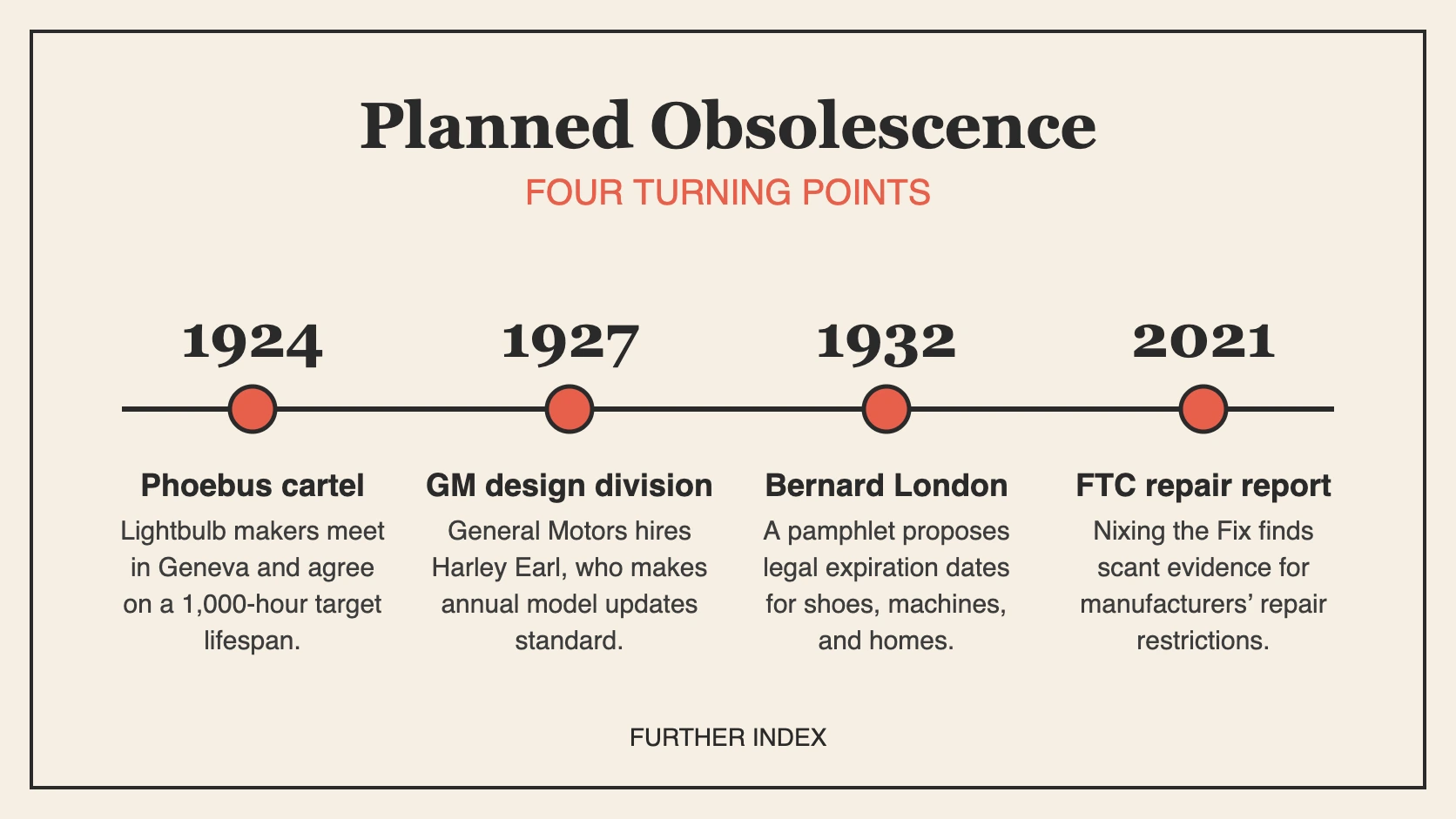
In December 1924, representatives of major electric-light manufacturers met in Geneva, Switzerland. They included Germany’s Osram, the Netherlands’ Philips, and France’s Compagnie des Lampes; General Electric took part through its overseas subsidiaries.
Together they established an international organization known as the Phoebus cartel.
The companies coordinated markets, production, and technical standards. One of their most consequential decisions concerned how long an ordinary incandescent lightbulb should last.
By early 1925, the group had adopted a target lifespan of 1,000 hours for standard household bulbs. Many earlier bulbs had lasted considerably longer.
This was no informal agreement. Manufacturers submitted samples for testing, and companies whose bulbs fell outside the prescribed standards faced financial penalties.
Historical research based on corporate records shows that the cartel worked deliberately to reduce bulb lifespans. Markus Krajewski’s investigation, published in IEEE Spectrum, documents how the average life of the cartel’s reference bulb fell from about 1,800 hours in 1926 to 1,205 hours by 1933–34.
There was a technical complication. Incandescent bulbs involve trade-offs between brightness, electrical efficiency, and longevity. A filament designed to burn hotter can produce more light but wear out faster.
That means a shorter-lived bulb is not automatically evidence of manipulation. The significant fact about Phoebus is that manufacturers coordinated lifespan targets and enforced them, while also pursuing commercial objectives.
The cartel eventually collapsed amid economic, legal, and wartime pressures. But its records provide an unusually clear example of planned obsolescence: businesses deliberately managing how long a product would remain usable.
When a perfectly good car started looking old
Around the same time, American automobile manufacturers discovered another way to encourage replacement.
A car did not have to stop working to become undesirable.
In the 1920s, General Motors, under president Alfred Sloan, began developing the annual model change as a commercial strategy. New styling, colors, and body details gave customers a reason to consider replacing vehicles that still performed their basic functions.
In 1927, GM hired designer Harley Earl to lead a new design division, and Earl went on to make annual updates to each model an industry standard. The approach helped establish a familiar feature of consumer culture: the new model year.
Some design changes introduced real improvements in comfort, safety, or performance. Others were largely cosmetic.
For consumers, the two could be hard to distinguish amid the excitement around a new product.
A car from the previous year might still be mechanically sound. Its appearance, however, could announce that it belonged to yesterday.
This was a different form of planned obsolescence from the lightbulb cartel’s. Rather than shortening a product’s physical lifespan, manufacturers could shorten the period during which people considered it desirable.
The man who wanted expiration dates for everything
In 1932, with the United States struggling through the Great Depression, a New York real estate broker named Bernard London published a pamphlet titled Ending the Depression Through Planned Obsolescence.
London wanted the government to assign official lifespans to manufactured goods. Once a product reached its expiration date, it would be legally “dead,” and a government agency could destroy it, particularly when unemployment was high.
He envisioned this applying to an enormous range of possessions, including shoes, machines, and homes.
London believed that people keeping their possessions for longer contributed to falling demand, reduced production, and unemployment. He argued that forcing a regular cycle of replacement could stimulate economic activity.
The government never adopted his proposal as a nationwide policy. It also should not be mistaken for the origin of every later practice called planned obsolescence. Manufacturers were already experimenting with ways to influence product lifespans and replacement cycles.
Still, London’s pamphlet is revealing because it states an economic argument with unusual bluntness: continued consumption could be treated as something society needed to organize, even when existing goods remained useful.
It raises a question that remains relevant today. When economic growth depends partly on selling more products, what incentive does a manufacturer have to make something that rarely needs replacing?
Planned obsolescence comes in different forms
The term planned obsolescence is often used as though it describes one deliberate trick. In practice, several different processes can lead consumers to replace products.
Physical obsolescence occurs when a product wears out or fails. Deliberately selecting components with limited durability can contribute to this, but ordinary wear and engineering trade-offs can produce similar outcomes.
Style obsolescence happens when fashion or design changes make a functional product seem outdated. The annual automobile makeover is a classic example.
Technological obsolescence occurs when newer technologies make older products less useful, compatible, or capable. Sometimes that reflects genuine progress. Sometimes a product loses functionality because the manufacturer withdraws support or compatibility.
Repair-related obsolescence arises when fixing a product becomes difficult or uneconomical because parts, tools, documentation, or service options are unavailable or restricted.
These distinctions matter. A device that fails after five years has not necessarily been designed to fail after five years. Proving deliberate intent requires stronger evidence than a frustrating ownership experience.
The Phoebus cartel is historically significant precisely because its own documents survive and show the coordination.
Why fixing things became so difficult
Consider a modern smartphone.
Its processor may still be capable, its screen undamaged, and its camera perfectly adequate. But if the battery deteriorates and replacement is expensive or inconvenient, buying another phone can begin to look attractive.
Repair barriers, a modern route to planned obsolescence, are not confined to phones.
In 2021, the U.S. Federal Trade Commission published Nixing the Fix, a report examining restrictions on consumer repairs.
The agency identified practices including limited access to replacement parts and repair information, unavailable diagnostic software, and product designs that make components difficult to replace.
Manufacturers sometimes defend restrictions by citing safety, intellectual property, or product quality. Those concerns can be legitimate in particular circumstances, but the FTC found “scant evidence” to support manufacturers’ justifications for the restrictions it examined.
When repair becomes expensive or inaccessible, consumers may replace products sooner than they otherwise would. Independent repair businesses can also struggle to get the materials and information they need to compete.
A functioning product may become effectively unusable because one component cannot be repaired at a reasonable cost.
The environmental cost of replacing everything
Every replacement has a material history.
Manufacturing a new device requires raw materials, energy, transportation, and labor. Discarded electronics can contain valuable recoverable metals alongside substances that require careful handling. Our guide to tracing the origins of the products you buy shows how to follow that history.
Resisting planned obsolescence by keeping a product longer can reduce the need for new manufacturing, although the environmental calculation varies by category.
An older appliance that consumes substantially more electricity, for example, may eventually be less environmentally efficient than a newer replacement. The new product’s manufacturing impact must be weighed against its operating savings.
That is why the sensible question is rarely whether old products are always better.
It is whether replacement delivers enough genuine benefit to justify its financial and environmental costs.
Can consumers push back?
The growing right-to-repair movement challenges restrictions that prevent owners and independent technicians from fixing products, a quiet driver of planned obsolescence.
Its goals commonly include access to spare parts, repair manuals, diagnostic tools, and software needed to complete legitimate repairs.
For consumers, the practical questions begin before a purchase.
Can the battery be replaced? Are spare parts available? Does the manufacturer publish a software-support period? Can an independent repair shop service the product? What will it cost to fix a common failure?
Those questions may tell you more about long-term value than the newest feature on the box.
Price matters, but so does the total cost of owning something over time. A cheaper product that must be replaced repeatedly can ultimately cost more than a durable, repairable alternative. For more on looking past the sticker, see our guide to finding the real price of products.
None of this means every consumer should keep every possession indefinitely. People replace products for perfectly reasonable reasons, including accessibility, safety, changing needs, and meaningful technological improvements.
The point is to make replacement a choice rather than an unavoidable consequence of poor durability or restricted repair.
Who decided?
No single meeting saw businesses collectively decide that everything should become disposable. Planned obsolescence emerged piece by piece.
Instead, different industries developed different ways to encourage repeat purchases. Lightbulb manufacturers coordinated lifespans. Automobile companies used styling to stimulate demand. Bernard London proposed making replacement an explicit government policy. Modern manufacturers have sometimes restricted how consumers can repair their purchases.
These examples do not describe identical practices, and they do not establish that every manufacturer practices planned obsolescence by deliberately engineering premature failure.
They do reveal a persistent tension between selling more goods and helping people get the longest useful life from the goods they already own.
The next time something breaks, the most revealing question may be whether the product has truly reached the end of its useful life, or whether repairing it has simply become too difficult.
Further Reading and Sources
- Markus Krajewski, “The Great Lightbulb Conspiracy,” IEEE Spectrum. Historical investigation of the Phoebus cartel and its corporate records.
- Encyclopaedia Britannica, “Harley Earl.” Biography of the General Motors designer who made annual model updates an industry standard.
- Bernard London, Ending the Depression Through Planned Obsolescence (1932). Original pamphlet, available through Project Gutenberg.
- Federal Trade Commission, Nixing the Fix: An FTC Report to Congress on Repair Restrictions (2021).