
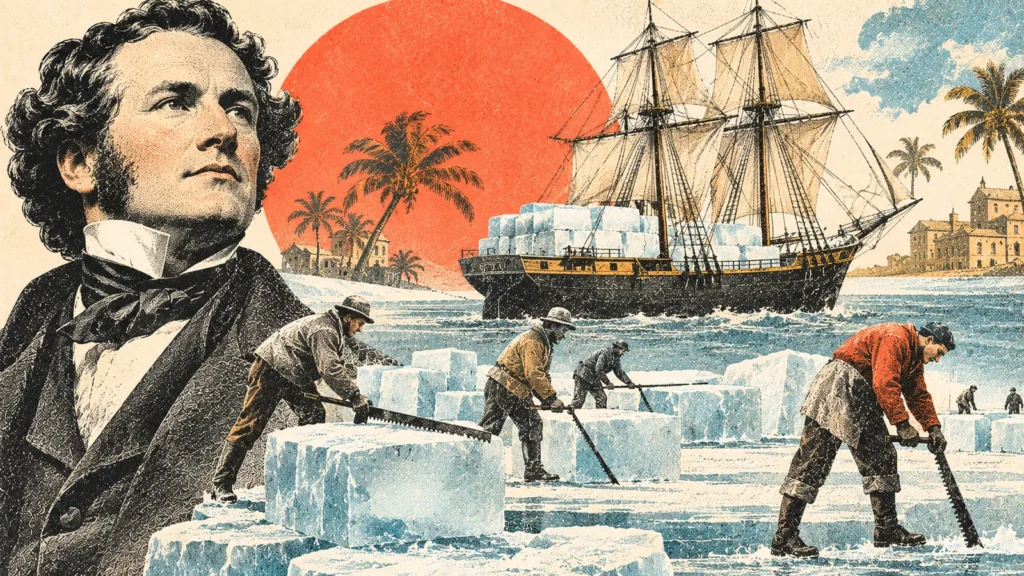
In September 1833, a ship carrying ice from New England arrived in Calcutta, then a major British-ruled city in India. Its cargo had crossed the Atlantic, rounded the Cape of Good Hope, and sailed into the Indian Ocean. The journey took about four months, and much of the ice melted along the way. Yet enough survived to be sold in a city where the climate made natural ice an extraordinary luxury.
The shipment was part of a business Frederic Tudor, a Boston merchant, developed after nearly three decades of trying to persuade people in warm climates to buy frozen water. His idea was simple but commercially improbable: harvest ice during New England winters, preserve it in insulated ships and warehouses, and sell it in places where lakes never froze.
Watch the short version.
Frederic Tudor became known as the Ice King. His business helped create an international market for a product that had once seemed impossible to move across oceans. But the story involves more than one determined entrepreneur. It also includes the workers who cut the ice and the colonial economies that made its sale profitable.
A business built on disappearing products
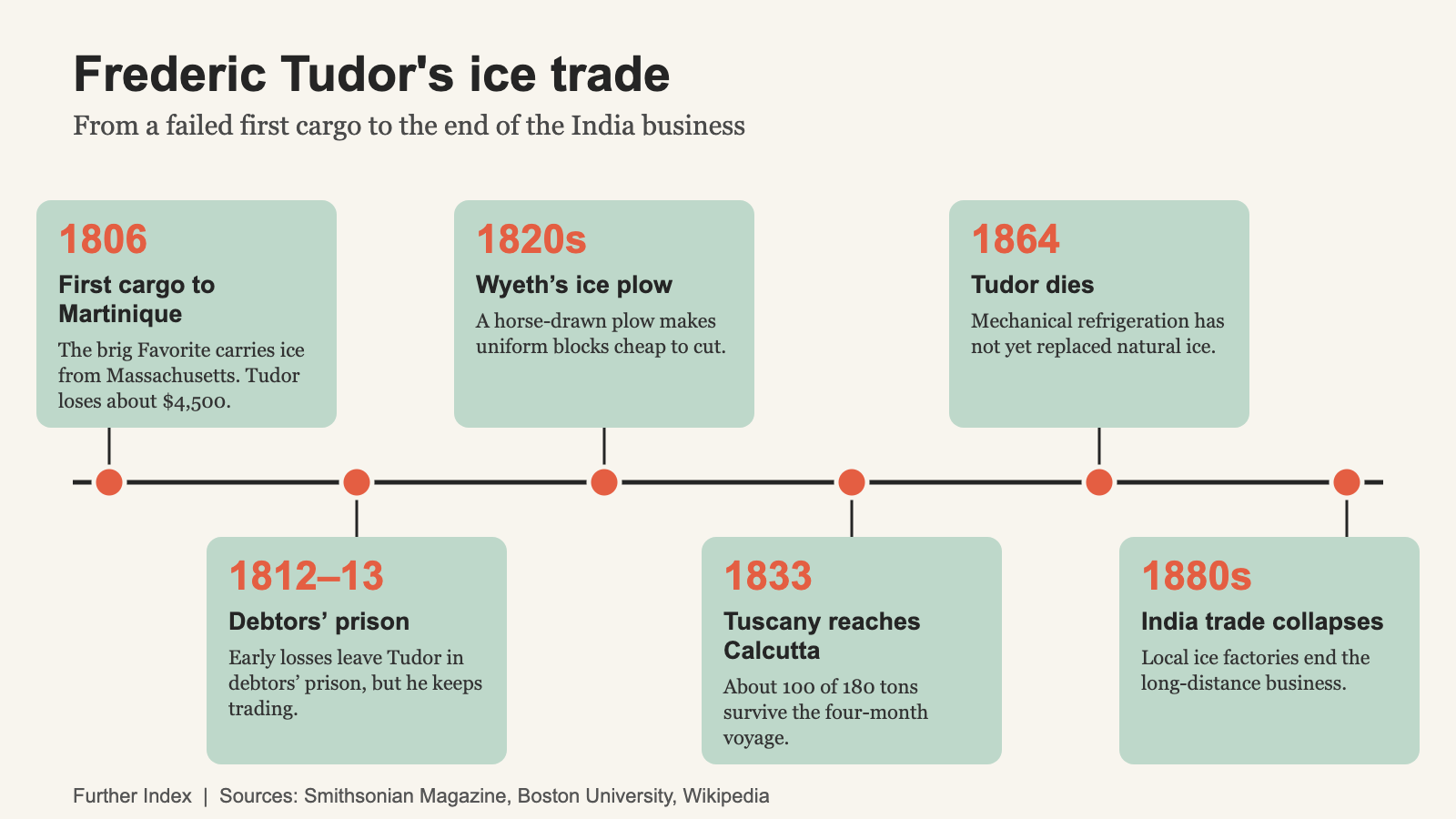
Frederic Tudor began his ice-exporting venture in 1806, at 23. He bought a brig, the Favorite, loaded it with ice cut from his father’s farm in Saugus, Massachusetts, and sailed for Martinique in the Caribbean.
The venture was a financial gamble. Ice was heavy, expensive to ship, and hard to store. Much of this first cargo melted on the roughly three-week voyage, and with no icehouse in port, the rest was hard to hold and sell. By most accounts, Tudor lost about $4,500 on the trip.
Demand was also a problem. People in warm climates knew how to cool food and drinks, but a regular commercial supply of natural ice was new to many markets. Tudor had to find customers and build storage while managing a product that shrank every day.
His early ventures brought heavy losses, and his debts landed him in debtors’ prison in 1812 and 1813. He kept experimenting with shipping, insulation, storage, and pricing anyway. Over time, he expanded beyond the Caribbean into the southern United States and, eventually, India.
The enterprise depended on solving two problems at once. Tudor had to keep the ice from melting before it arrived, and he had to find customers willing to pay enough for the surviving cargo to cover everything that melted along the way.
How do you ship a frozen pond across the ocean?
The ice trade relied on a useful physical fact: a large mass of ice melts more slowly, relative to its volume, than many small pieces exposed separately to warm air. Packing blocks tightly together reduced the surface exposed to heat, and insulation slowed the heat that did reach them.
Early ice merchants tried many ways to protect their cargo. Sawdust, a free byproduct of the lumber industry, proved especially useful. Packed around the blocks, it trapped air and slowed how quickly heat reached the ice.
The ice also had to be cut and packed efficiently. Workers harvested it from frozen ponds and lakes during the winter, using specialized tools to score the surface into regular blocks. Horses, cutting equipment, and coordinated crews turned a seasonal chore into a commercial operation.
One key figure was Nathaniel Jarvis Wyeth, who grew up beside Fresh Pond in Cambridge and worked for Tudor in the 1820s. His horse-drawn ice plow made it easier to produce uniform blocks. Standard-sized pieces packed tightly into icehouses and ships, cutting wasted space and making storage far more efficient.
The technology was clever, but the principle was simple. The merchants were not creating cold. They were conserving the cold that a New England winter had already produced.
The long voyage to India
The 1833 shipment to Calcutta showed how far the trade could reach. The ship Tuscany left Boston on May 12 with about 180 tons of ice. It reached the Ganges in September, roughly four months and 16,000 miles later, with about 100 tons still frozen.
For European residents of colonial Calcutta, imported ice offered a luxury that had been hard to get reliably. It could cool drinks, preserve certain foods, and bring relief in the hottest months. Demand led to specialized icehouses, where imported blocks could be stored and sold after a ship arrived. Tudor eventually built icehouses in Madras and Bombay as well.
The business also reflected the inequalities of colonial society, a theme that runs through The Great Hedge of India as well. Ice shipped from thousands of miles away was costly, and its commercial success depended on customers with money to spend. Wealthy buyers had a very different experience from the workers who unloaded the cargo, hauled the blocks, and maintained the storage buildings.
Over time, ice became affordable to more people in some markets. Its early arrival in India, though, was closely tied to colonial trade networks and the spending power of privileged consumers.
For Frederic Tudor, the shipment proved that a frozen product could survive an ocean crossing and still find buyers on the other side of the world.
The workers behind the Ice King
Accounts of the nineteenth-century ice trade often focus on Frederic Tudor’s determination. The industry, however, ran on physical labor.
Henry David Thoreau saw some of it at Walden Pond in Concord, Massachusetts. He wrote that about 100 Irishmen came from Cambridge every day to haul out the ice, and he noted that water from his pond reached distant cities, Calcutta among them.
Harvesting began when the ice was thick enough to cut. Workers cleared snow, marked the surface into sections, and used saws and cutting tools to separate large blocks. They then hauled the ice from the water, moved it into storage, and packed it for shipment. The work was cold, wet, and often dangerous.
Icehouses needed careful construction and upkeep. Ships were loaded with heavy cargo that would shrink during the voyage. At the destination, dockworkers and delivery crews had to move the remaining blocks quickly into insulated storage.
The business also benefited from developments outside Frederic Tudor’s control. Better transportation, harvesting equipment, and storage buildings helped the industry grow. Other merchants entered the trade, and competition produced new ways to distribute ice.
By 1847, 353 ice-laden vessels left Boston Harbor, carrying almost 75,000 tons of ice, according to figures cited by Boston University. By the mid-19th century, natural ice had become an important commercial product in the United States and several overseas markets.
When cold became a commodity
Before mechanical refrigeration, people relied on many methods to keep food cool or preserve it. Salting, drying, smoking, fermentation, underground storage, and seasonal ice collection all played important roles. Ice was valuable, but getting it depended on geography, climate, and access to storage.
Commercial ice harvesting changed that. A winter in Massachusetts could supply a customer in a distant tropical port. The seasonal cold of one region became something that could be packaged, shipped, priced, and sold elsewhere.
The trade also changed expectations. Once people could buy ice regularly, they found new uses for it, from cold drinks and food storage to commercial distribution and medicine.
In the United States, ice delivery eventually became a familiar part of city life. Households used insulated iceboxes, and delivery workers brought blocks to customers who needed to refill them. The icebox was an important ancestor of the electric refrigerator, although it still depended on a steady supply of harvested or manufactured ice.
The growth of this market shows how a new commercial service can reshape everyday habits. What begins as an expensive novelty can become something people organize their lives around.
The invention that changed everything
Natural ice harvesting stayed a substantial industry well into the era of mechanical refrigeration. The change came gradually, and different places adopted new technology at different rates.
Mechanical refrigeration made it possible to produce ice without waiting for winter or importing it from a colder climate. Refrigeration systems also let businesses cool spaces and preserve products without relying only on deliveries of natural ice.
These technologies eventually undermined the economics of long-distance ice shipping. A factory that made ice near its customers could avoid many of the costs and risks of harvesting frozen ponds, loading ships, and losing cargo to melting. Frederic Tudor’s Indian business, which had operated in Calcutta, Madras, and Bombay, collapsed in the 1880s as commercial refrigeration spread.
Domestic electric refrigerators later transformed household food storage and reduced dependence on the neighborhood ice delivery. The shift took decades, but the direction was clear: artificial refrigeration offered a more controllable source of cold.
Frederic Tudor died in 1864, before mechanical refrigeration had fully transformed the market he helped create. His achievement belonged to an unusual period when the world’s demand for cooling could be met, in part, by moving winter from one place to another.
What the ice trade tells us about technology
The international natural-ice trade seems almost absurd today. Why ship frozen water thousands of miles when machines can make it locally? That question assumes technologies that were unavailable or impractical when Frederic Tudor started.
In the early nineteenth century, harvesting and shipping ice was one of the few ways to supply large quantities to tropical markets. The system was expensive and imperfect, but it worked well enough to support a growing industry.
The story also shows that successful technologies do not always last. Natural ice harvesting became more efficient, developed specialized equipment, supported international shipping routes, and created new consumer habits. Many of those achievements built demand that later refrigeration technologies satisfied more effectively. We also explore this pattern in Who Decided We Should Replace Things That Still Work?, where older products give way to newer ones for reasons that go beyond whether they still work.
Today, cooling is so familiar that its infrastructure is easy to overlook. Refrigerators hum in kitchens, refrigerated containers carry food across oceans, and temperature-controlled warehouses support global supply chains. These systems use energy and require constant maintenance, but they enable kinds of food distribution that earlier generations could barely imagine.
Two centuries ago, a cold drink in a tropical city might depend on workers cutting a pond in Massachusetts, sailors crossing an ocean, and merchants keeping a shrinking cargo frozen for months.
For a brief period in history, winter itself was an export.
Further Reading and Sources
- Smithsonian Magazine, “The Ice King Cometh: Frederic Tudor, Father of the Ice Industry.” A profile of Tudor and the origins of the ice trade.
- Boston University, “Tracing the History of New England’s Ice Trade.” Includes Boston’s 1847 export figures and the labor behind the trade.
- Henry David Thoreau, Walden (1854). The chapter “The Pond in Winter” describes the ice cutters at Walden Pond. Available through Project Gutenberg.
- Frederic Tudor, Wikipedia. Dates and figures for the Martinique and Tuscany voyages.