
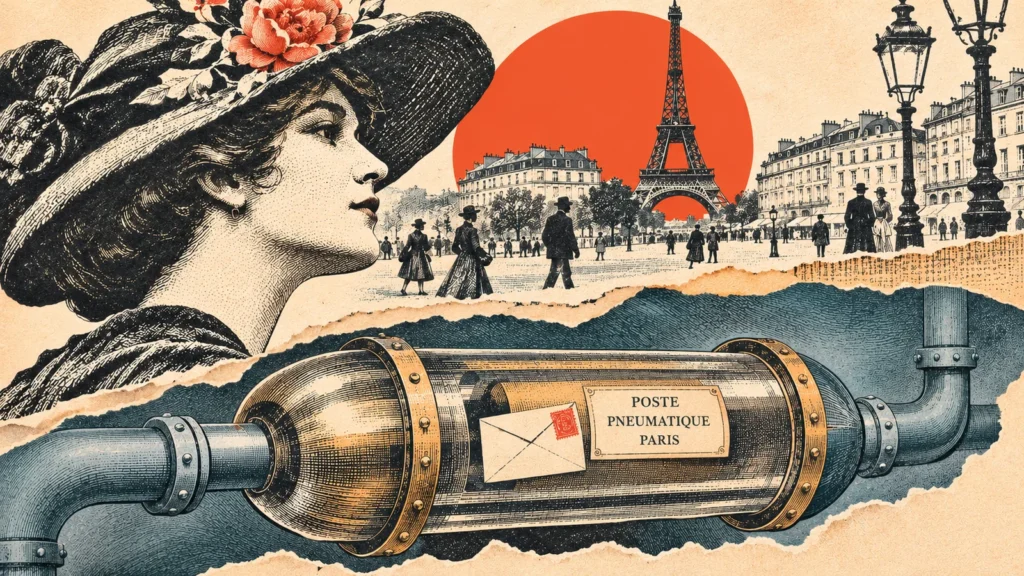
For more than a century, cities used compressed air to send letters beneath their streets. Paris built an underground communications network that survived until 1984.
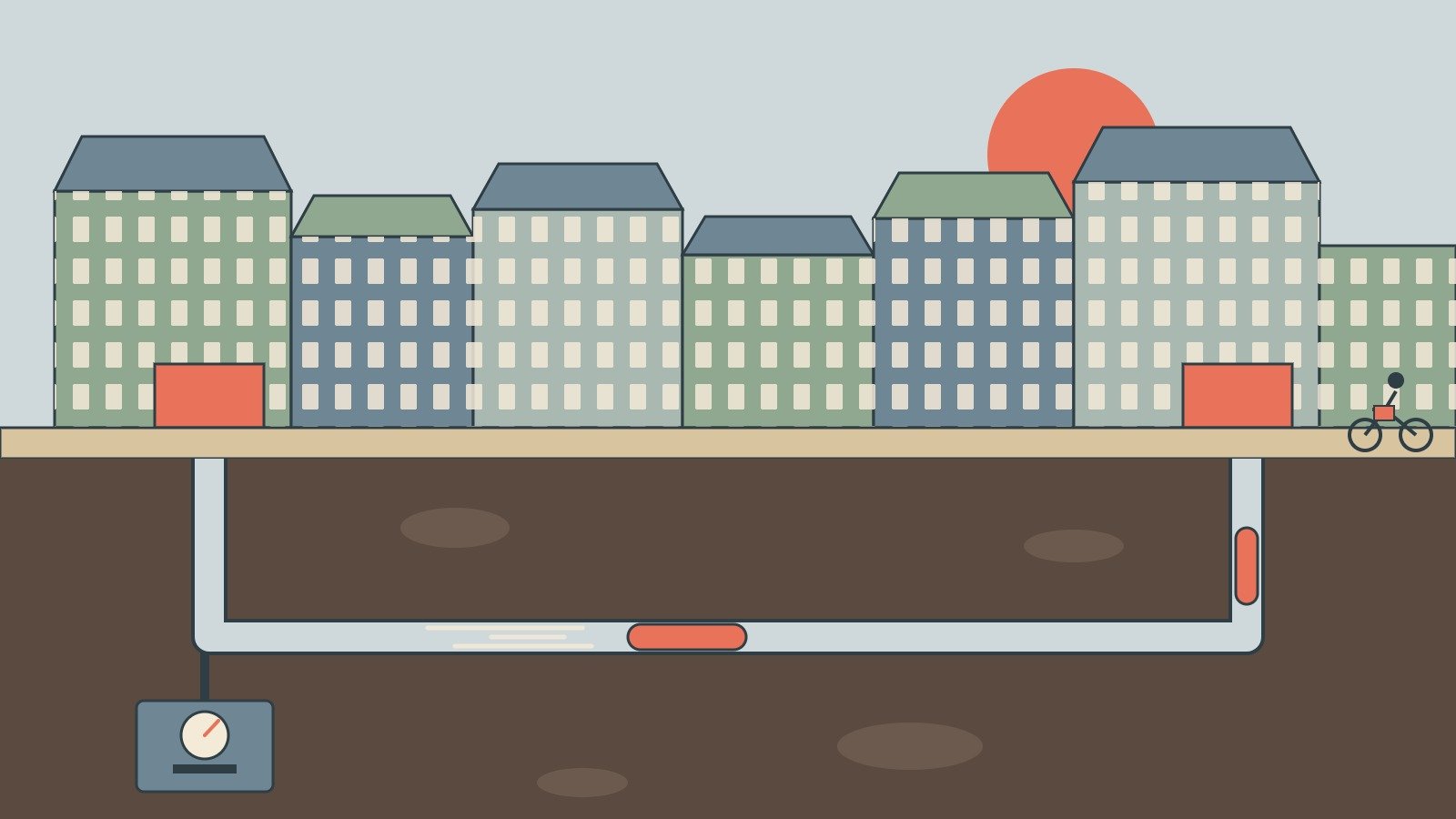
Imagine Paris in 1900. You have a message that cannot wait for tomorrow’s mail. Perhaps it’s a business instruction, an invitation, or a note to someone you love. You write it down, take it to a postal counter, and pay for delivery. A postal worker places your message inside a cylindrical carrier, seals it, and loads it into a pipe. A burst of compressed air sends the carrier speeding beneath the streets.
At the receiving station, another worker retrieves the message. A messenger takes it the rest of the way to its destination. This was the poste pneumatique, Paris’s pneumatic postal system. For generations, it moved written messages through an underground network of pipes. Its customers included businesses, government offices, journalists, and ordinary Parisians who wanted to communicate quickly.
Paris began experimenting with pneumatic mail in 1866. The service would outlast two world wars, the invention of the telephone, and the arrival of personal computers. Long before email, cities had already learned how to send messages through networks that most people never saw.
The idea was surprisingly simple
Pneumatic transport relies on a straightforward principle: air pressure can move an object through a tube.
Imagine placing a small cylinder inside a pipe that fits it closely. Increase the pressure behind the cylinder, or reduce the pressure ahead of it, and the difference pushes the cylinder along. With enough pressure, a properly designed pipe, and a reliable way to load and retrieve carriers, the same principle can move documents between buildings.
The difficult part is turning that principle into a transportation system. Engineers needed machinery to generate pressure or suction, stations where carriers could enter and leave the network, and pipes that could handle repeated journeys without excessive leaks or blockages. They also needed to know where each carrier was going.
Unlike an electrical signal, a pneumatic carrier occupies physical space. It has weight, takes time to travel, and must be collected at the other end. Multiple carriers require coordination, particularly where routes connect or share equipment. For short distances, the system offered an extraordinary advantage: messages could move between stations without waiting for a person or vehicle to carry them through the streets.
In a crowded nineteenth-century city, that was a compelling proposition.
Paris builds an underground messaging network
Paris began testing pneumatic transport in 1866, initially as a short line connecting telegraph offices. The connection to the telegraph is important.
By the mid-nineteenth century, electrical telegraphy had transformed long-distance communication. Messages could travel across countries in minutes, but a telegram still had to reach a telegraph office and be delivered to its recipient. Pneumatic tubes offered a way to move written messages between offices within the city.
The early network expanded, and in 1879 the service opened to private correspondence. Parisians could send specially formatted messages through the system, with postal workers handling the underground journey and messengers completing delivery aboveground.
One familiar form was the petit bleu, a blue-colored message associated with the service. At its peak, the network extended for more than 400 kilometers beneath Paris. Its pipes connected postal facilities across the city, making the pneumatic post a distinctive part of urban communications.
A message could begin its journey in a neighborhood post office, travel beneath busy boulevards, and emerge in another district, all while the sender went about the rest of the day.
What was it like to send a pneumatic message?
For the customer, the process was relatively ordinary. You wrote a message using the appropriate postal stationery and handed it over for dispatch. The postal service took responsibility for routing it through the network and delivering it to the recipient.
Behind the counter, the process was more elaborate. Workers organized correspondence, loaded carriers, operated equipment, received incoming capsules, and arranged the final delivery.
The tubes could transport messages between stations quickly, but the complete service still depended on human labor. A pneumatic message did not simply appear in someone’s home. It had to be processed, dispatched, received, sorted, and delivered.
That distinction matters when we compare the system with modern digital communication. The underground portion could be remarkably fast. The entire journey, however, included the time needed to get the message into and out of the network.
Even so, the service was useful enough to become part of Parisian life for more than a century.
London had an even bigger ambition
Paris was not the only city experimenting with compressed air. London developed pneumatic transport systems during the nineteenth century, including the London Pneumatic Despatch Company’s ambitious attempt to move mail and small parcels through large underground tubes.
The company was formed in 1859, and its line between Euston Station and a nearby postal office opened in 1863. Unlike the smaller tubes used primarily for messages, the London system was designed around wheeled vehicles traveling through substantial underground pipes.
The concept was bold: instead of sending individual letters through a narrow tube, engineers hoped to move larger quantities of mail through dedicated tunnels powered by air pressure. The company built routes connecting postal and railway facilities, showing that air pressure could move heavier loads.
But the system never became a permanent part of London’s postal infrastructure, and the company ended its operations in 1874. London’s engineers proved that air could move mail beneath a busy city. Making the system pay for itself was another matter.
Building underground routes was expensive, and the network needed enough traffic to justify its construction and operation. The dream of air-powered urban transport was much larger than the practical network that emerged.
New York sent mail beneath the streets
Across the Atlantic, New York developed its own pneumatic mail system. It began operating in 1897, connecting postal facilities in Manhattan. The network later expanded to Brooklyn, including a route across the Brooklyn Bridge.
The American system was designed to move mail in bulk rather than individual handwritten messages. Each carrier could hold hundreds of letters, and compressed air propelled it between postal stations.
According to the Smithsonian National Postal Museum, carriers traveled up to 35 miles per hour. That sounds startling for something moving through a pipe beneath a city.
The advantage was particularly clear on congested routes. A journey that might take a mail wagon many minutes could be completed through the tubes in a fraction of the time. Other American cities adopted pneumatic mail too, including Philadelphia (which started first, in 1893), Boston, Chicago, and St. Louis.
For a period, pneumatic mail seemed to offer an answer to a persistent urban problem: how to move large quantities of correspondence through crowded streets without relying entirely on surface transportation.
The engineering came with complications
The tubes were fast, but the infrastructure was costly. Pipes had to be installed beneath developed streets, maintained, repaired, and connected to suitable postal facilities. The system could carry only what fit inside its carriers. Large parcels and irregularly shaped objects still required other methods.
Its routes were also relatively inflexible. A delivery truck could take a different street or serve a newly developed neighborhood. A buried pipe could not change its destination without construction work.
As cities expanded and postal operations evolved, these limitations became increasingly important. New York’s pneumatic mail system ceased operation in 1953. The underground routes had once represented an ingenious response to urban congestion. Eventually, more adaptable transportation methods proved easier to operate at scale.
Why did Paris keep its system until 1984?
Paris’s pneumatic post lasted much longer. By the twentieth century, the city had developed an extensive network and an established customer base. For people who needed rapid written communication within Paris, it remained a familiar option. But the world around the tubes was changing.
Telephones allowed people to speak directly across the city. Later, telex and other electronic communications systems provided new ways to transmit written information. Maintaining a physical network of pipes, compressors, stations, and delivery workers became increasingly difficult to justify.
The system’s great advantage had always been speed between connected stations. Newer technologies could transmit information without moving a physical object. On March 30, 1984, Paris’s pneumatic postal service closed. It had survived for more than a century, spanning an extraordinary period of technological change.
By the time the service ended, personal computers were entering homes and offices. The underground messaging network belonged to both worlds: the age of industrial machinery and the emerging age of digital communication.
The tubes didn’t disappear everywhere
The decline of citywide pneumatic mail didn’t mean pneumatic transport became useless. Walk into a modern hospital, and you may find a descendant of the same technology. Hospitals use pneumatic tube systems to move small physical items between departments. Depending on the facility and its procedures, those items can include laboratory specimens, medications, and other materials that need to reach another location promptly.
A carrier enters a station, travels through a network of pipes, and arrives elsewhere in the building. The principle would be recognizable to a nineteenth-century pneumatic engineer. The difference is the setting.
A hospital is a relatively contained environment with predictable destinations and frequent demand for transporting small objects. Pipes can connect laboratories, pharmacies, and clinical departments without extending across an entire city. Banks have used pneumatic tubes at drive-up teller lanes, while factories have employed similar systems to transport items over short distances.
These applications reveal why the technology survived in some places and disappeared in others. Pneumatic transport remains useful when the object itself needs to move, the route is relatively fixed, and rapid point-to-point delivery justifies the equipment. It is less attractive when the goal is to communicate information.
Was pneumatic mail an early internet?
The comparison is tempting. Both systems used networks to move messages between connected locations. Both required infrastructure, routing, and coordination. Both let people communicate without traveling to the recipient. But the differences are substantial. Pneumatic systems moved physical carriers through pipes. Their capacity depended on carrier size, travel time, equipment, and the number of routes available.
Digital networks transmit encoded information as electrical, optical, or radio signals. A single connection can carry enormous quantities of data without requiring a separate physical container for each message. Calling pneumatic mail an early internet would blur those differences. Still, the resemblance tells us something interesting about the history of communication.
Long before modern computers, engineers and postal workers were already solving problems that sound familiar today: connecting distant locations, speeding delivery, coordinating traffic, and making a network reliable. They approached those problems with the tools available to them.
For Paris, that meant compressors, metal tubes, and messengers moving through the streets.
What remains beneath the city?
The history of pneumatic mail reminds us that technological progress rarely follows a single, predictable path. Some inventions disappear because they fail. Others succeed for decades before changing circumstances make them less practical.
Paris’s pneumatic post was useful enough to serve generations of customers. New York’s system demonstrated how rapidly physical mail could move through an urban network. London’s experiments pushed the engineering in ambitious directions. Each city found different answers to the same question: how can we move information and objects more quickly?
Today, we can send a message from Paris to New York almost instantly. The underground tubes that once carried correspondence seem wonderfully elaborate by comparison. Yet somewhere in a hospital, a cylindrical carrier may still be traveling through a pipe, propelled by the same basic physical principle.
The technology survived because some things still can’t be emailed.
More from Further Index
- The Great Hedge of India: a living wall built to collect a salt tax.
- Fordlândia: Henry Ford’s rubber town in the Amazon.
- How to Research a History Story Yourself: free archives and primary sources.
- The World in 2036: three AI assistants imagine the next decade.
Further reading and sources
- Smithsonian National Postal Museum: Historical materials on pneumatic mail and postal transportation in the United States.
- New York Public Library: Pneumatic mail company records, including documents relating to the development and operation of pneumatic mail.
- Comité pour l’histoire de La Poste: Historical research on the Paris pneumatic postal network and the petit bleu.
- The Postal Museum (London): Articles and archive material on the Pneumatic Despatch Company and the later Mail Rail.
- Science Museum Group Collection: Objects and records relating to pneumatic communication equipment, including Lamson carriers.
- United States Postal Service: Postal history resources on pneumatic tube mail.