
Walk down the dog food aisle and the bags read like a wellness brochure. “Grain-free.” “Holistic.” “Premium.” “Ancestral.” Most of these words sound like a promise about nutrition. Few of them are.
This guide explains what the common label terms mean, which ones have no formal definition, and which parts of the label tell you something you can check.
Why Dog Food Labels Mislead
A pet food label has two jobs. One is legal: it must identify the product, state the quantity, name the maker, and list the ingredients, with ingredients generally listed by weight (FDA). The other is marketing, and the front of the bag is where marketing lives. Many of the words that catch your eye there are not defined in a way that lets you compare one bag to another.
Many states base their pet food rules on model regulations published by the Association of American Feed Control Officials (AAFCO), and FDA treats claims that a food treats or prevents disease as drug claims. Neither fact turns a word like “holistic” into a measure of quality.
What Six Common Label Terms Actually Mean
Grain-Free
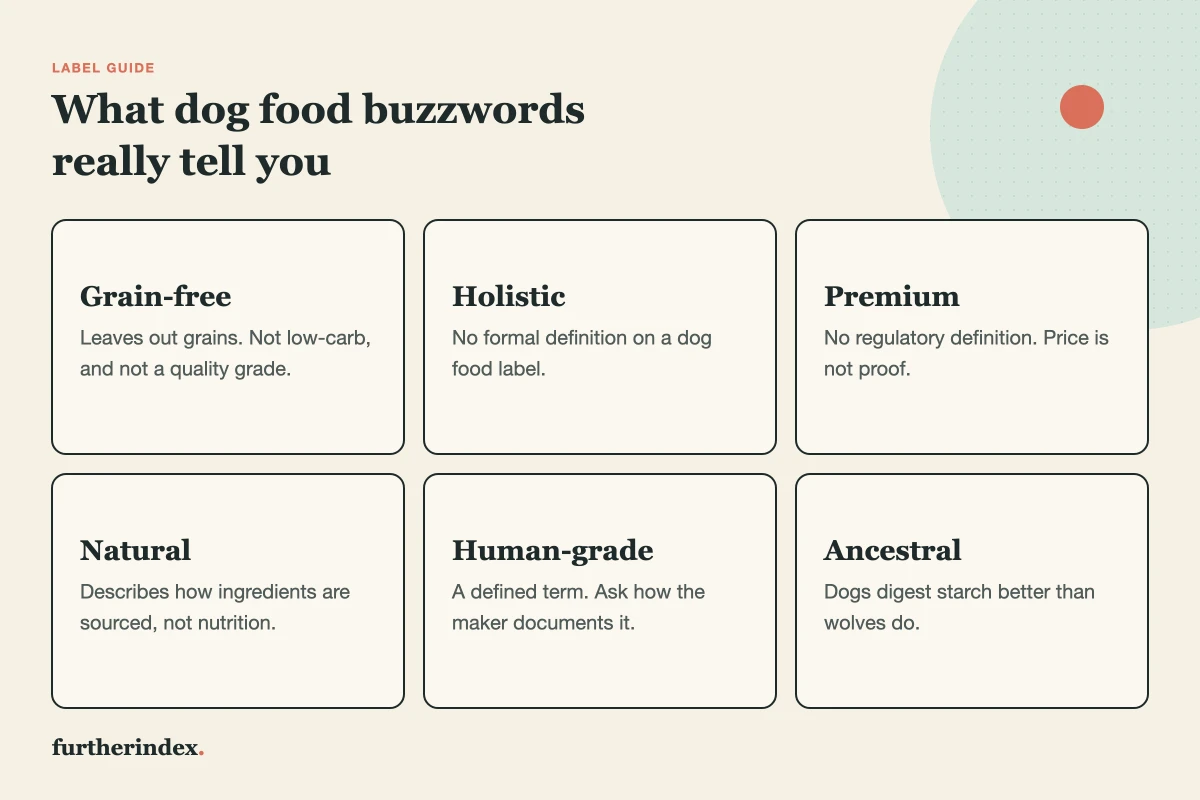
Grain-free means the recipe leaves out wheat, corn, rice, and similar grains. It does not mean low-carbohydrate. Grain-free recipes often swap in peas, lentils, other legumes, or potatoes, so the carbohydrate content can stay about the same.
There is also a health question. In 2018, FDA began investigating reports of diet-associated dilated cardiomyopathy (DCM), a serious heart condition, in dogs eating certain foods, many labeled grain-free and high in peas, lentils, other legumes, or potatoes. FDA has not established a cause, calls the issue complex, and notes that report counts alone do not prove a food caused the disease. In December 2022, it said it would not post further public updates until meaningful new scientific information emerges (FDA). If your dog has a medical reason to avoid a grain, follow your veterinarian’s advice. Otherwise, grain-free is not a quality upgrade by default.
Holistic
No formal definition stands behind “holistic” on a dog food label. It describes a marketing approach, not a nutritional standard.
Premium and Ultra-Premium
“Premium,” “super premium,” and “ultra-premium” have no regulatory definition either. A premium bag can cost more without containing better ingredients, and a plainly labeled bag can be nutritionally complete. Price and adjectives do not tell you which. The same logic applies on Amazon, where a Best Sellers badge reflects sales rank, not quality.
Natural
AAFCO does define “natural” for pet food, but the definition concerns how ingredients are sourced and processed. It says nothing about whether the recipe suits your dog. A natural food and a poorly balanced food can be the same bag.
Human-Grade
Human-grade is one of the few terms with a defined meaning: the claim applies only when every ingredient is suitable for people to eat and the finished food is made and handled to human food standards. That is a high bar, and it is a claim about ingredients and handling, not about balanced nutrition. If a bag says human-grade, you can reasonably ask the company how it documents the claim.
Ancestral and Biologically Appropriate
Ancestral labels often imply that dogs should eat like wolves. Research points the other way on starch. A 2013 study in Nature by Axelsson and colleagues found that dogs carry more copies of a gene for digesting starch than wolves do, which suggests dogs handle starch better than their wild relatives. A label that leans on wolf imagery is telling a story, not describing your dog’s digestion.
What to Look for on a Dog Food Label
The parts of the label that matter are less eye-catching.
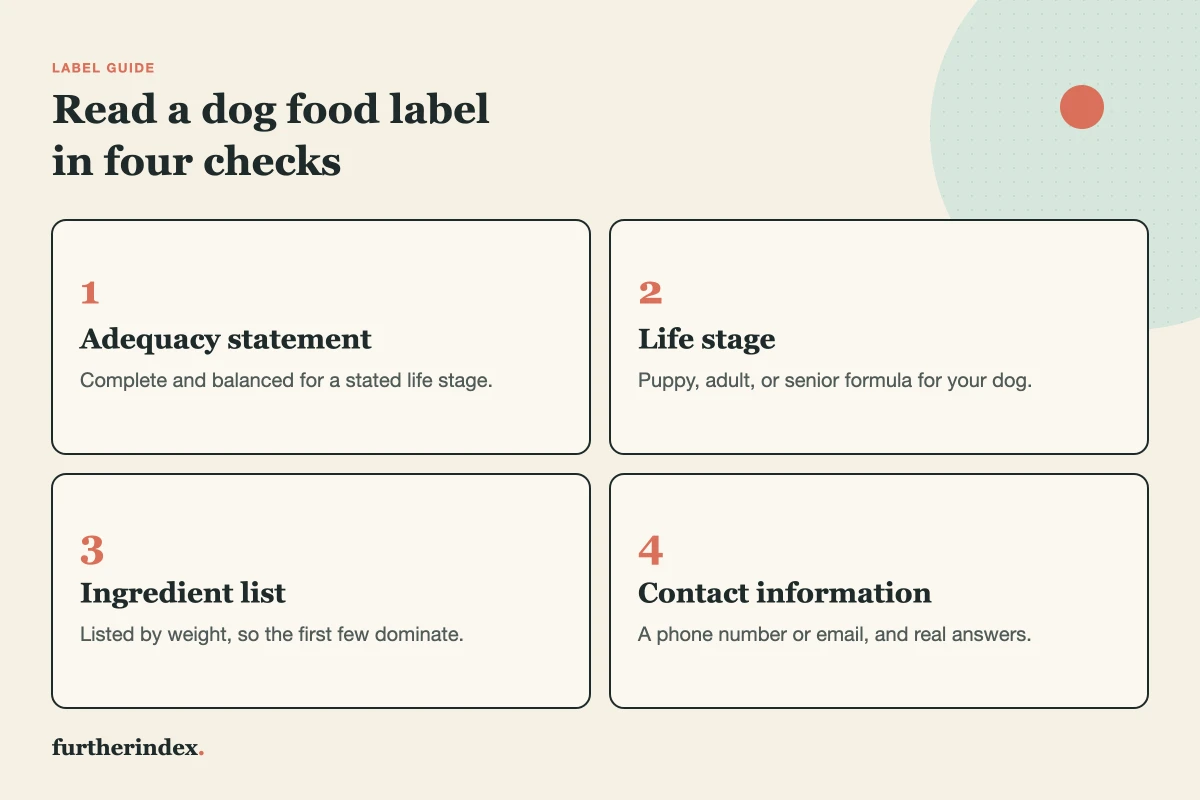
- The nutritional adequacy statement. Look for wording that the food is complete and balanced for a specific life stage, such as growth, adult maintenance, or all life stages. A food can reach that claim by being formulated to meet AAFCO nutrient profiles or by passing feeding trials. The statement shows which route the company used (WSAVA).
- The life stage match. A puppy, an adult, and a senior dog need different formulas. A large-breed puppy has needs of its own, so ask your veterinarian.
- The ingredient list. Ingredients appear in order by weight, so the first few make up most of the food. Common names and specific ingredients are easier to evaluate than vague ones.
- The manufacturer’s contact information. A company that stands behind its food provides a phone number or email and answers questions. For a deeper look at who actually makes a product, see our guide to tracing where products come from.
Questions to Ask the Manufacturer
The World Small Animal Veterinary Association (WSAVA) publishes a list of questions owners can ask any pet food company. WSAVA does not endorse specific brands. It offers criteria instead. The core questions are:
- Does the company employ a nutritionist, and what are that person’s qualifications? WSAVA considers a PhD in animal nutrition or board certification appropriate.
- Who formulates the recipes?
- What quality control checks does the company run on ingredients and finished food?
- What product research has the company done, and was it published in peer-reviewed journals?
The WSAVA guideline notes that companies are not required to do this research, so a clear answer tells you something. You can read the full list in the WSAVA guideline on selecting a pet food.
The Bottom Line
Choose a food by its nutritional adequacy statement for your dog’s life stage, then check that the maker can answer the WSAVA questions. Ignore the adjectives on the front of the bag, and have your veterinarian confirm the pick for your dog’s age, size, and health. If you are comparing options, you can browse dog food on Amazon and apply the same label checks there. Our guide to finding the real price of products helps with comparing deals.
Disclosure: As an Amazon Associate, Further Index earns from qualifying purchases.