
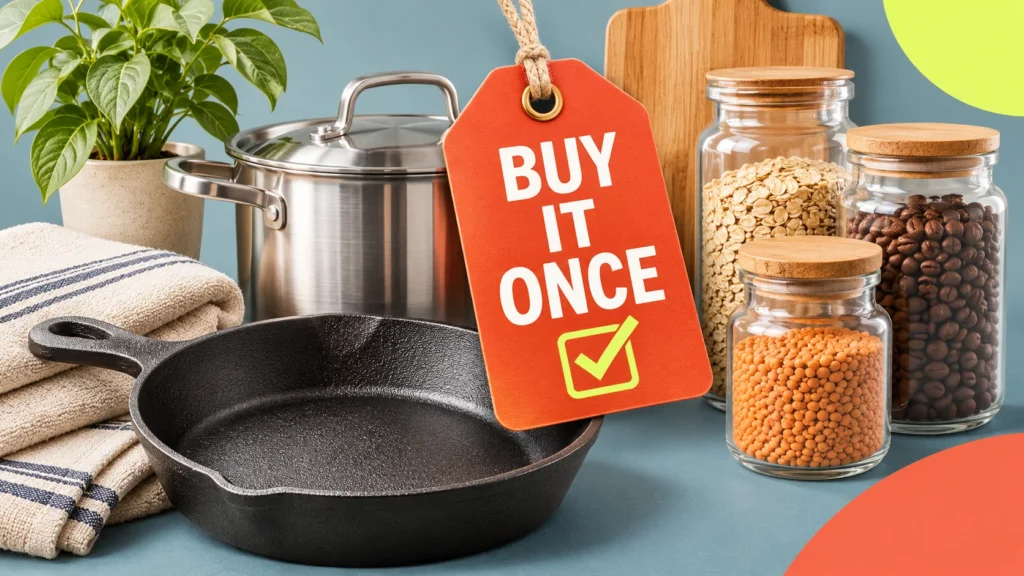
Here is the math behind a cheap pan. Suppose a $25 nonstick skillet wears out every two years. Over twenty years, that is ten pans and $250. A Lodge cast-iron skillet, which typically sells for about $20 to $35 depending on the retailer, costs that once. The two-year lifespan is an assumption, so swap in your own, but the pattern holds: a cheap item you replace repeatedly can cost more than a better one you keep.
The buy-it-once home goods approach is not minimalism, and it is not a case for spending more on everything. It is a cost argument that works in a narrow set of categories, and only when the product is repairable, well supported, and built from materials that last. This guide covers which categories qualify, which products meet the standard, and how to check a warranty before you rely on it.
Affiliate disclosure: Further Index participates in the Amazon Services LLC Associates Program. If you buy through links marked as sponsored, we may earn a small commission at no extra cost to you.
What Buy It Once Home Goods Actually Means
A buy-it-once home good is not simply an expensive item. Price alone does not qualify a product, and a high price can hide a short lifespan. The qualifiers are practical:
- Repairability: The product can be restored when it wears. It has no glued housings, no proprietary parts, and no components the maker has stopped selling.
- A warranty that holds up: Coverage from a brand with a track record of honoring claims, with the exclusions read in full.
- Durable material: The core material wears so slowly, or recovers so easily, that decades of use are realistic.
- Brand longevity: The manufacturer has operated long enough that support is likely to exist when you need it.
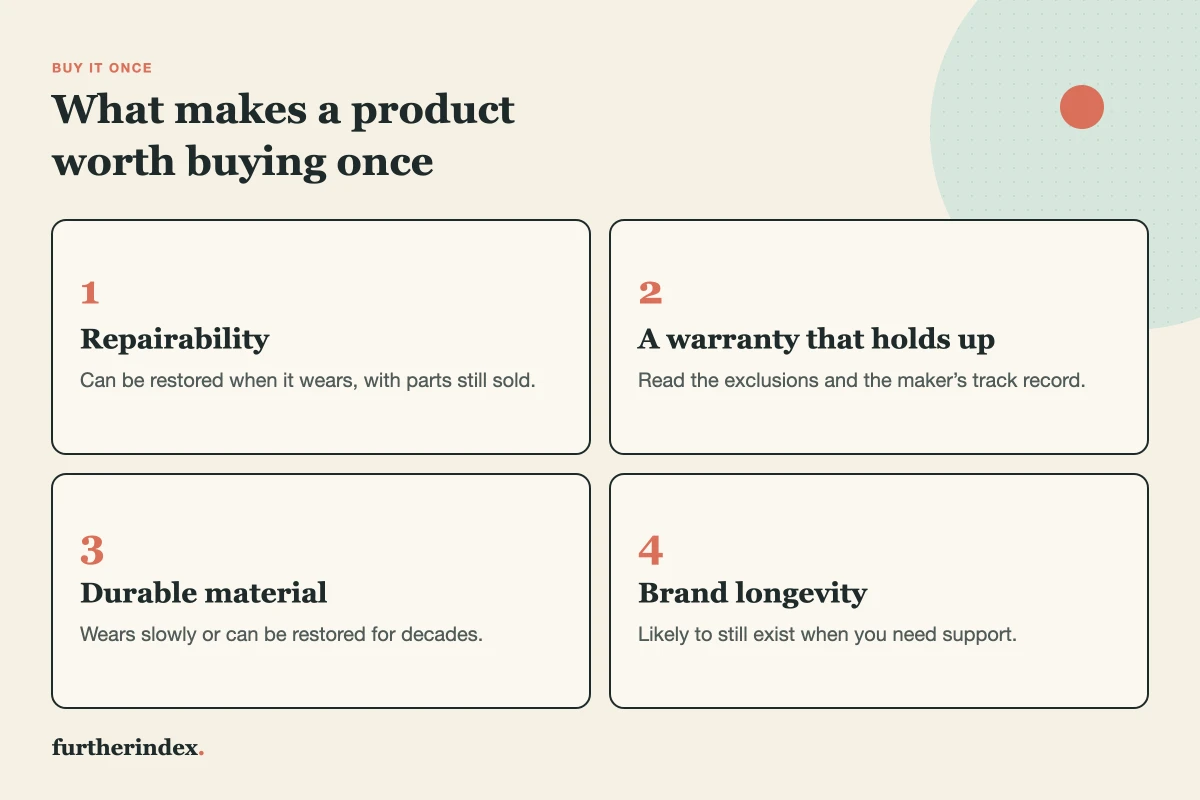
This guide calls the combined standard the twenty-year test: if you maintain it reasonably, will the product still work and still be supported in twenty years? Most products fail that test. The ones below come closest.
Is Paying More Worth It?
It depends on the category. Cookware, knives, and a few well-built appliances can pay back the premium. Consumer electronics almost never do, because the technology ages out before the hardware wears out. Furniture falls in between and depends on how it’s built.
To test any purchase, divide the cheap option’s price by its realistic lifespan in years, then multiply by twenty. If the result exceeds the price of the better option, the premium pays for itself on replacement cost alone, before counting time, returns, or frustration. The lifespan you plug in is the weak point, so use a conservative number you can defend.
Marketing signals deserve the same skepticism as price. A product with hundreds of glowing reviews and a countdown timer has not proven it lasts. For more on how rankings and badges work, see our guide to what the Amazon Best Sellers badge actually measures, and for comparing deals, see how to find the real price of products.
Cast Iron Cookware: The Classic Buy It Once Pan
Cast iron is a classic example of durable cookware. Unlike pans with synthetic nonstick coatings, its cooking surface develops a natural layer of seasoning from oil heated onto the iron. This protective layer helps prevent rust and makes food less likely to stick. With regular cooking and proper care, the seasoning can improve over time. As cookware manufacturer Lodge explains, the more you cook with cast iron, the better its seasoning becomes.
What to Buy
Lodge 10.25-inch cast iron skillet is the usual starting point. Lodge was founded in 1896 in South Pittsburg, Tennessee, and still makes most of its cast iron in its foundries there. The skillet comes pre-seasoned, so it is ready to use, and it carries a limited lifetime warranty. Read the terms before counting on it. The Lodge warranty covers casting defects, cracking, and warping, and excludes normal wear such as rust and sticky seasoning, as well as misuse, soaking, and dishwashers. It also excludes purchases from unauthorized sellers, so buy from Lodge or an authorized retailer.
Stargazer cast iron skillet is a premium American-made alternative with a smooth machined cooking surface and a lifetime warranty. It costs far more than Lodge; one retailer lists the 12-inch size at $175, against roughly $25 for a Lodge skillet at big-box stores. It makes sense mainly if the texture of a standard cast-iron surface bothers you.
The Bottom Line on Cast Iron
A Lodge skillet is the lowest-cost way to get a pan that can last decades, as long as you keep it dry, oiled, and out of the dishwasher. Start there and upgrade only if you find a specific reason to.
Carbon Steel Pans: Lighter and Just as Durable
Carbon steel uses the same seasoning system as cast iron in a lighter, thinner pan that heats faster. It is also uncoated, so it has no finish to wear off. Two widely used options:
- Matfer Bourgeat Black Carbon Steel: Made in France, uncoated, with a welded, rivet-free handle. The Skillful Cook named it the best carbon steel pan in an America’s Test Kitchen comparison.
- de Buyer Mineral B: Made in France from 99% iron with a beeswax finish that protects it from oxidation until you season it. The de Buyer site says the pans carry a lifetime warranty.
Carbon steel suits households where cast iron’s weight is a problem. Cast iron holds heat longer and carbon steel responds faster, so the better pick depends on what you cook.
The Only Kitchen Knife Most Cooks Need
Block sets suggest complete coverage, but a single well-made 8-inch chef’s knife handles most everyday cutting. Add a way to sharpen it, such as a whetstone or a professional sharpening service, and the knife can last for decades. Look for these features:
- A forged or stamped blade in high-carbon stainless steel that takes and holds an edge
- A plain edge, because serrated edges are difficult to resharpen
- A handle built to stay attached, from a brand that has made knives for a long time
- A warranty you have read, with the exclusions
Victorinox Fibrox Pro 8-inch chef’s knife is the budget pick. It is Swiss-made with a stamped blade and a lifetime warranty against manufacturing defects, and it typically costs around $50. Stamped knives are lighter than forged ones, which some cooks prefer.
Wüsthof Classic 8-inch chef’s knife is the step up. Wüsthof has made knives in Solingen, Germany, since 1814, forges the Classic line, and backs it with a limited lifetime warranty. It costs considerably more than the Victorinox, and the extra money buys a forged blade and a heavier feel rather than a different cutting experience.
Modular Shelving: Furniture You Can Reconfigure
Flat-pack furniture is hard to repair or reconfigure, so it often ends up discarded. Modular steel and metal systems take the opposite approach: a stable design, interchangeable parts, and the ability to grow or rearrange as your space changes.
- String Shelving System: Designed in Sweden in 1949 and put into production the next year, it is still made in Sweden. String says the shelf, wall panel, and metal fittings remain identical to the 1949 original. Retailers list a one-year warranty, so String’s case rests on its long production run and compatible parts, not warranty length.
- USM Haller: Designed in 1963 by Fritz Haller and Paul Schaerer and made in Switzerland. USM says early-1960s Haller pieces are still in use and can be expanded with new components. USM lists a two-year warranty, so verify the terms with the seller before paying a premium price.
Both are expensive. They make sense when you expect to move, rearrange, or expand over many years and plan to keep the system rather than replace it.
Small Appliances: A Narrow Category
Most small appliances fail the twenty-year test. Many use glued or welded housings, depend on parts the maker stops selling, or rely on a companion app that can disappear. For the broader pattern, see our explainer on why we replace things that still work, and our repair toolkit for fixing what you already own.
Two brands come closest, with caveats:
- Vitamix: The company lists warranties of 5, 7, or 10 years depending on the model, which is long for a blender but not lifetime. Containers and blade assemblies are sold separately, and a container or blade bought on its own carries a three-year warranty. The motor base and container are separate pieces, so you can replace a damaged container without buying a new machine.
- KitchenAid stand mixer: The standard warranty is one year, so this recommendation rests on service and parts availability rather than coverage. Confirm that parts and service exist for the specific model before you buy.
What to Avoid in Small Appliances
- Housings that are glued or welded shut
- Appliances that need a companion app or cloud connection to work
- Brands that cannot show how long they keep parts available
- Single-serve pod systems, whose ongoing cost works against buying once
How to Verify a Lifetime Warranty
“Lifetime warranty” ranges from real coverage to marketing language. Lodge shows how much the fine print matters: its warranty is a limited lifetime warranty that excludes normal wear, misuse, and purchases from unauthorized sellers. Before relying on any warranty:
- Read the actual warranty document, not the product page summary. Exclusions for “normal wear” can rule out most claims.
- Check what voids coverage, including commercial use, cleaning methods, and where you bought the product.
- Look at how long the brand has operated. A long track record is a useful rule of thumb, because coverage only helps if the company still exists.
- Search for real claim experiences in owner forums and reviews to see how the company behaves when a claim arises.
- Confirm replacement parts are sold separately. A brand that sells parts is better positioned to support its products.
Where Paying More Does Not Pay Off
- Nonstick cookware: The coating is the working surface, and it wears out. Treat these pans as consumables and buy a reasonable one.
- Furniture with joints that cannot be repaired: When the joint fails, the piece usually goes with it.
- Smart appliances with cloud dependency: When the manufacturer retires the service, the smart features stop working.
- Appliances whose warranty ends before the premium pays back: If coverage runs out sooner than the savings arrive, the math does not close.
- Consumer electronics: Technology ages out of usefulness before the hardware wears out, so the buy-it-once framework doesn’t apply to phones, laptops, or televisions.
The Buy It Once Home Goods Checklist
Before any major home goods purchase, ask:
- Can I find replacement parts for this product today?
- Has this brand operated for ten years or more?
- Is the housing screwed together rather than glued?
- Does the warranty cover what I am likely to need, and have I read the exclusions?
- Can I find real owner experiences with warranty claims?
- Will this product still be usable and supported in twenty years?
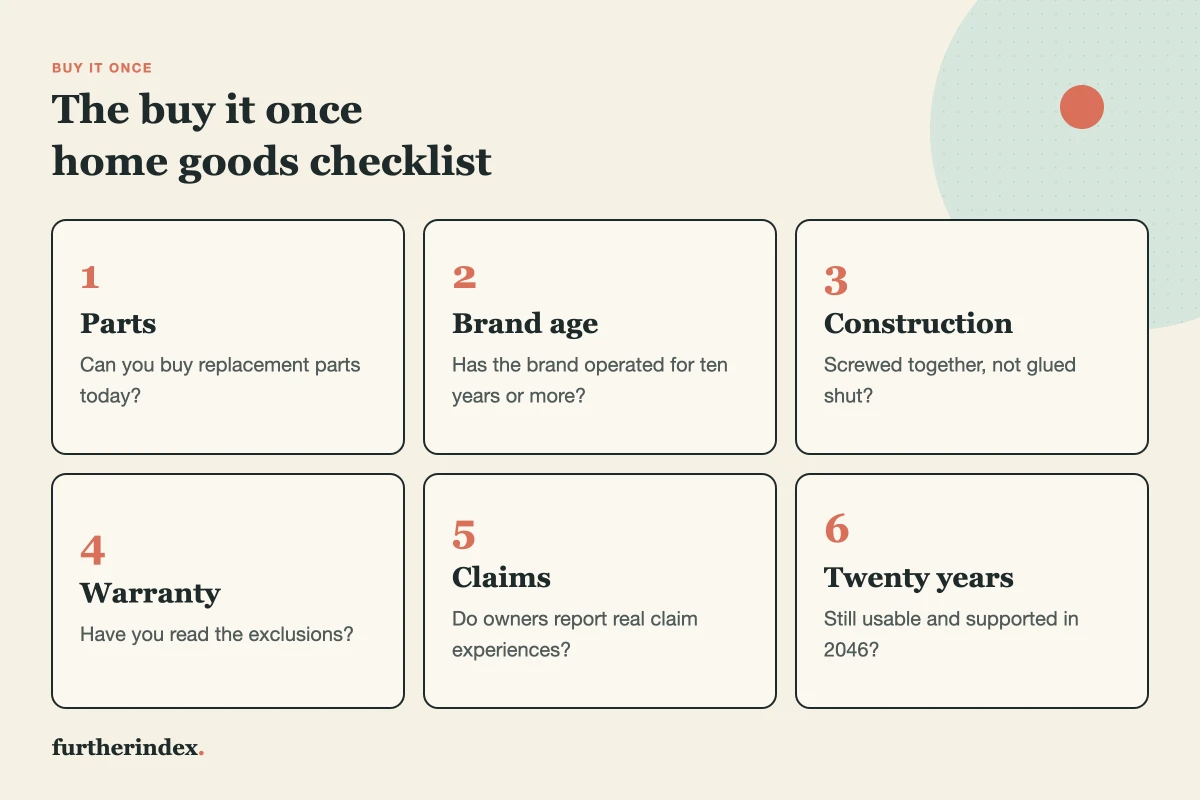
If the answer to any of these is no or uncertain, the product probably does not qualify, regardless of price or marketing language. Reconsider whether the premium is justified. If you decide to compare options, you can browse cookware on Amazon and apply the same checks.
The Hidden Cost of Cheap Goods
Every cheap pan you replace and every wobbling bookshelf you discard is a recurring cost. The buy it once approach asks you to spend once, on things built to be repaired, and to skip the categories where the math does not work. In cookware, knives, modular shelving, and a handful of appliances, buying carefully can cost less over time than replacing cheap goods.
Frequently Asked Questions
What are the best buy-it-once home goods to start with?
A cast-iron skillet and a single quality chef’s knife. A Lodge skillet typically costs about $20 to $35, and a Victorinox Fibrox Pro 8-inch knife costs around $50. Both can last for decades with basic care.
Is cast iron cookware worth it?
For most cooks, yes. It has no coating to wear out; it is pre-seasoned from the factory, and the seasoning improves with use. It does need care: keep it out of the dishwasher, dry it after washing, and oil it lightly.
What makes a product a true buy it once home good?
Repairable construction, durable materials, a warranty you have read and trust, and a brand with a long record of supporting its products. Price is secondary.
Are lifetime warranties worth anything?
Sometimes. A limited lifetime warranty from an established maker can be valuable, but exclusions for normal wear, misuse, and unauthorized sellers often narrow what it covers. Read the document before you rely on it.
Is carbon steel better than cast iron?
Neither is better in every case. Carbon steel is lighter and heats faster; cast iron holds heat longer. Both use the same seasoning approach and both can last for decades.
Which small appliances are worth buying for the long term?
Few qualify. Vitamix offers warranties of 5, 7, or 10 years depending on the model and sells containers and blade assemblies separately. KitchenAid stand mixers carry a one-year warranty, so confirm parts and service for your model first.
How do I know whether the premium is worth it?
Run the cost comparison: divide the cheap option’s price by its realistic lifespan, multiply by twenty, and compare the result with the price of the better option. If the better option costs less, the premium pays for itself.