
Nitric oxide (NO) is a gas your blood vessels use to send a simple message: relax. In 1998, Robert Furchgott, Louis Ignarro, and Ferid Murad won the Nobel Prize in Physiology or Medicine for discovering nitric oxide as a signaling molecule in the cardiovascular system.
That part is solid science. The marketing built around it goes far beyond the research. Supplement labels promise better blood flow, bigger workouts, and younger arteries, and most of those claims rest on small studies.
This guide covers what the research supports, in the order that makes sense: food, movement, breathing habits, and only then supplements. It also flags where the evidence is thin.
Affiliate disclosure: Further Index participates in the Amazon Services LLC Associates Program. If you buy through links marked as sponsored, we may earn a small commission at no extra cost to you.
The Short Version
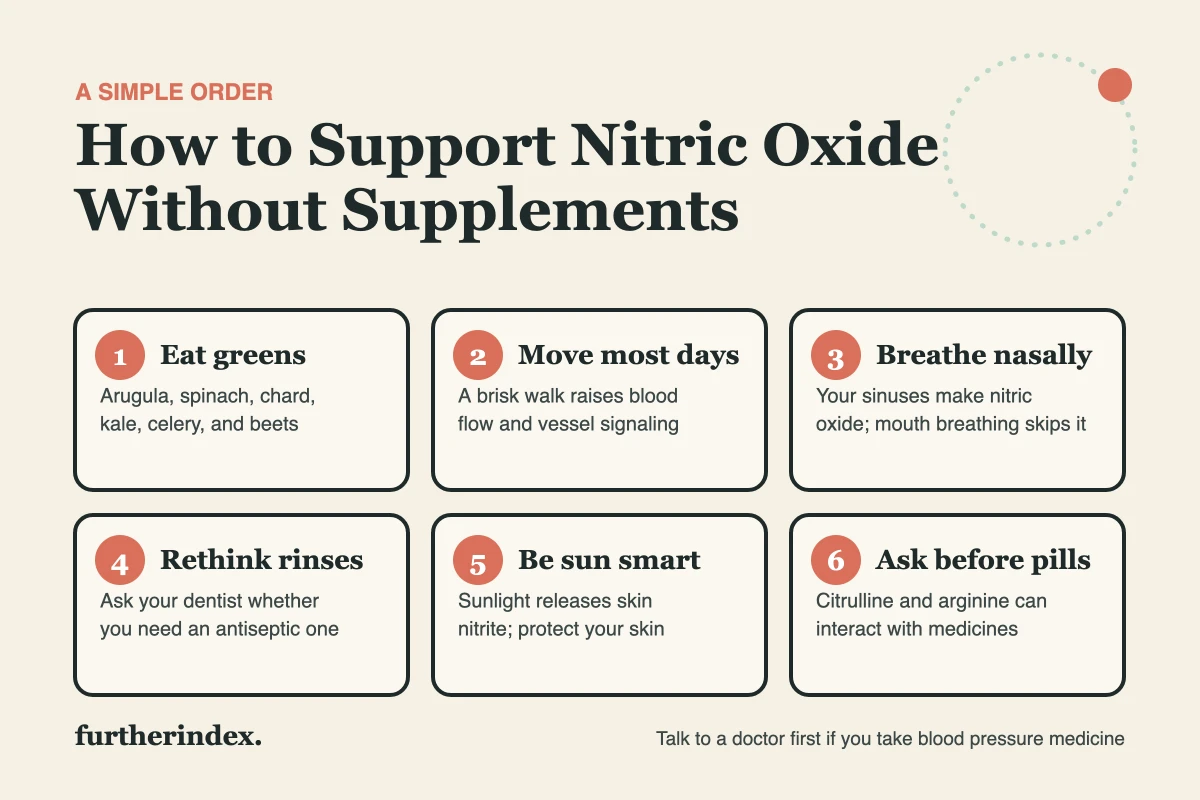
Nitric oxide supports healthy blood vessels, and you can support it with everyday habits. Eat nitrate-rich vegetables most days, move regularly, and keep antiseptic mouthwash in check. Treat supplements as the last step, and talk to your doctor first.
What Nitric Oxide Does
Endothelial cells, the thin layer lining your blood vessels, make nitric oxide. It signals the smooth muscle around the vessel to relax, widening the vessel and letting blood flow more easily. That is one of the main ways your body regulates blood pressure and delivers oxygen to tissue.
Nitric oxide is also short-lived. The Nobel committee noted that it converts to nitrate and nitrite within about 10 seconds. That is why steady production matters more than any single boost. Researchers also study its roles in immune defense and nerve signaling, but the strongest evidence sits in the blood vessels.
What Happens as Levels Drop
Endothelial function declines gradually with age. A review in Frontiers in Physiology describes the impairment as a progressive process that starts in middle age and calls it one of the main ways aging raises cardiovascular risk. Reduced nitric oxide availability is one mechanism the authors discuss.
That does not mean you can measure your own level at home, or that a boost will reverse aging. It means your vessels are worth looking after, and the habits below are the most supported.
Food First: The Nitrate Pathway
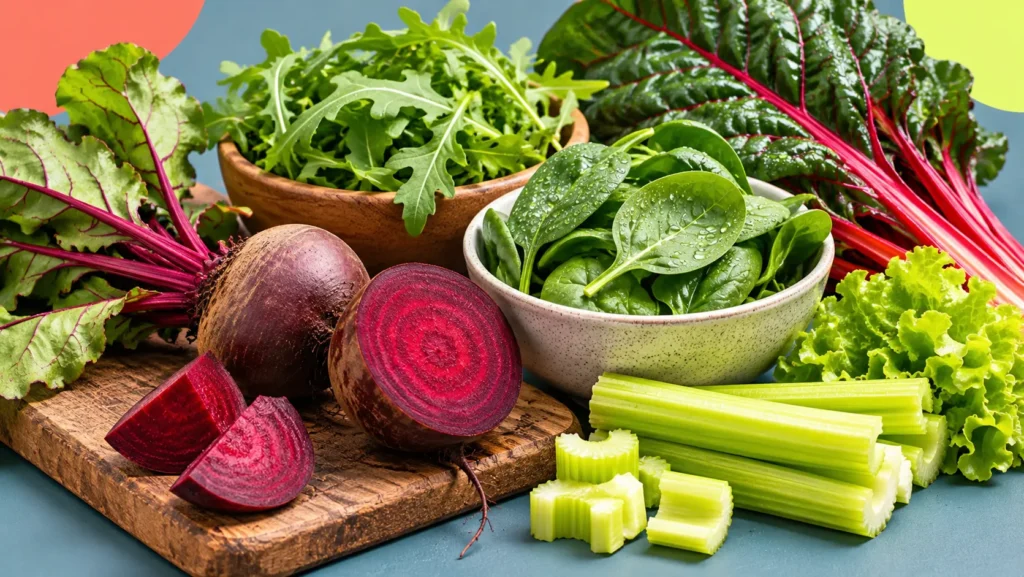
The best-studied route runs through vegetables. Leafy greens and beetroot are rich in dietary nitrate. Bacteria in your mouth convert nitrate to nitrite, and your body can then turn nitrite into nitric oxide.
A review and meta-analysis of human trials found that inorganic nitrate intake lowered resting blood pressure by about 4.8 mmHg systolic and 1.7 mmHg diastolic, and improved endothelial function. The drop is modest, and most trials used beet juice or nitrate supplements, so vegetables are a reasonable bet, not a guarantee.
The High-Nitrate Essentials
- Arugula: among the highest-nitrate leafy greens, and easy to add to a salad.
- Beetroot: the most studied source, mostly as juice.
- Spinach: a reliable everyday green.
- Swiss chard and kale: good nitrate sources that cook down easily.
- Celery and lettuce: mild vegetables that still add nitrate.
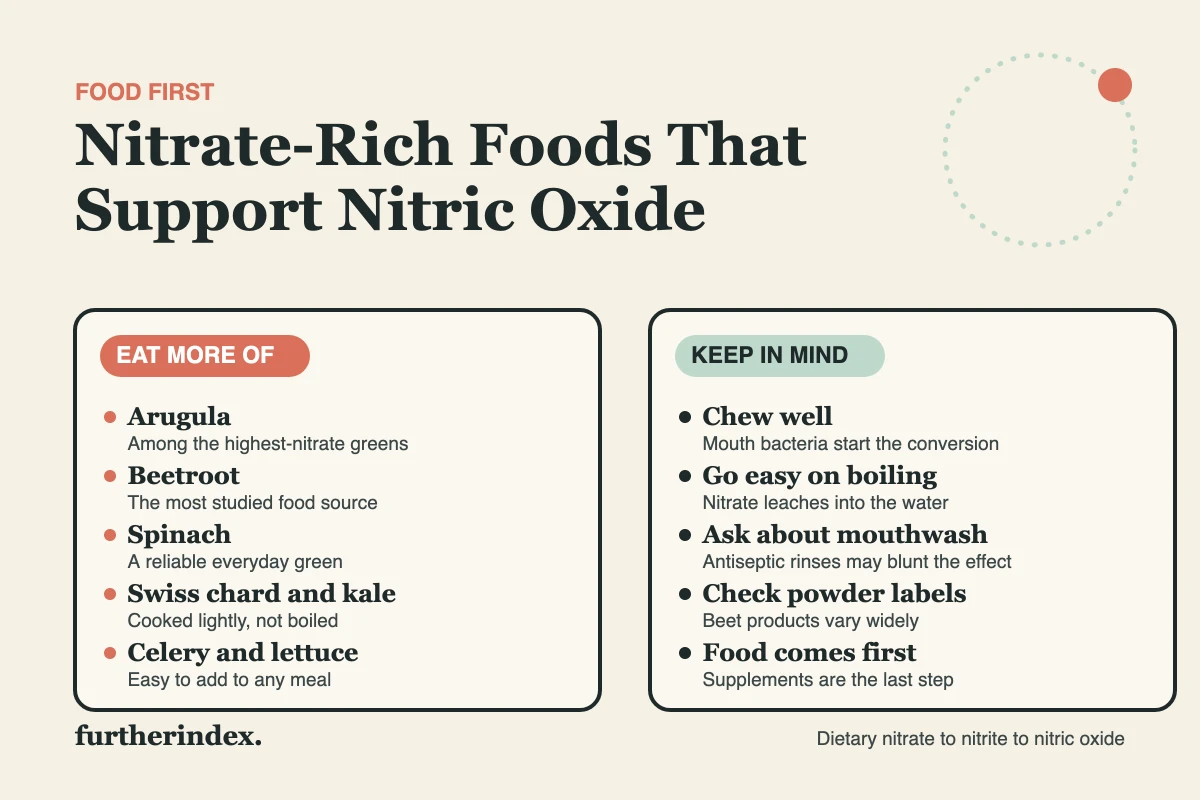
Boiling pulls nitrate into the cooking water, so raw or lightly steamed vegetables keep more of it. Chew well, because the conversion starts in your mouth.
The Mouthwash Question
In a 2013 study of 19 healthy volunteers, a week of chlorhexidine antiseptic mouthwash disrupted oral bacteria and affected blood pressure, which suggests those bacteria help set it. A later study in treated hypertensive adults reported higher blood pressure after three days of antibacterial mouthwash.
Both studies were small and short. Keep brushing and flossing. If you use an antiseptic rinse regularly, ask your dentist whether you need it.
Lifestyle Habits That May Help
Move Regularly
Researchers think that when blood flow rises during activity, the force on vessel walls prompts the endothelium to make more nitric oxide. That is one reason regular movement supports vessel health. A brisk walk counts, and our guide to why walking is the most underrated exercise explains how to make it stick.
Breathe Through Your Nose
Your paranasal sinuses produce large amounts of nitric oxide, and one small study found that humming increased nasal nitric oxide about 15-fold compared with quiet breathing. No study here shows that nasal breathing raises your blood levels, so treat it as a free habit and not a treatment.
Use Sunlight Wisely
In a study of 24 healthy volunteers, UVA exposure of the skin lowered blood pressure and raised circulating nitrite. The doses were two standard erythemal doses, meaning enough to redden skin. That is not an argument for tanning. Follow your dermatologist’s sun-safety advice, because the risk of skin cancer outweighs this benefit.
A Note on Stress
Stress management belongs on any vessel-health list, and our guide to managing stress for deep sleep and daily balance is a good place to start. The direct link between stress and nitric oxide is harder to prove, so we will not promise a specific effect.
Supplements: What the Evidence Supports
Nitric oxide supplements don’t contain nitric oxide because the gas lasts only seconds. They contain ingredients your body may convert into it. Before you buy anything, our guide on evaluating supplements and avoiding fakes covers label and testing basics.
L-Citrulline
This is the best-supported option, though the evidence is modest. A meta-analysis of randomized trials found that L-citrulline may reduce systolic blood pressure, and a diastolic drop appeared only in studies using 6 grams a day or more. Trials used 3 to 9 grams a day and enrolled 12 to 34 people.
Our pick: a plain, single-ingredient L-citrulline powder with the dose printed on the label. Look for a third-party testing seal such as Informed Sport or NSF Certified for Sport, which screen for banned substances. Shop L-citrulline powder on Amazon
Beetroot Powder and Juice
Beet products vary far more than the labels suggest. A study of 24 beet juice products from 21 companies found roughly a 50-fold range in nitrate content, and only five products consistently provided at least 5 millimoles of nitrate per serving. If you want a beet product, choose one that states its nitrate amount. Otherwise, eat the vegetable.
L-Arginine
Arginine is the raw material your body uses to make nitric oxide, but MedlinePlus notes that it can lower blood pressure, may add to the effect of blood pressure drugs, and does not seem to help prevent or treat a heart attack. Skip it unless a doctor recommends it.
Before you supplement: talk to your doctor if you take blood pressure medicine or nitrates for a heart condition, or if you have heart, kidney, or blood pressure problems. Ask your doctor first if you are pregnant or breastfeeding.
The Bottom Line
Start with vegetables and regular movement, since those carry the strongest support. Add L-citrulline only after you have covered the basics, and your doctor agrees. Skip arginine unless a doctor recommends it.
Nitric Oxide Questions
Do nitric oxide supplements work?
Some ingredients, such as L-citrulline, show modest effects on blood pressure in small trials. The evidence is weaker than the marketing, and product quality varies.
Which foods boost nitric oxide?
Nitrate-rich vegetables lead the list: arugula, beetroot, spinach, Swiss chard, kale, celery, and lettuce. Eat them raw or lightly steamed and chew well.
Can mouthwash lower nitric oxide?
Small studies suggest antiseptic mouthwash can disrupt the mouth bacteria that start nitrate conversion and affect blood pressure. Ask your dentist whether you need one.
Further Reading
- Nobel Prize: Physiology or Medicine 1998
- Frontiers in Physiology: Mechanisms involved in the aging-induced vascular dysfunction
- PubMed: Inorganic nitrate and cardiovascular risk factors, a meta-analysis
- PubMed: Nitrate content of beet juice products
- MedlinePlus: L-arginine
- Further Index: How to Research Health Topics in the Age of AI and Disinformation
This article is for general information and is not medical advice. Talk with a qualified healthcare provider before you change your diet, habits, or supplements, especially if you have a health condition or take medicine.