

A Human Guide to the System Behind the System
Table of Contents
Here’s how health insurance works in real life, and why the system feels so confusing until you understand its hidden rules. Most people think insurance is the thing you hand over at the doctor’s office so you don’t have to pay full price. And in a loose sense, that’s true. But that’s not how it actually works. Health insurance is not a payment method. It is a second healthcare system layered silently on top of the first one.
It determines what care you’re allowed to receive, what you pay for it, which doctors you can see, which hospitals are “in,” which are “out,” which medications are approved, and which procedures require a blessing from someone you’ll never meet.
If healthcare already feels confusing, insurance is the reason it often feels impossible. This guide explains the entire process clearly, honestly, without jargon, and without pretending the system is simpler than it actually is. Let’s pull back the curtain, shall we?
This guide is general information, not medical, legal, or financial advice. Plans differ by insurer and state, so check your own plan documents. Last reviewed November 2026.
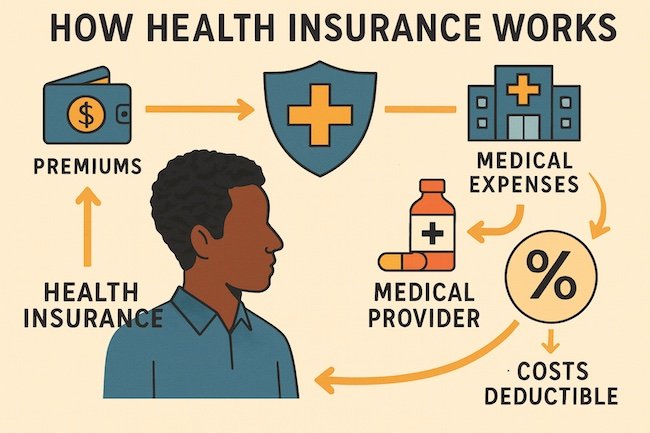
1. Insurance Doesn’t Pay for Everything. It Negotiates Everything.
People assume insurance “covers” care.
However, in reality, insurance is a negotiation for the price of care.
Before you step into a doctor’s office, your insurer has already struck a deal with that clinic:
- A negotiated price for each service
- A reimbursement structure
- A set of rules for what is “medically necessary”
- A contract that decides whether you can even go there
That is why prices for the same service can differ so much from one facility to the next. The scan is the same, and a big part of the difference is the contract. A RAND analysis of 2022 claims found that employers and private insurers paid hospitals 254 percent of Medicare prices on average, with wide gaps between states.
If you think healthcare insurance is about medicine, you’re in for a rude awakening. It’s about money, contracts, and networks.
2. The Network Is the Real Map (Not the Insurance Card)
Your insurance card tells you almost nothing.
The important part is something you rarely see: the provider network.
“Network” means:
The list of doctors and hospitals your insurer has negotiated with.
That determines:
- who you can see
- how much you pay
- whether your care is denied entirely
It is entirely possible to have “great insurance” and still get stuck with:
- a large bill from an out-of-network lab
- an urgent care visit that costs far more than you expected
- a medication that “isn’t covered” unless you change to a cheaper one
- a specialist who won’t accept your plan
Your experience depends on the network, not the brand name on the card.
Federal law now limits some of these surprises. Since 2022, the No Surprises Act has banned surprise bills for most emergency care, even at an out-of-network hospital, and for certain out-of-network providers, such as anesthesiologists, who treat you at an in-network facility. It doesn’t cover every situation, so confirm that a provider is in-network before a planned visit.
3. Deductibles, Copays, and Coinsurance: Three Ways of Saying “You Pay First”
These terms confuse everyone, but they boil down to one truth:
Many plans are built so you pay a share of the cost before the plan does.
Here’s the plain-English version:
Deductible:
What you pay for covered services before your plan starts paying, except for free preventive services. (HealthCare.gov)
Copay:
A fixed amount you pay each time you get certain care, such as $20 for a doctor visit.
Coinsurance:
Your share, as a percentage, of covered costs after you meet the deductible. With 20% coinsurance on a $125 visit, you pay $25 and your plan pays $100.
So a typical path looks like this:
- You pay the plan’s negotiated price for covered care until your deductible is met.
- Then you pay a percentage (coinsurance).
- Then your plan pays the rest of each covered bill.
- Unless something is “not covered,” in which case you pay it all.
Out-of-pocket maximum: The most you pay for covered, in-network care in a plan year. After you reach it, your plan pays 100% of covered services for the rest of the year. Premiums, services your plan doesn’t cover, and out-of-network care don’t count toward it. For 2026 Marketplace plans, the limit is $10,600 for an individual and $21,200 for a family. Free preventive services are covered even before you meet your deductible.
Health insurance is not designed to be intuitive. And it becomes clear once you realize that the system exists for cost-sharing, not simplicity.
More Health Guides You Might Need Next
4. Prior Authorization: The Hidden Gatekeeper
Prior authorization is the part nobody warns you about.
Even if:
- your doctor recommends the treatment
- it’s medically necessary
- it’s clearly documented
- everyone agrees it’s the right step
Your insurance company still reserves the right to delay or deny coverage.
Prior authorization is the insurer’s way of saying:
“Prove to us that this care is worth the cost.”
Doctors and patients often find it frustrating, and insurers use it to control spending. In Medicare Advantage alone, KFF found that insurers made nearly 53 million prior authorization decisions in 2024 and denied about 7.7% of them. Only 11.5% of denials were appealed, but about 80.7% of those appeals were partially or fully overturned. If your plan says no, an appeal is worth trying.
If you’ve ever wondered why care feels slow, fragmented, or full of hoops, this is one of the biggest reasons.
5. The Explanation of Benefits (EOB) Is a Drama Recap
The EOB is the most misunderstood part of the system. It looks like a bill, feels like a bill, and scares people like a bill. But it’s not a bill. It’s a recap of the negotiation between your provider and your insurance.
It outlines:
- what the clinic charged
- what insurance allowed
- what insurance actually paid
- what’s left for you
Only the final line matters: “You may owe.” Everything above it is backstage math.
6. The Cash Price Secret (Your Insurance Might Be the Most Expensive Option)
While it might feel counterintuitive, the “cash price,” what you pay if you skip insurance for a visit, is sometimes:
- simpler
- lower
- and faster than using your insurance
Why would the uninsured patient pay less?
Some providers charge self-pay patients less than the rate billed to insurers, because contract terms, administrative costs, and claim submissions add to the insurance rate. It isn’t true everywhere, so ask for both prices.
If you’ve ever wondered why urgent care asks, “Are you using insurance today?” that is why.
Federal rules now make this easier to check. Since January 2021, hospitals must post their standard charges online, including the discounted cash price and the rates they negotiate with insurers, for at least 300 shoppable services.
Paying cash can sometimes avoid:
- out-of-network penalties
- prior authorizations
- lab surcharges
- facility fees
- multi-month paperwork cycles
Before you pay cash, ask whether the payment would count toward your deductible and out-of-pocket maximum, and compare it with your in-network price. If you’re uninsured or choose to self-pay, you can ask for a good faith estimate before care; the No Surprises Act gives most people that right. This is general information, not financial advice.
7. You Are Allowed to Ask Questions
That is the part most people forget.
You are allowed to ask:
- Why is that the price?
- Is there a cash rate?
- Is this in-network?
- What happens if I wait?
- Is there a cheaper setting for this test?
- What exactly am I being billed for?
- Can you reprocess this claim?
Many people stay quiet because the system feels intimidating. Your questions might seem inconvenient, but they are necessary, and they can help you catch billing errors and avoid surprise costs.
A Final Thought on How Health Insurance Works
Health insurance isn’t confusing because you missed a class in school. It’s confusing because it operates according to rules that most people never get to see.
The moment you understand those rules, the entire experience becomes less intimidating; the vocabulary becomes decipherable, the paperwork becomes navigable, and the confusion becomes manageable.
You don’t need to master every detail; you need a clear map of the landscape. Once you understand how health insurance works, the system becomes far easier to navigate.
If you want to understand the bigger picture behind all this, read Why Is Healthcare So Confusing? A Human Guide to Navigating the System, it breaks down the structural issues that make the entire system feel overwhelming.
Related Further Index Guides
- How I Search for Peace Online (algorithmic noise vs real-world noise)
- How I Search for Truth When Everything Feels Biased
- How I Search for Privacy Online (system complexity parallels)
Covered California Healthcare Coverage
If you’re in California (like we are) and want a clearer view of your coverage options, Covered California offers a straightforward starting point for understanding plans, networks, and costs. Outside California, HealthCare.gov points you to the Marketplace in your state.
Sources
- HealthCare.gov: Your total costs for health care
- HealthCare.gov Glossary: Out-of-pocket maximum/limit
- CMS: No Surprises, Understand your rights against surprise medical bills
- CMS: Hospital Price Transparency for consumers
- KFF: Medicare Advantage insurers made nearly 53 million prior authorization determinations in 2024
- RAND: Prices paid to hospitals by private health plans, Round 5.1